
Can You Trust Old Photographs of Paris?
Photography is turning two hundred: the oldest surviving image, taken by Nicéphore Niépce from a window of his house in Saint-Loup-de-Varennes, dates from 1826 or 1827, and France is marking the anniversary with a year of celebrations running to autumn 2027, Paris Photo at the Grand Palais from 12 to 15 November among them. For us, who reconstruct the Paris that has vanished, it is a good moment to ask a question nobody asks of old photographs, precisely because they look truthful: how truthful are they?
Yes, provided you know what an old photograph cannot show. Before the 1880s, exposures of several minutes erased passers-by and emptied the streets; before 1882, plates saw only blue and burned every sky to white; before 1907, any colour in a photograph was added by hand; and as early as 1871, entire scenes were staged in a studio and sold as documents. A photograph is an exact witness to the shape of things and a partial witness to everything else. That is why a serious reconstruction always cross-checks photographs against plans, paintings and written sources.
Why are the streets empty in old photographs?
Look at the boulevard du Temple as Louis Daguerre photographed it in the spring of 1838, one of the earliest daguerreotypes known. A great Parisian boulevard at 8 in the morning, and nobody: not a carriage, not an idler, except, at lower left, a man having his boots polished. The boulevard was not deserted. The plate needed four to five minutes of exposure, and everything that moved during those minutes dissolved. Only the bootblack’s customer, standing still with his foot on the box, remained. He is generally held to be the first human being ever photographed.
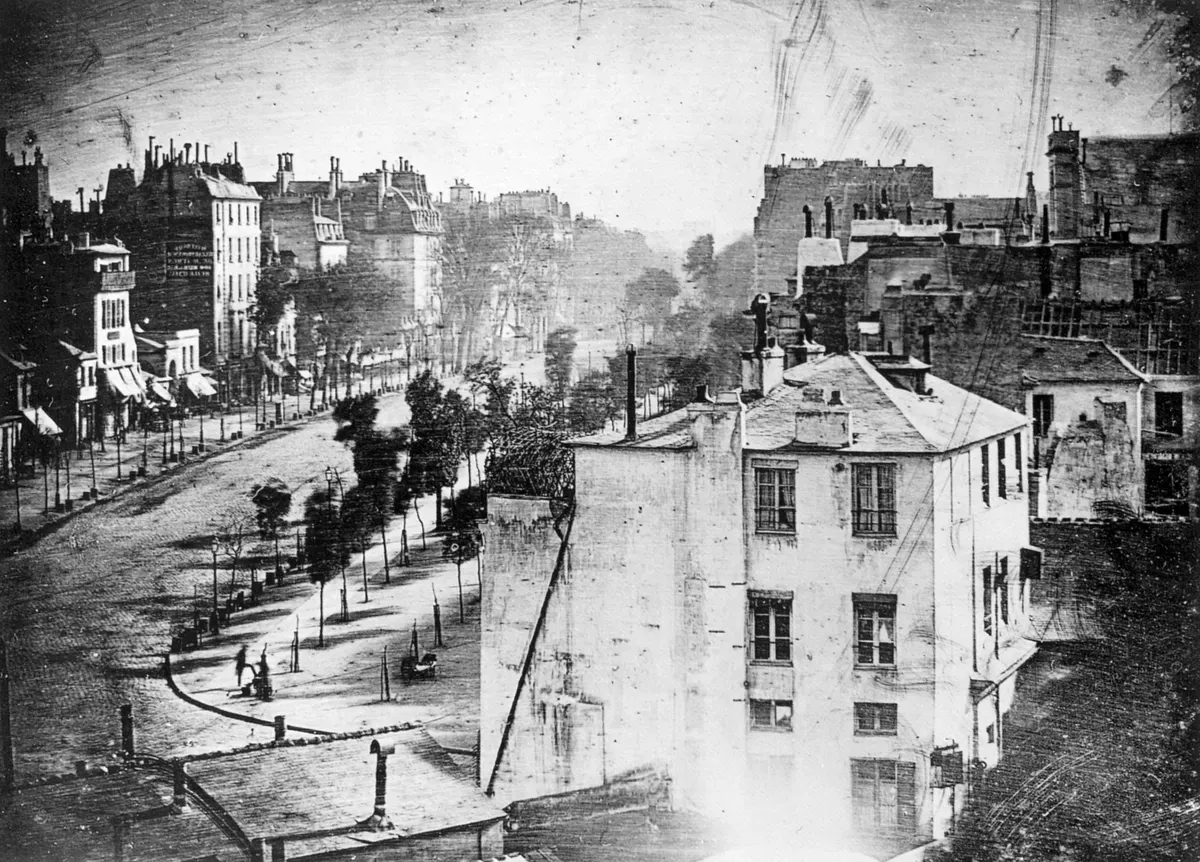
The boulevard du Temple by Daguerre, 1838: the street was busy, the exposure emptied it. The man having his boots polished, at lower left, stayed in the picture because he did not move.
Thirty years later the problem had not gone away. In 1865 the City of Paris commissioned Charles Marville, its official photographer, to record the streets condemned by Haussmann’s new boulevards: around 425 views, now at the musée Carnavalet. In them, the streets of old Paris look silent, damp, almost abandoned. They were among the most crowded in the city. Marville worked early, with long exposures, and only the passers-by who agreed to stop appear in the frame. The same goes for Eugène Atget, who photographed old Paris from the late 1890s until 1927 with a view camera and 18 by 24 centimetre glass plates: his streets are peopled with blurred silhouettes, ghosts who did not hold the pose.
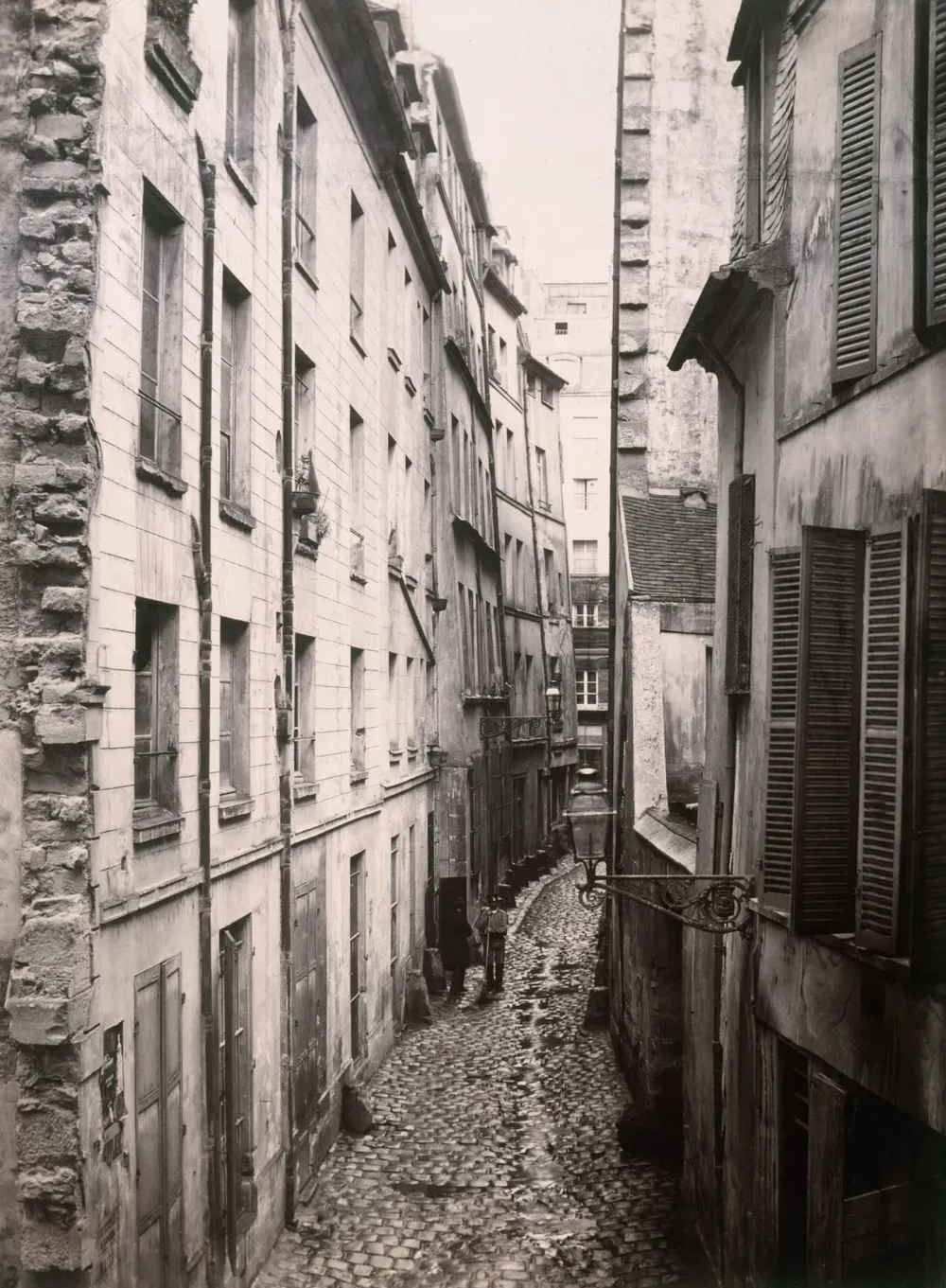
Rue Gervais-Laurent on the île de la Cité, by Charles Marville, 1865, a year before its demolition. Only two people: the ones who agreed to keep still.
The rule changes in the 1880s, when gelatin dry plates allow exposures of a fraction of a second, and then in 1888 with the first Kodak and its slogan, “you press the button, we do the rest”. That is why photographs of the 1889 World’s Fair finally show crowds in motion, where those of 1860 showed stage sets.
Why is the sky always white?
In almost every nineteenth-century photograph, the sky is a blank white surface. It is not that the weather was always fine: the emulsions of the period were sensitive only to blue, violet and ultraviolet light. A sky, even an overcast one, saturated the plate long before the street was properly exposed. So-called orthochromatic plates, sensitive to green, grew out of Hermann Wilhelm Vogel’s work in 1873 and only went on sale in 1882. In the meantime, photographers cheated: from 1856, Gustave Le Gray composed his celebrated seascapes by printing two negatives in succession, one for the sea, one for the sky.
The flaw has a more insidious consequence than the absence of clouds: the grey values do not match how bright things really were. A vivid red comes out almost black, a pale blue comes out white. In an old photograph, a flag, a shop sign or a dress can look dark when in reality it blazed.
Who framed the picture, and for whom?
A photograph always answers the question of whoever commissioned it. Marville was not photographing street life: he was drawing up an inventory of what was about to disappear, straight down the axis of the roadway, for the city’s historical works department. Atget sold “documents for artists”, as the sign on his studio announced: façades, ironwork details, courtyards, never events. And the building of the Eiffel Tower was followed, for Gustave Eiffel himself, by Louis-Émile Durandelle, who photographed the state of the works on fixed dates from the Champ-de-Mars: a tower in majesty, an empty foreground, the Trocadéro neatly centred under the arch. A site report that was already, at the same time, a publicity image.
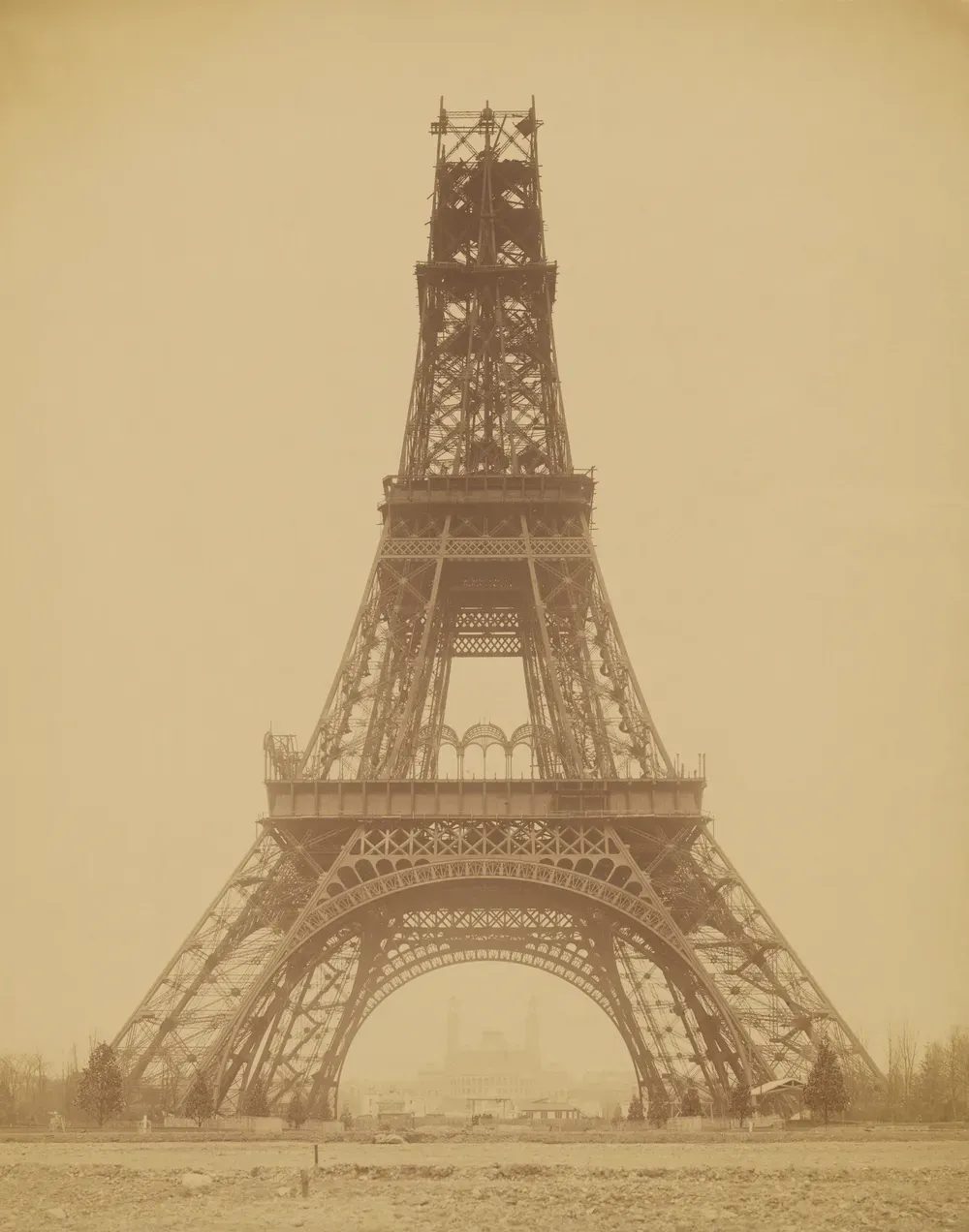
The construction site on 23 November 1888, by Louis-Émile Durandelle, for Gustave Eiffel. A dated series, invaluable for reconstructing the progress of the works, and a framing chosen to impress.
Was Paris really those colours?
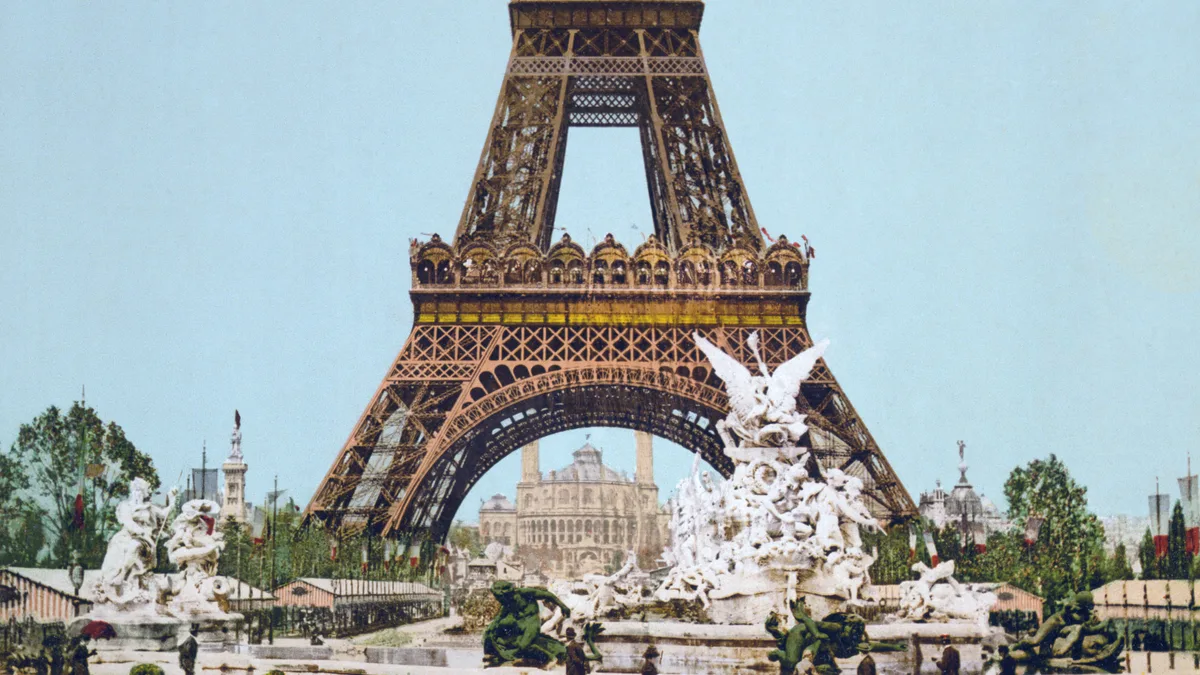
You have probably seen views of Paris around 1900 in surprisingly fresh colours, turquoise skies and cream façades. These are photochroms, a process developed in Zurich in the 1880s by Hans Jakob Schmid: it starts from a black-and-white negative, and a craftsman transfers the colours onto six to fifteen lithographic stones, following the photographer’s notes or, failing that, his own taste. The result is seductive and it is not a colour photograph: it is an interpretation.
Our cover image is a good example. It shows the Eiffel Tower and the monumental fountain of the 1889 Fair in a uniform orange-brown. Yet the Tower of 1889 had just moved from the “Venetian red” of its assembly to a “red-brown” in three shades, darker at the base and lighter at the top. The colourist in Zurich could not have known, and he chose. The first true colours of Paris come much later: the autochrome of the Lumière brothers, patented in 1903 and marketed in 1907, then Albert Kahn’s campaign, whose operators photographed Paris between 1912 and 1914 for his Archives de la Planète. And even then, the exposure time meant people had to pose.
Could a photograph be faked in 1871?
Yes, and skilfully. In the aftermath of the Paris Commune, the photographer Eugène Appert published a series titled “Les Crimes de la Commune”: the execution of the hostages at La Roquette, the killing of generals Lecomte and Clément-Thomas, the massacre of the Dominicans of Arcueil. The scenes were staged in a studio with extras, onto whom he pasted the heads of the real Communards, whom he had photographed in prison at Versailles, the whole thing retouched by hand and set against a real backdrop. Sold as documents, the images were banned by the government in December 1871, not because they were false, but because they disturbed the public peace.
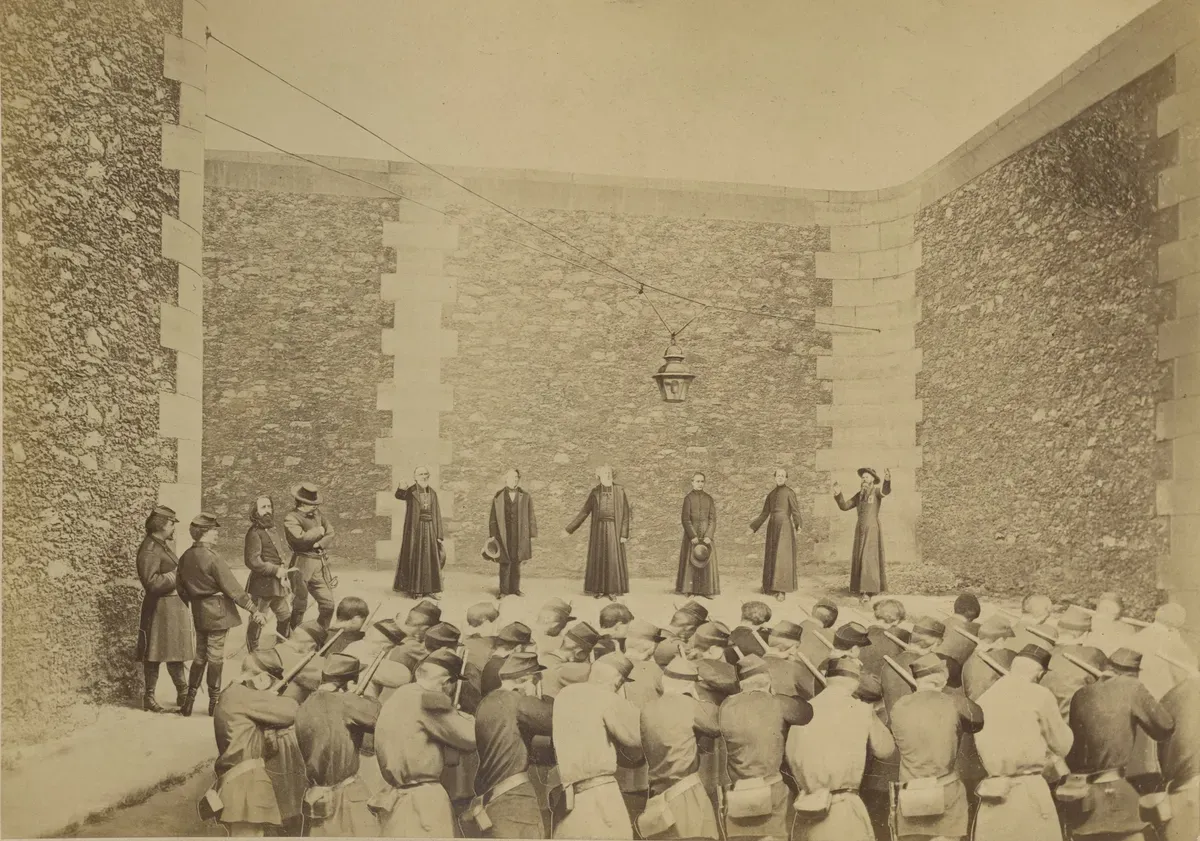
“Execution of the hostages, La Roquette prison, 24 May 1871”, by Eugène Appert: a photomontage, extras posed in a studio and heads pasted on. Fakery is as old as photography.
The case is extreme, but it recalls something obvious: the provenance of an image matters as much as the image. Where does the print come from, who commissioned it, in which album did it circulate? Without those answers, an old photograph is a rumour.
How do we use photographs to reconstruct 1889?
For The Symbol of Paris, which brings the 1889 World’s Fair back to life at the foot of the Eiffel Tower, photographs are the most abundant and most precise source we have. They fix what engravings idealise: the exact geometry of the palaces, the height of the pavilions, the position of each fountain, the silhouettes of visitors in hats, since by 1889 the snapshot finally existed. Durandelle’s series gives us, date by date, the progress of the construction, and it is what allows us to show the Tower at half its height without inventing it.
But we know what they do not say. They do not say the colour: the Tower’s “red-brown” comes from the archives of the painting campaigns, not from the negatives, and the tints of the palaces come from paintings, period chromolithographs and written descriptions. They do not say the sky, or the real light, or the noise. Nor do they say what was happening outside the frame chosen by a photographer paid to show the Fair at its best. Every scene therefore cross-checks the photographs against plans, engravings and the press, before being reviewed by our scientific committee. It is the same method as for old maps: love the source, and know exactly where it falls silent.
Five rules for reading an old photograph of Paris
- An empty street before 1880 says nothing about how busy it was: the exposure time erased the passers-by.
- A white sky is not a clear sky: before orthochromatic plates, the sky always saturated.
- Greys are not brightness: a red looks black, a blue looks white.
- Any colour before 1907 was added afterwards, often by someone who never saw the scene.
- Look for the client: whoever commissioned the picture chose the frame, the hour and what to leave out.
Questions we are asked
Why is there nobody in old photographs of Paris? Because the earliest photographs needed several minutes of exposure: anything that moved vanished from the image. Daguerre’s boulevard du Temple, in 1838, keeps only one motionless man having his boots polished. Crowds appear in photographs from the 1880s onwards, with the snapshot.
Are the colour photographs of Paris around 1900 real? In most cases, no: they are photochroms, black-and-white negatives coloured by hand by a lithographic craftsman. The first true colour photographs of Paris are autochromes, from 1907 onwards, notably those of Albert Kahn’s Archives de la Planète between 1912 and 1914.
How old is photographic fakery? As old as photography. In 1871, Eugène Appert sold photomontages of “Les Crimes de la Commune” composed in a studio with extras and pasted-on heads, banned in December of that same year. Before believing an old image, always ask where it comes from.
In short
Old photographs of Paris are exact and incomplete witnesses: exact about the shape of things, silent about the crowds, the sky, the colour and everything the client left out of the frame. Daguerre empties the boulevard du Temple, Marville inventories condemned streets, photochroms colour from memory, Appert manufactures history in a studio. You can trust them for geometry, never for atmosphere. An honest reconstruction of 1889 starts there: by knowing what the photograph could not see.
Sources
- “Boulevard du Temple”, daguerreotype by Louis Daguerre, 1838, and its documented entry (exposure time, identification of the bootblack).
- Charles Marville, photographer of the City of Paris, and rue Gervais-Laurent in the collections of the musée Carnavalet, Paris Musées.
- Eugène Atget, “documents for artists”, and the holdings of the Bibliothèque historique de la Ville de Paris.
- Hermann Wilhelm Vogel and orthochromatic plates, 1873; Gustave Le Gray and two-negative printing.
- The photochrom process, Photoglob Zürich, and the photochrom collection of the Library of Congress.
- “Les sept couleurs de la tour Eiffel”, City of Paris.
- The autochrome of the Lumière brothers, and Albert Kahn’s Archives de la Planète, musée départemental Albert-Kahn.
- “Crimes de la Commune”, Eugène Appert, 1871, and the prints held at the Metropolitan Museum of Art.
- The bicentenary of photography, French Ministry of Culture, 2026-2027.
- Images: photochrom of the 1889 Fair (Library of Congress, public domain); Daguerre, “Boulevard du Temple” (public domain); Marville, “Rue Gervais-Laurent”, 1865 (Paris Musées, public domain); Durandelle, state of the works on 23 November 1888 (Getty Research Institute, public domain); Appert, “Exécution des otages, prison de la Roquette” (Metropolitan Museum of Art, public domain); all via Wikimedia Commons.