
What Was the Île de la Cité Like in the Early 15th Century?
Stand on the parvis of Notre-Dame and half-close your eyes. There is a lot to erase: the parvis itself, far narrower then, the 19th-century Hôtel-Dieu, the squares, the police headquarters. Around 1400, the Île de la Cité was a city within the city, packed with houses, churches and shops, between a palace the king had deserted and a finished cathedral. And by a stroke of luck, two direct witnesses described it for us.
In the early 15th century, the Île de la Cité concentrated the kingdom’s justice (the Parlement sat in the Palais de la Cité, which the kings no longer inhabited), the cathedral of Notre-Dame with its cloister of canons and the Hôtel-Dieu hospital, and a dense weave of parishes and lanes. Four bridges lined with houses tied it to both banks. We know it through two exceptional sources: the “Journal d’un bourgeois de Paris” (1405-1449), kept by a canon of Notre-Dame, and Guillebert de Metz’s “Description de la ville de Paris” (1434). And it was there, on 16 December 1431, that an English child was crowned king of France.
A palace without a king
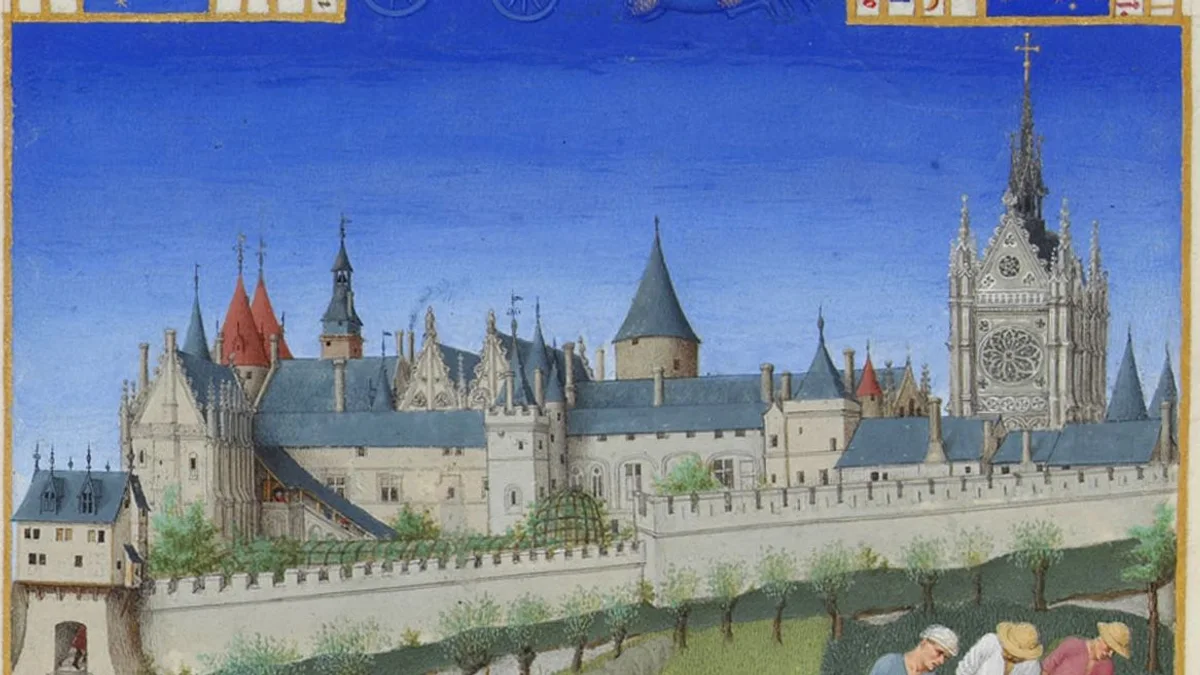
At the western tip of the island, the Palais de la Cité lines its towers along the Seine. The kings of France had not lived there since the riots of 1358: by the early 15th century, Charles VI resided at the hôtel Saint-Pol on the right bank, and the palace had become the seat of justice and administration, Parlement, chancery, Chambre des comptes, with its prison, the Conciergerie. It was anything but a dead place: Guillebert de Metz describes galleries full of merchants, down to a pewterer who kept nightingales that sang in winter, and the famous great marble table of the ceremonial hall, made “of nine pieces”. Above the rooftops rose the spire of the Sainte-Chapelle, built by Saint Louis to house the relics of the Passion.
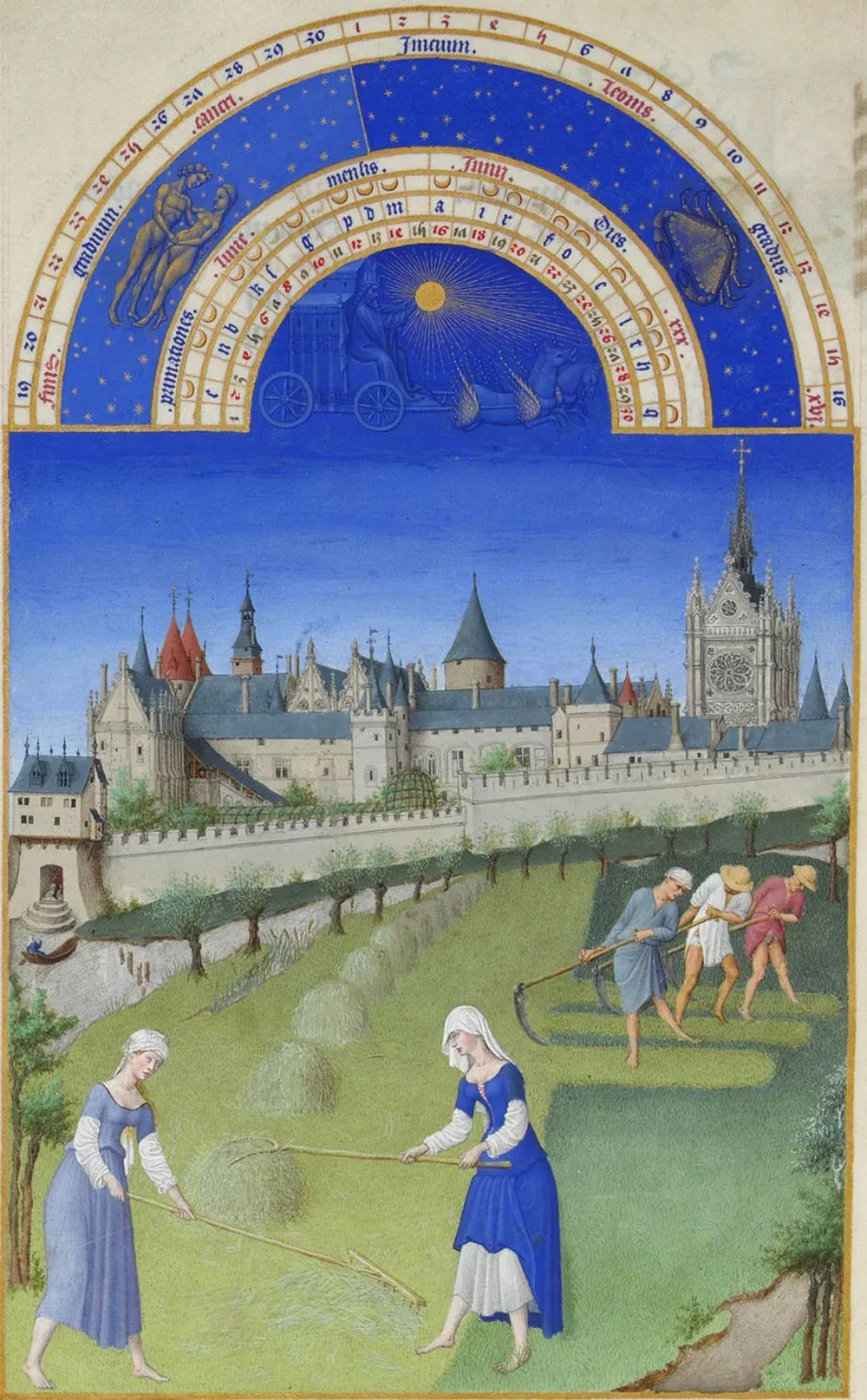
June in the Très Riches Heures du duc de Berry (illumination, c. 1412-1416, musée Condé, Chantilly): behind the haymakers, the Palais de la Cité and the Sainte-Chapelle as they appeared from the left bank. The oldest precise portrait of the island.
The cathedral quarter
At the eastern end, the other power. Notre-Dame had been finished for decades, and around it lived a closed world: the canons’ cloister, a privileged quarter north of the cathedral, from which the author of the “Journal” wrote; his editor Alexandre Tuetey identified him as a canon of Notre-Dame rather than a bourgeois. South of the parvis, the Hôtel-Dieu had cared for the poor for centuries. In between ran lanes whose names still sound in the archives, the rue Neuve-Notre-Dame, the rue de Kalende, the Vieille Juiverie, and parish churches packed side by side, Saint-Christophe, Saint-Barthélemy, Saint-Michel, which Guillebert lists one by one. The foundations of that vanished quarter can be visited today beneath the parvis, in the archaeological crypt.
Four bridges heavy with houses
You did not so much reach the island as cross it. Four bridges moored it to the two banks, and all carried houses, so many that a 15th-century Italian traveller marvelled that you crossed them without believing you were passing over a river. Guillebert de Metz counts sixty-eight rented premises, “louages”, on one side of the Grand-Pont, today’s pont au Change, and seventy-two on the other: the money-changers kept shop facing the goldsmiths. In the year 1400, “when the city was in its flower”, he writes, so many people crossed it all day long that you would always meet a white monk or a white horse there. To the north-east, the footbridge known as the planches de Mibray was replaced from 1413 by the pont Notre-Dame, a wooden bridge lined with “fine dwellings”: sixty-four belonged to the city and eighteen to private owners, with five more under construction in 1422, Guillebert notes. Towards the left bank ran the Petit-Pont, the oldest crossing in Paris, and the pont Saint-Michel, completed at the end of the 14th century. We devoted a whole article to these inhabited bridges and their disappearance.
1431: an English king crowned at Notre-Dame
The early 15th century was a time of misfortunes: the madness of Charles VI, the civil war between Armagnacs and Burgundians, then the Anglo-Burgundian occupation of Paris from 1418. In that setting, the island witnessed the most astonishing scene of its history. On 2 December 1431, the young Henry VI of England entered Paris; on 16 December, a Sunday, the boy, who had just turned ten, walked “à pié bien matin” (on foot, early in the morning) from the palace to Notre-Dame, where the cardinal of Winchester crowned him king of France.
The canon of the “Journal” saw it all, and his account is merciless. At the banquet held in the great hall of the palace, on the marble table, the crowd poured in from the morning and overwhelmed everything: more than forty hoods stolen in the crush, the University and the Parlement unable to reach their tables. The meat, prepared “the Thursday before”, scandalised the Parisians, “car les Anglois estoient chefz de la besongne” (for the English were in charge of the affair); even the sick of the Hôtel-Dieu, who usually received the leftovers of great feasts, judged they had never seen such meagre scraps. Henry VI left the day after Christmas without pardons or tax relief, and January 1432 was so cold that the Seine froze solid for seventeen days, hard enough to walk on. The coronation at Reims, in 1429, had had Joan of Arc; the Paris one convinced no one, not even its chronicler.
What remains today
- The Sainte-Chapelle and the Conciergerie, the only great remnants of the medieval palace, with the hall of the Gens d’armes.
- The archaeological crypt beneath the parvis, which preserves the foundations of the vanished quarter, including the rue Neuve-Notre-Dame.
- The heads of the kings of Judah at the musée de Cluny, torn from Notre-Dame’s façade during the Revolution, whose rediscovered colours we have told elsewhere.
- The two witnesses themselves, readable online on Gallica: the “Journal d’un bourgeois de Paris” and Guillebert de Metz’s “Description”.
And the ground beneath has not finished talking. Since the 2019 fire, more than twenty archaeological operations have been carried out in and around the cathedral. The excavations at the transept crossing in 2022 yielded two lead sarcophagi and more than a thousand fragments of the 13th-century rood screen, 650 of them still carrying their paint: the coloured enclosure behind which our canon sang the office in 1431. And since January 2026, the parvis itself has been under excavation for eight months by the City of Paris archaeologists, ahead of the redesign of the cathedral’s surroundings: beneath the concrete slab, medieval walls, crockery and even the latrines of the quarter Guillebert describes have already come to light. The setting of this story is literally rising back to the surface.
And to see the period rather than read it: in The Origins of Paris, our riverside walk reconstructs the medieval place de Grève, facing the island, on the very spot where the goods that fed the Cité came ashore. Virtual-reality binoculars over your eyes, today’s panorama gives way to the one our canon knew.
In short
Around 1400-1431, the Île de la Cité was the kingdom in miniature: a palace turned law court, a cathedral and its world of canons, a hospital, tightly packed parishes and four bridges covered with houses. Two direct witnesses, the anonymous canon of the “Journal d’un bourgeois de Paris” and Guillebert de Metz, let us describe it street by street, down to the English coronation of 1431, its strangest hour. The setting has almost entirely vanished; the texts are intact.
Sources
- “Journal d’un bourgeois de Paris, 1405-1449”, Alexandre Tuetey’s 1881 edition, Gallica (BnF, in French); the 1431 coronation at paragraphs 584 to 598.
- Guillebert de Metz, “Description de la ville de Paris au XVe siècle”, written around 1434, Le Roux de Lincy’s 1855 edition, Gallica (BnF, in French).
- “L’ordo du sacre d’Henri VI à Notre-Dame de Paris (16 décembre 1431)”, academic study, HAL open archive (in French).
- “Les Très Riches Heures du duc de Berry”, musée Condé, château de Chantilly (the June page depicts the Palais de la Cité, c. 1412-1416; in French).
- “Archéologie de Notre-Dame de Paris : avancées des recherches”, Inrap, and “Deux découvertes archéologiques majeures à Notre-Dame de Paris”, French Ministry of Culture (in French).
- “Sous le parvis de Notre-Dame, huit mois de fouilles”, City of Paris, 2026 (in French).