
Was Notre-Dame Painted in Colour?
Close your eyes and picture Notre-Dame in the Middle Ages. You see grey stone, don’t you? Dark portals, rock-coloured statues, an austere silhouette above the rooftops. It is the most widespread image of the medieval cathedral, and it is probably the most wrong. Grey is not the colour of the Middle Ages; it is the colour of the time that has passed over it.
Yes, Notre-Dame was partly painted. In the Middle Ages, the sculptures of its portals were coloured and highlighted with gold, as shown by the analyses of the original heads from the gallery of kings, rediscovered in 1977 and kept at the musée de Cluny: pink flesh tones, eyes outlined with a stroke, blue-grey beards, touches of orange, red and green. The same finding was made in Amiens, where laser restoration revealed the pigments of the portals. Reconstructing the past means living with an uncomfortable truth: we know it was colourful, we do not always know exactly how.
The day the kings got their heads back
The story begins with a collective beheading. In 1793, the Revolution mistook the twenty-eight kings of the gallery running across Notre-Dame’s façade for kings of France, and had them torn down. The statues you see today are 19th-century recreations, carved under Viollet-le-Duc. The originals were thought lost forever.
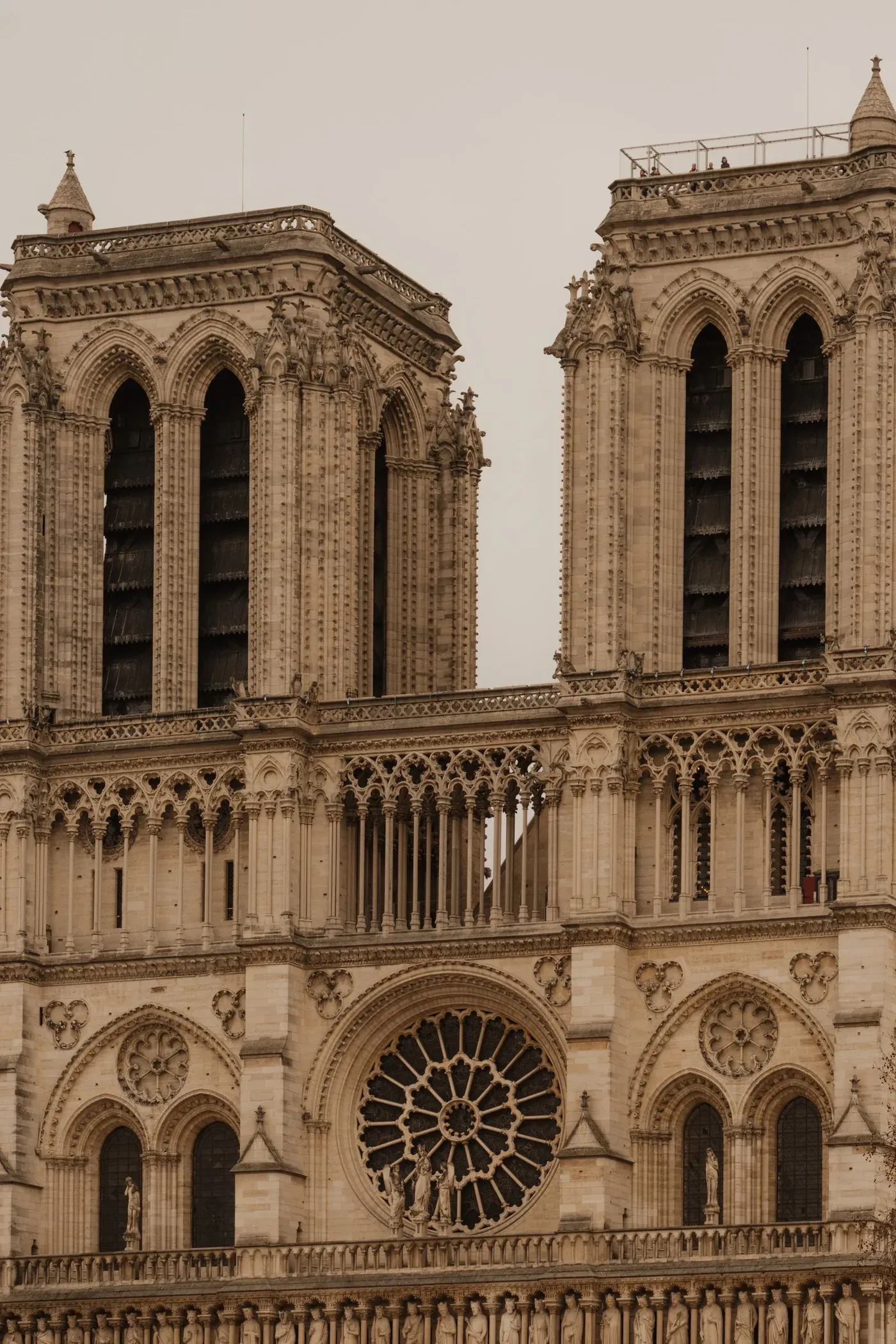
The façade today: the kings of the gallery are 19th-century copies. The original heads, meanwhile, kept their colours.
Until 1977. That year, works in the courtyard of a townhouse in the 9th arrondissement unearthed twenty-one heads of the kings of Judah, buried there since the Revolution. Damaged, but recognisable, and above all carrying a secret: traces of paint. The scientific analyses conducted since describe faces with pink flesh tones, eyes ringed with a line, blue-grey hair and beards, highlights of orange, red, green and black. These heads, on display at the musée de Cluny, are one of the most direct testimonies of what the medieval façade really was: a portal inhabited by painted figures, not a wall of bare stone.
Amiens, the proof by laser
What Paris suggests, Amiens demonstrates. During the great restoration of its cathedral’s portals, carried out with lasers in the 1990s, restorers uncovered traces of polychromy across all the sculptures, studied by the French research laboratory for historic monuments: as early as the 13th century, the portals were entirely painted in vivid colours. Since then, the Chroma show has projected those rediscovered colours back onto the façade every year, and audiences discover, stunned, a Gothic cathedral in festival dress.
The phenomenon reaches beyond the Middle Ages, by the way: Greek and Roman statues were painted too, and their marble whiteness is a misunderstanding that museums now spend considerable energy correcting. Whole stretches of our image of the past are, literally, bleached.
What we know, and what we do not
So much for the comfortable part. The rest is less so: knowing that the portals were painted does not tell you how they were painted at a given moment. The traces are fragmentary, campaigns of repainting followed one another over the centuries, pigments shifted hue as they aged, and both the façade and the interior went through several states. Any image of a “Notre-Dame in colour” is therefore a hypothesis: the most honest possible when it rests on analyses, period illuminations and building accounts; pure invention when it comes from an overconfident brush, or from a generative model fed on clichés.
What it changes when you reconstruct
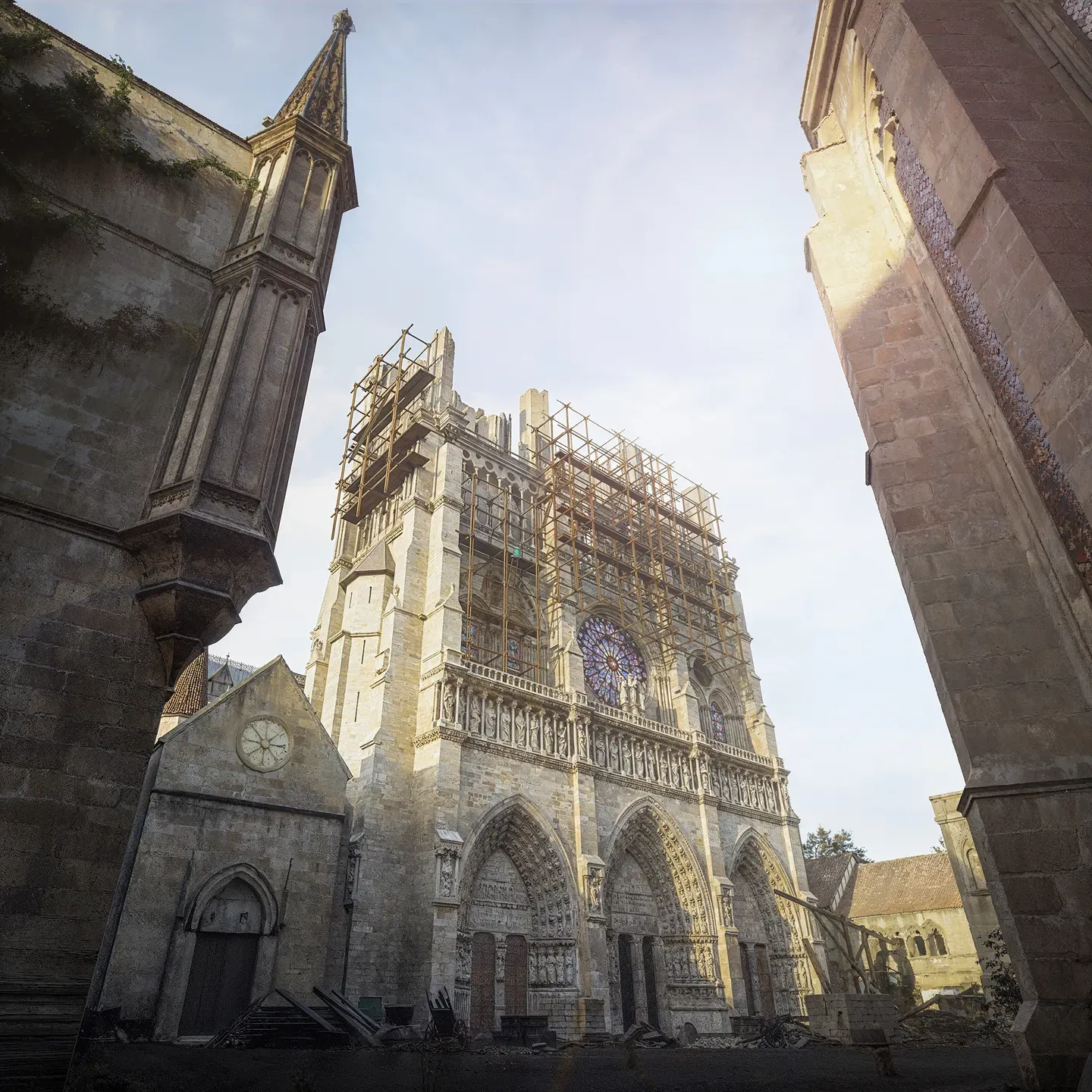
Our Notre-Dame construction site in The Origins of Paris: the freshly cut stone of a building still rising, before the colours of the finished state.
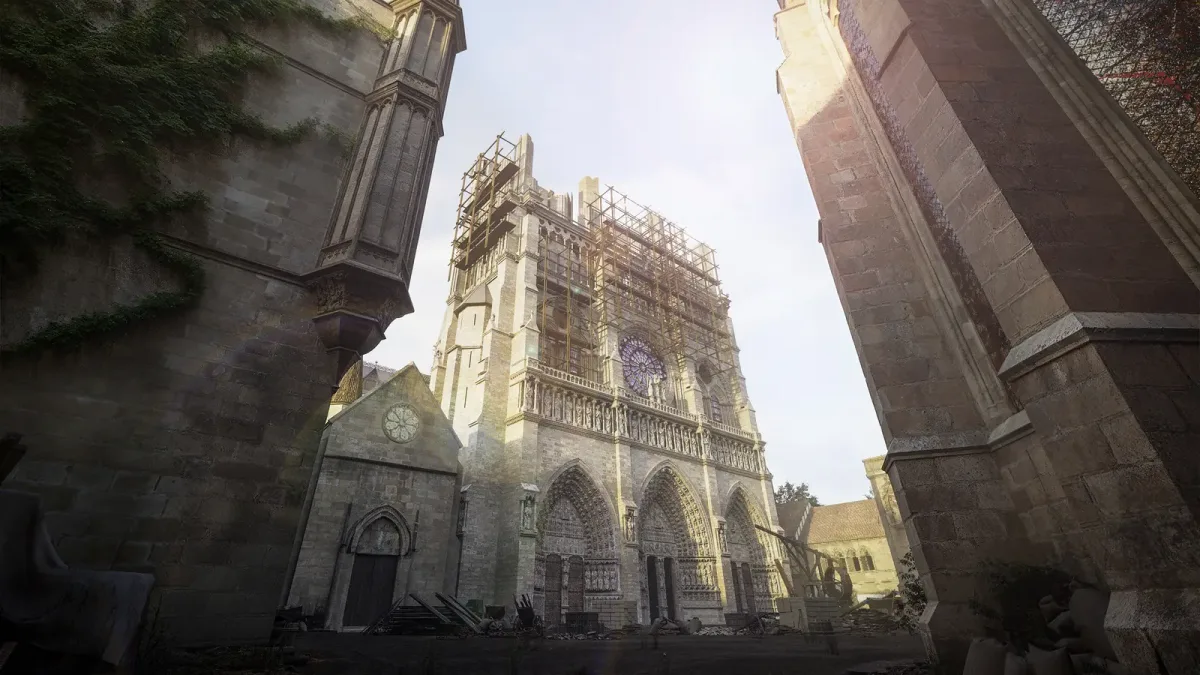
This is exactly the kind of trade-off we face on every scene. In The Origins of Paris, our reconstruction shows Notre-Dame in mid-construction, in the heart of its two centuries of works: freshly cut limestone, pale and blond, wooden scaffolding, a rose window being fitted. A documented state, prior to the finery of the finished building. For every choice of this kind, the rule is the same as for the plague mask we once ruled out: sources first, documented hypothesis second, and a refusal to invent when the archives fall silent, all validated by the historians who work with us. An honest reconstruction is not the one that shows everything; it is the one that can say what it chose, and why. Our behind-the-scenes page details that method.
Where to see medieval colour today
- At the musée de Cluny, in front of the heads of the kings of Judah and their traces of polychromy, a twenty-minute walk from the cathedral.
- In Amiens, during the Chroma projections, which return the documented colours to the façade.
- At Notre-Dame itself, whose restoration has given the painted 19th-century chapels back their brilliance, an echo of the medieval taste for colour as revisited by Viollet-le-Duc.
- In the illuminations of medieval manuscripts, which show architecture painted red, blue and gold, browsable in digitised form on Gallica.
In short
Medieval Notre-Dame was not grey: its sculpted portals were painted and gilded, as proven by the heads rediscovered in 1977 and the findings in Amiens. But between knowing that colour existed and knowing which colour went where lies the whole gap between evidence and hypothesis, and it is in that gap that the honesty of a reconstruction is decided. The grey of cathedrals is a real page of history; it is simply not the first one.
Sources
- “Têtes de la galerie des rois de Juda de Notre-Dame de Paris”, musée de Cluny, national museum of the Middle Ages (in French).
- “La polychromie de la cathédrale” and “Chroma”, Amiens Métropole (in French).
- “La polychromie du portail central de la cathédrale d’Amiens”, Laboratoire de recherche des monuments historiques (in French).
- The making of our reconstructions and the history behind The Origins of Paris, for our full method.