All the history behind the experience, era by era - from the first Parisii to the great floods of the Seine. Every scene you walk through in virtual reality is sourced, cross-checked and validated by historians.
What stayed with you?
Five questions on what you have just travelled through. Thirty seconds.
Question 1 of 5
Where did archaeologists find the great Gaulish settlement of the Parisii?
History long placed the Parisii on the Île de la Cité. Excavations over recent decades uncovered, out at Nanterre, a vast Gaulish settlement already active in the 3rd century BC. In September 2026 a Gaulish wall found under the Hôtel-Dieu reopened the debate: it may belong to the rampart of the Lutetia oppidum, on the Île de la Cité.
Question 2 of 5
How long did Parisians hold out against the Vikings in 885?
Several hundred ships surrounded the Île de la Cité. Led by Count Odo, the Parisians resisted for more than a year despite famine and assault. The city never fell.
Question 3 of 5
What share of Parisians did the Black Death carry off in 1348?
Paris then held close to 200,000 people. On some days more than 500 bodies were buried. The epidemic lasted until 1351.
Question 4 of 5
In January 1910, how high did the Seine rise at the Pont d’Austerlitz?
A record, reached on 28 January 1910. The river took about ten days to rise and some 35 days to fall. Whole neighbourhoods stayed under water for weeks.
Question 5 of 5
Which invention changed safety on the streets of Paris in the 18th century?
Before it, places such as the Canal des Cagnards were the city’s underworld. Public lighting changed everything.
Paris was born on the banks of a river. Ever since the Neolithic, people have settled here, drawn by the promise of water, fish, fertile land and natural travel routes. The Seine is the connecting thread of the Origins of Paris experience. In this companion guide, we retrace each era for you, so you can delve deeper into what you discovered during your visit.
THE BIRTH
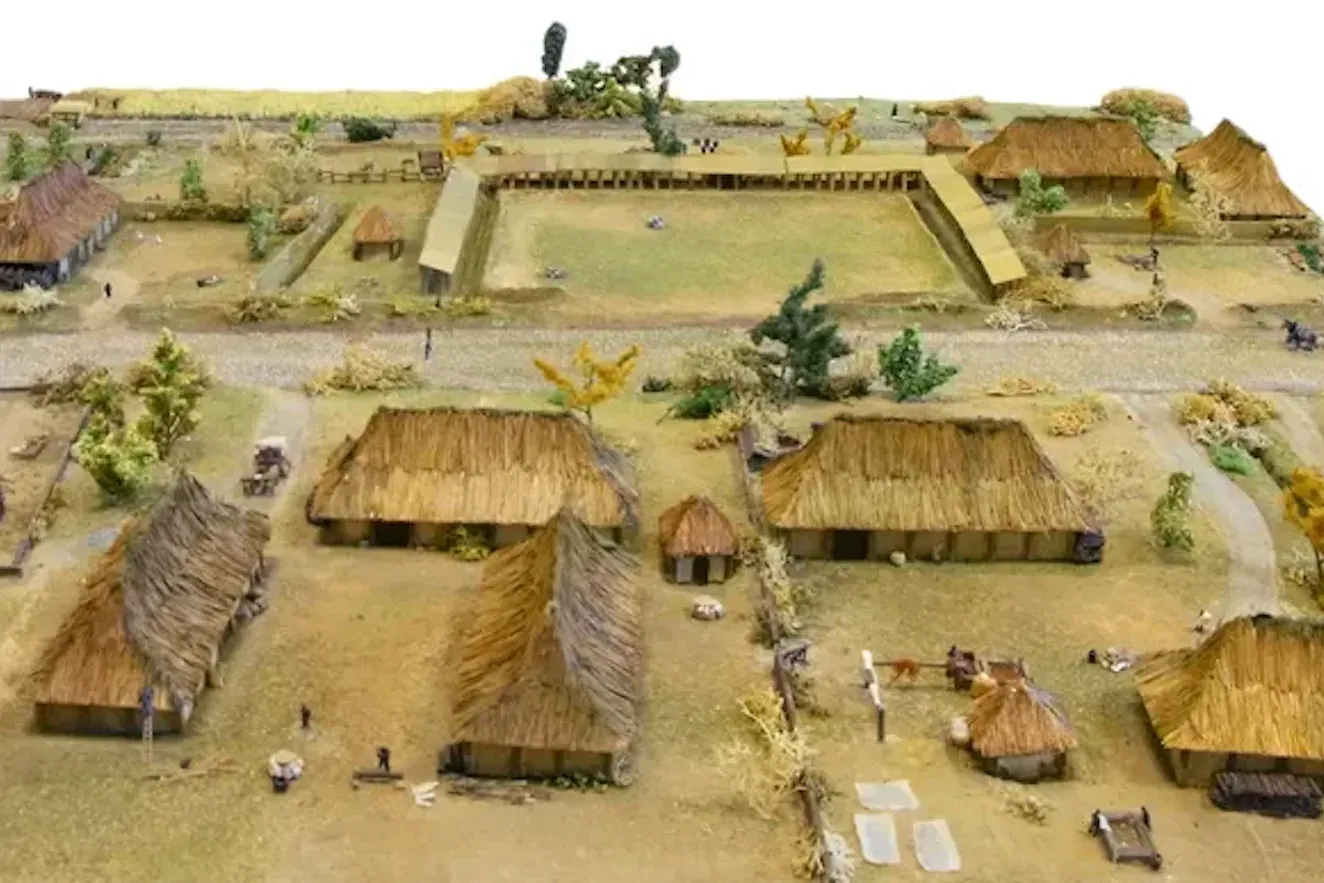
For a long time, history placed the Parisii, the Gaulish people who gave Paris its name, on the Île de la Cité, long regarded as the cradle of the city. Excavations in recent decades had overturned that certainty: it was near Nanterre, west of today’s capital, that the remains of a vast Gaulish settlement were unearthed, one already thriving in the 3rd century BC. A discovery made under the Hôtel-Dieu in the summer of 2026 has reopened the debate.
September 2026: a Gaulish wall under the Hôtel-Dieu. Since February 2026, the City of Paris archaeology service (DHAAP) and Inrap have been excavating two courtyards of the Hôtel-Dieu, on the Île de la Cité. In the summer of 2026 they uncovered a stone and timber wall preserved over some twenty metres, built with a technique typical of late Iron Age Gaulish fortifications, backed by a platform of sand and gravel nearly two metres thick. Its facing bears the marks of a fierce fire: carbonised seeds, a burnt timber building and a Gaulish spearhead were found beside it. The first carbon-14 analyses of the wood give a wide bracket, between 200 and 10 BC.
The wall may belong to the rampart of the Parisii oppidum, the Lutetia that Caesar describes as set on an island in the Seine and that the Gauls burned themselves in 52 BC, as the troops of his lieutenant Titus Labienus approached. The Ministry of Culture still urges caution: the levels under study fit the late Iron Age and a destruction by fire, but they are not enough to date that fire to 52 BC. The excavation continues, and a cast should allow a reconstructed section of the rampart to be shown to the public. Press release from the French Ministry of Culture, 23 September 2026.
A dugout canoe discovered at the Bercy site, now on display at the Musée Carnavalet in Paris. Neolithic period, between 2880 and 2500 BC - long before the arrival of the Parisii.
In the Origins of Paris experience, our intention for this era was to convey just how marshy the Right Bank of the Seine once was. Who, in those earliest days, could have imagined that this vast marshland would one day become the capital of France?
lutetia
It was the Romans who laid the city's foundations.
When the Romans settled here in the 1st century BC, they transformed a scattered Gaulish territory into a true city: Lutetia. No longer a mere cluster of dwellings along the river, it became a planned, ordered city built in stone. The forum, the baths, the theatre, the paved streets and the cardo maximus gave shape to the urban space. Hills such as Sainte-Geneviève became major sites of settlement.
A bird's-eye view of Lutetia, created by Timescope. As you can see, the Gallo-Roman city grew mainly on the Left Bank of the river - higher ground, and far less marshy.
Detail of a Roman ship in London - the stern. We studied many visual sources in order to faithfully recreate the Roman ships of the Lutetia era in the Origins of Paris experience.
The theatre, as depicted by Timescope.
The Forum, reconstructed in 3D by Timescope. Now vanished, this was the beating heart of public life in Lutetia.
A scene from the Origins of Paris experience, on the banks of the Seine in the age of Lutetia (225 AD).
THE VIKING SIEGE
The Vikings had already raided Paris several times, but the siege of 885 remains the most memorable. Several hundred ships encircled the Île de la Cité, the fortified heart of the city. For more than a year, the people of Paris held out with great courage, led by Count Odo. Despite famine and relentless assaults, the city did not fall. The siege has gone down in history as a symbol of Parisian defiance in the face of the invader. The monk Abbo of Saint-Germain left a first-hand account of the Viking siege of Paris - there is a podcast well worth a listen on the subject.
The Building of Notre-Dame
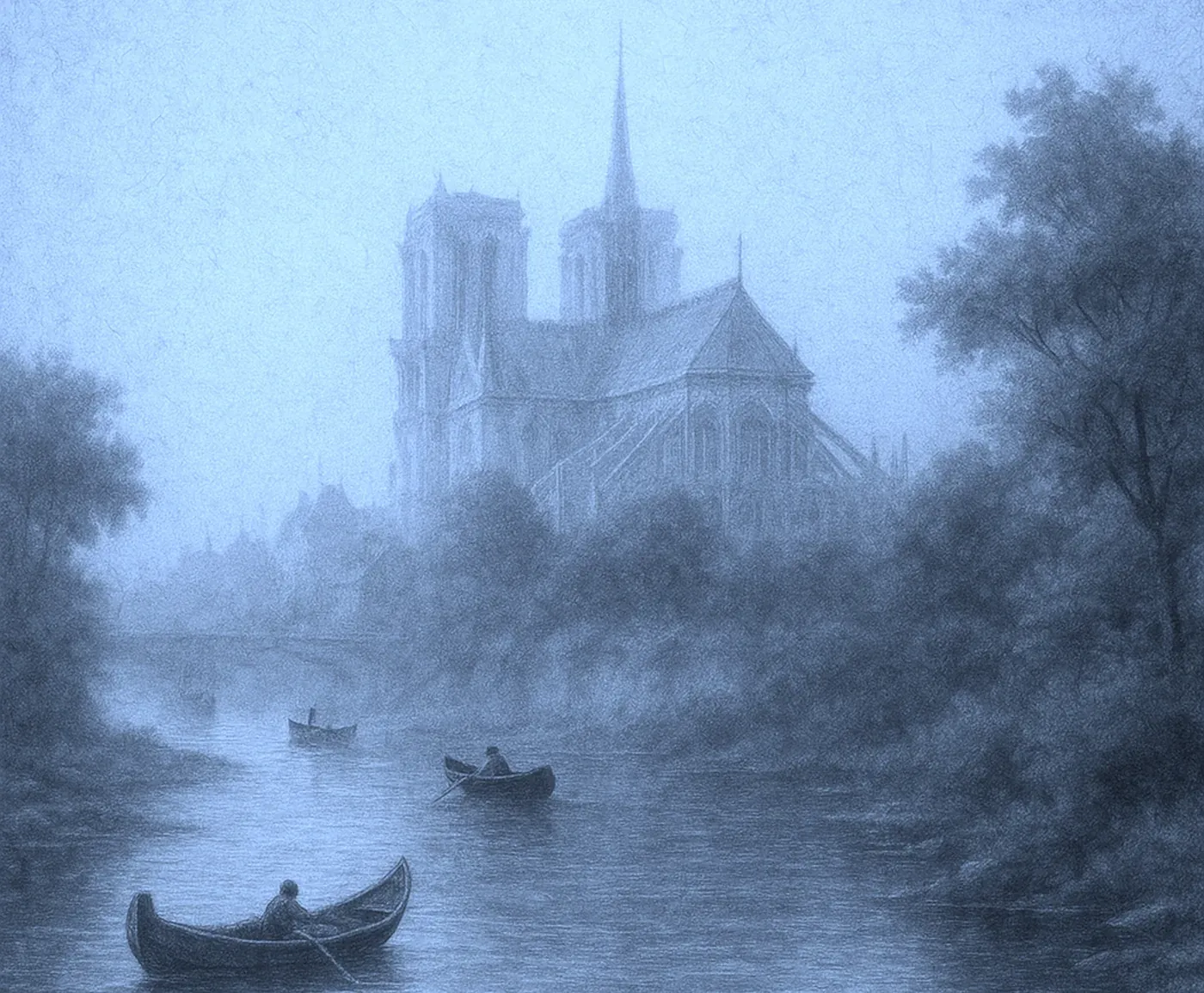
An iconic monument, visible from the banks of the Seine and impossible to leave out of an experience about the history of Paris: the cathedral of Notre-Dame. What struck us as compelling in the Origins of Paris experience was to convey the sheer scale of the undertaking it represented - two centuries of work in the very heart of the city!
The bank of the Seine in the 14th century. Notre-Dame was far more visible from the riverside back then, as buildings were lower in the Middle Ages.
Notre-Dame under construction in the Origins experience. The cathedral of Paris was built between 1163 and 1345.
The Black Death
The epidemic - caused by the bacillus Yersinia pestis, most likely brought from Central Asia - reached Paris aboard merchant ships and, within a few weeks, swept through an overcrowded city of nearly 200,000 inhabitants. Transmitted mainly by rat fleas, it announced itself with painful buboes, high fevers and haemorrhages, carrying off between a third and a half of all Parisians and forcing authorities and citizens alike to bury, at times, more than 500 bodies a day. This crisis, which lasted until 1351, brought a temporary collapse of urban life and foreshadowed profound social upheavals, opening the way to the transition into modern Europe.
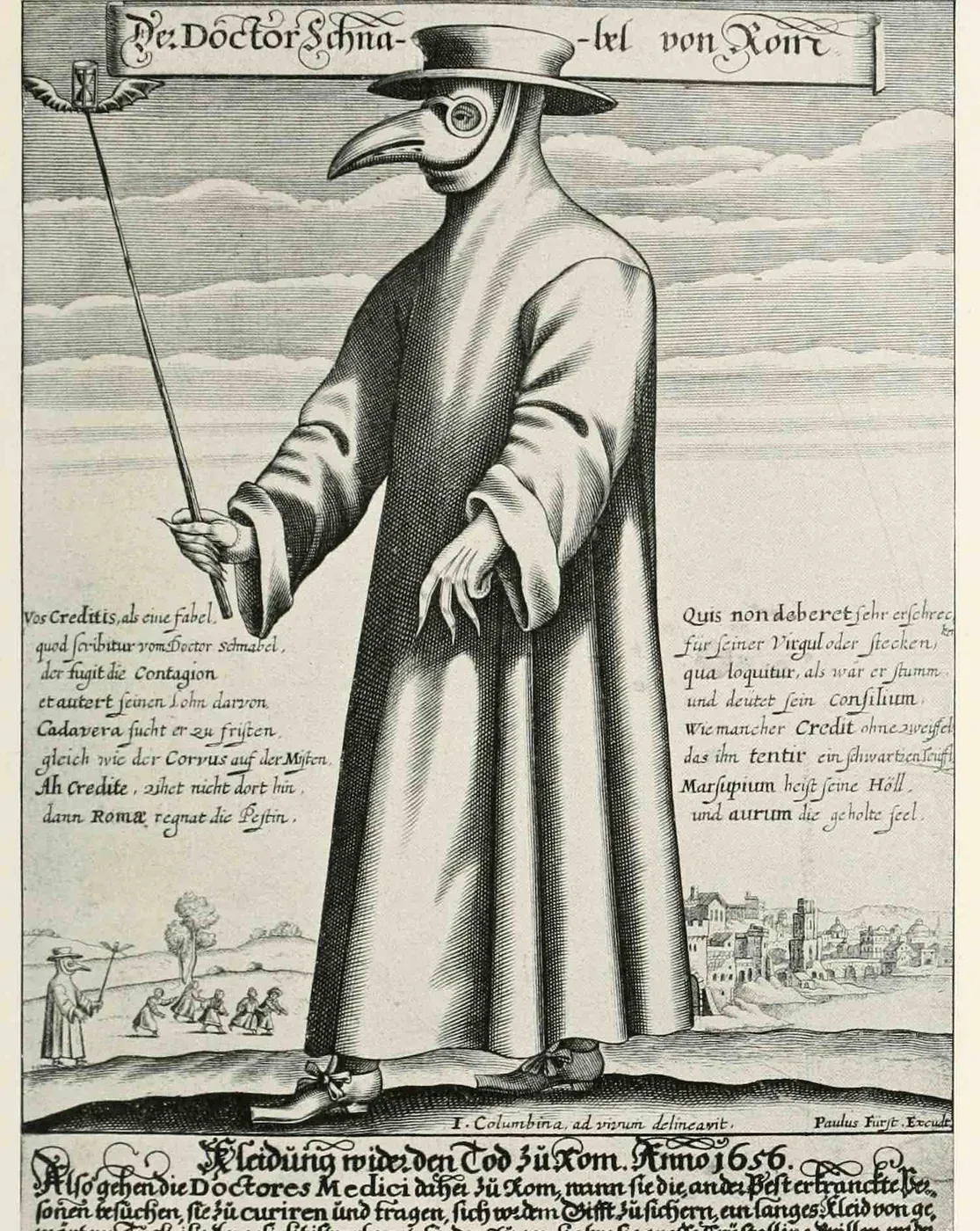
Strange masks for the plague doctors. The famous long-beaked mask, invented in 1619 by Charles de Lorme to filter out the 'miasmas', does not appear in the Origins experience, since it came along well after the epidemic of 1348.
Visual depictions of the plague - engravings, frescoes and paintings such as the Danse Macabre or the Triumph of Death - often rendered terror and despair through striking scenes of skeletal corpses, funeral processions and allegorical figures, capturing the emotional shockwave that swept through medieval societies.
In the Origins of Paris experience, we recall the origin of the French word 'corbillard' (hearse), which dates precisely from this time of the Black Death. The boats used to carry the dead out of the city towards Corbeil gave the word its name.
The Renaissance
The city is reborn. The population grows. Paris takes shape…
In the 16th century, under François I, Paris opened up to the new forms of the Italian Renaissance, and the Place de Grève - the civic and judicial heart of the capital - embodied this renewal. Lined with newly dressed façades of harmonious proportion, it saw the rise of a new Hôtel de Ville inspired by Florentine palaces, hosted lavish festivities and became the setting for official ceremonies celebrating royal power and the triumph of the humanist arts. At once a trading crossroads, a place of political assembly and the public stage for executions, the Place de Grève was transformed into an urban space that spelled out the ambitions of a Paris resolutely turned towards modernity.
A scene from the experience at the Place de Grève. The city's central port at a time when Paris was growing - gaining in population and political power - the square was known to every Parisian. Goods were unloaded here and carried on to Les Halles.
A depiction of the Place de Grève by Hoffbauer, with the Hôtel de Ville at its centre.
A crowd gathered on the Place de Grève to watch an execution (Timescope 3D).
Goods being unloaded at the Place de Grève - a Timescope model.
The centre of the Place de Grève - historical archive.
THE BRIDGE FIRE
On the night of 23–24 October 1621, a fierce fire - which broke out in the stalls on the wooden deck of the neighbouring Pont Marchand - spread to the Pont au Change, consuming its piers and shops before residents and the city watch finally brought it under control. This dramatic episode prompted the city's money changers to fund, from 1639 onwards, the bridge's reconstruction in stone - sturdier and far safer.
The Canal des Cagnards
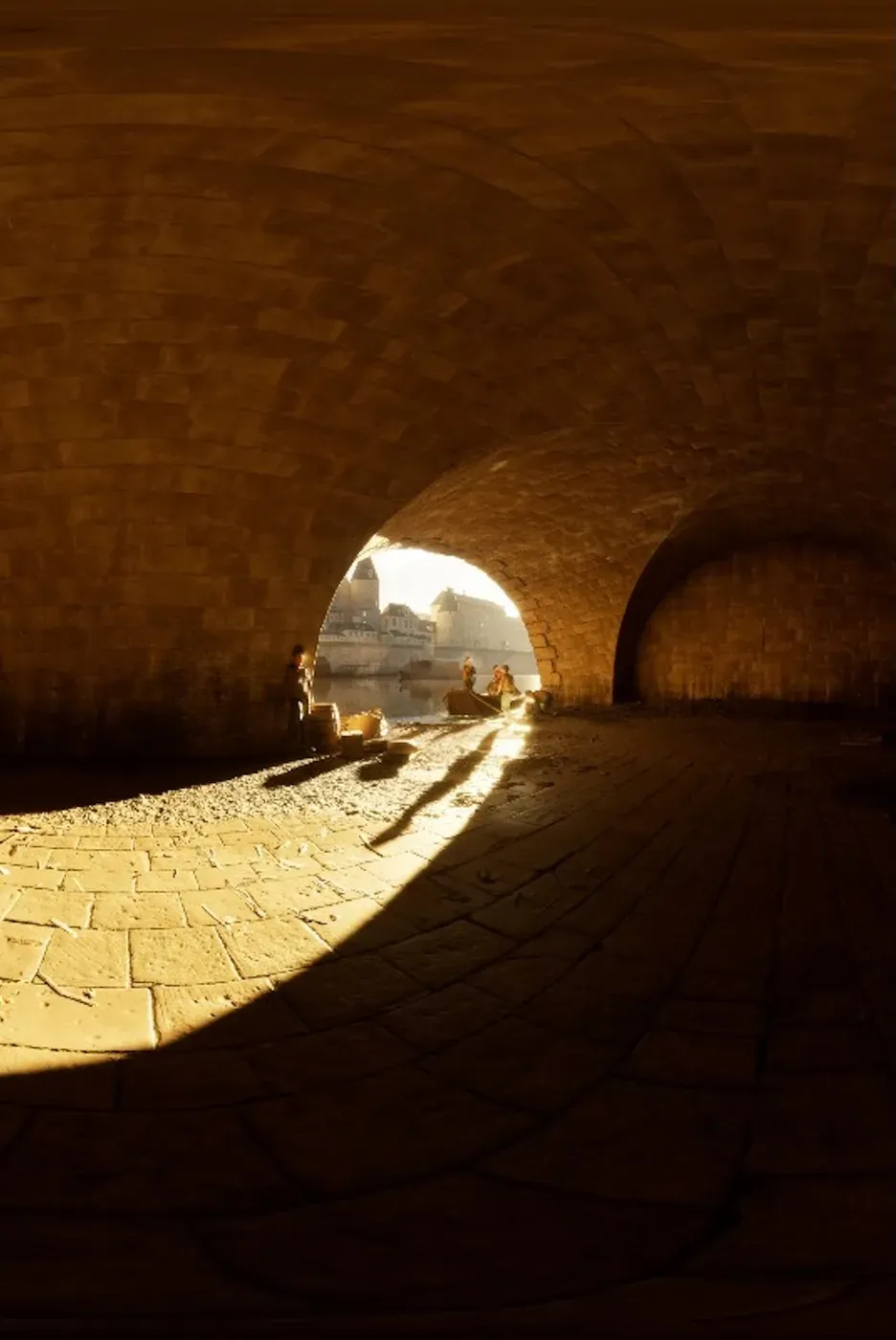
In the Origins of Paris experience, we wanted to look at the Canal des Cagnards - which no longer exists today - through the lens of the city's underworld: to tell the story of just how unsafe Paris could be before the 18th-century invention of the reverberatory street lamp, which changed everything.
The vault of the Quai de Gesvres - a depiction by Auguste Regnier.
The Canal des Cagnards recreated in the Origins of Paris VR experience. It is dark, and brigands have gathered in the shadows.
LIFE ALONG THE SEINE
The Seine is the connecting thread of the Origins experience. We thought it worth telling that people swam in it - even then! - but also recounting a few unusual chapters of history, like the winter of 1880, when a cold spell grew so fierce that it froze the river over.
A photograph of the frozen Seine in the winter of 1879–1880. 'The winter of 1879–1880 was remarkable for the extreme severity of the cold; for most of our rivers it brought freezes and break-ups the like of which had not been seen for nearly a century' (Lalanne and G. Lemoine, 1881).
A 3D reconstruction by Timescope of the frozen Seine. In the Origins of Paris experience, we wanted in particular to show scenes of skating and snowball fights, to capture the everyday life of Parisians.
2025 - the year the Origins of Paris experience launched - is also the year Parisians can once again swim in the Seine, a pastime they enjoyed with such delight a century ago!
The Great Flood
One of the harshest ordeals the city of Paris has ever faced.
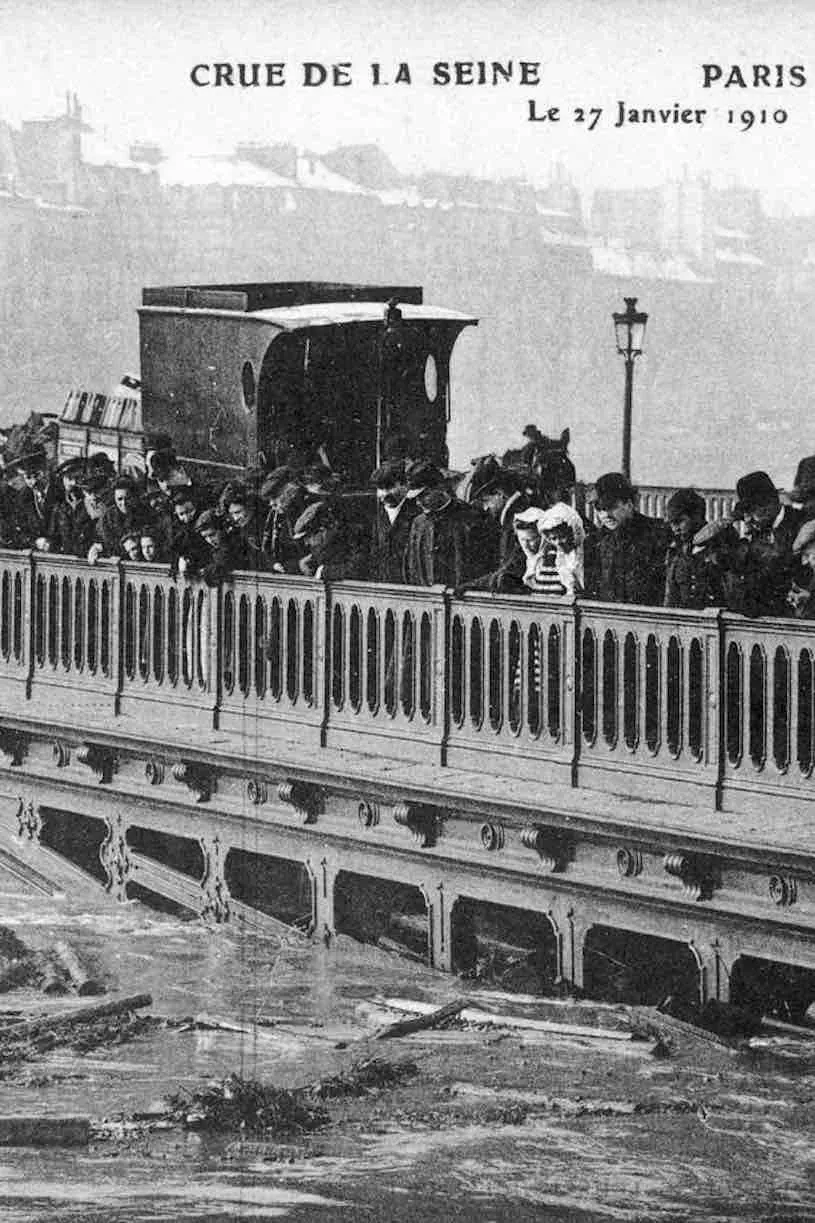
The Seine flood of 1910, known as the hundred-year flood, remains one of the most striking inundations since that of 1658. It submerged much of the Seine valley, causing major disruption across Paris. Though it claimed few lives, this natural disaster did considerable economic damage throughout the region. On 28 January 1910, the river reached a record level of 8.62 metres on the gauge at the Pont d'Austerlitz. For several weeks, many Parisian neighbourhoods remained under water. The waters rose over some ten days, followed by a slow retreat that stretched out over roughly 35 days.
To get supplies, Parisians made do however they could. Patrice de Moncan - 'Paris inondé - La grande inondation de 1910', éd. du Mécène.
It was also one of the first natural disasters ever to be photographed.
THE EIFFEL TOWER'S APOTHEOSIS
The Eiffel Tower brings the Origins of Paris experience to a close. Built for the 1889 World's Fair, it marked Paris's entry into the modern age. Conceived as a temporary feat of engineering, it became a lasting symbol. Across the 20th century its role kept changing: radio antenna, tourist landmark, laboratory for experiment. This final chapter shows how the Tower became the icon of Paris - then and now.
Resources
Teaching resources
To prepare for and extend the visit in class - sourced and adapted by school level.
The reconstructions in The Origins of Paris draw on archives, period imagery and the work of historians and archaeologists. The full bibliography, era by era, is set out in our teaching booklets.