
Underground Paris: What Can You Really Visit Beneath the City?
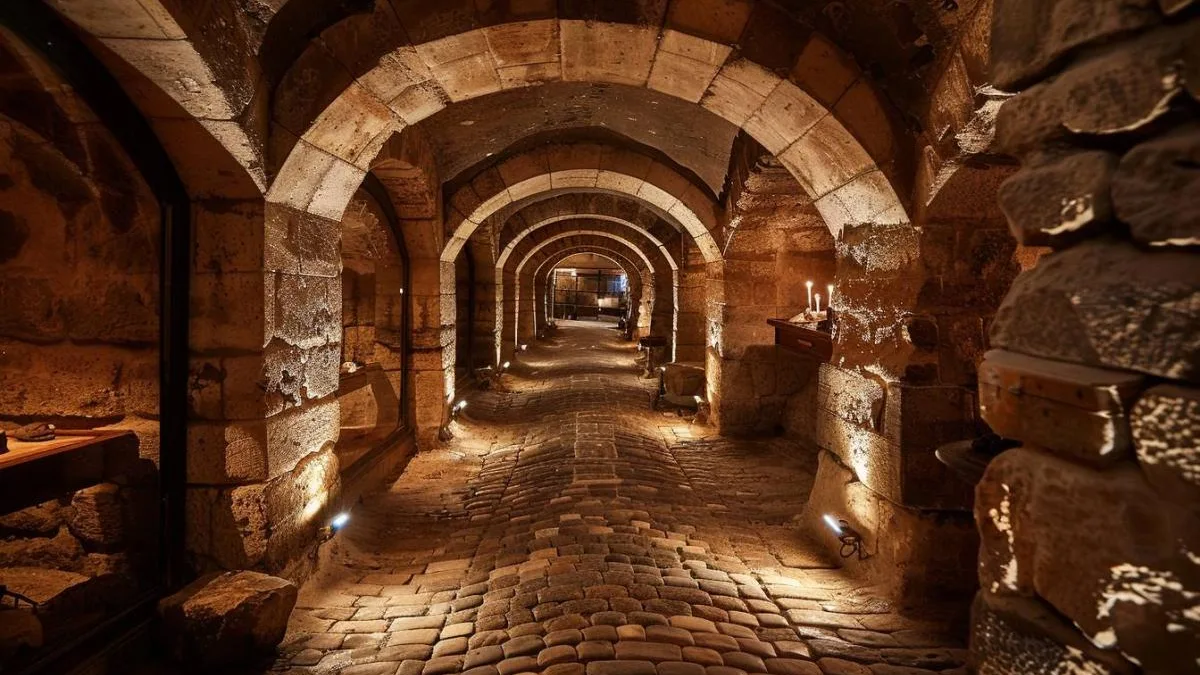
Beneath your feet, Paris keeps going. More than 300 kilometres of quarry galleries, an ossuary, rivers of wastewater, ancient quays, castle moats and metro stations where no train stops anymore. The good news: part of that world can be visited.
Under Paris you can visit the Catacombs (reopened in April 2026 with a completely new route), the archaeological crypt of the Île de la Cité with its remains of ancient Lutetia, the moats of the medieval Louvre, the Sewer Museum, the crypt of the Panthéon, and the Bastille vault by boat. More confidential: the Capucins quarry, or a ghost metro station during special events. Here is the place-by-place guide.
Why is there a Paris under Paris?
Because Paris was built out of its own subsoil. For centuries, the two materials the city is made of were quarried directly beneath it: the limestone of its buildings to the south, the gypsum of its plaster (the original “plaster of Paris”) to the north, leaving a honeycomb of galleries behind. The map drawn in 1908 by Émile Gerards, author of the classic “Paris souterrain”, is an X-ray of that hidden city:
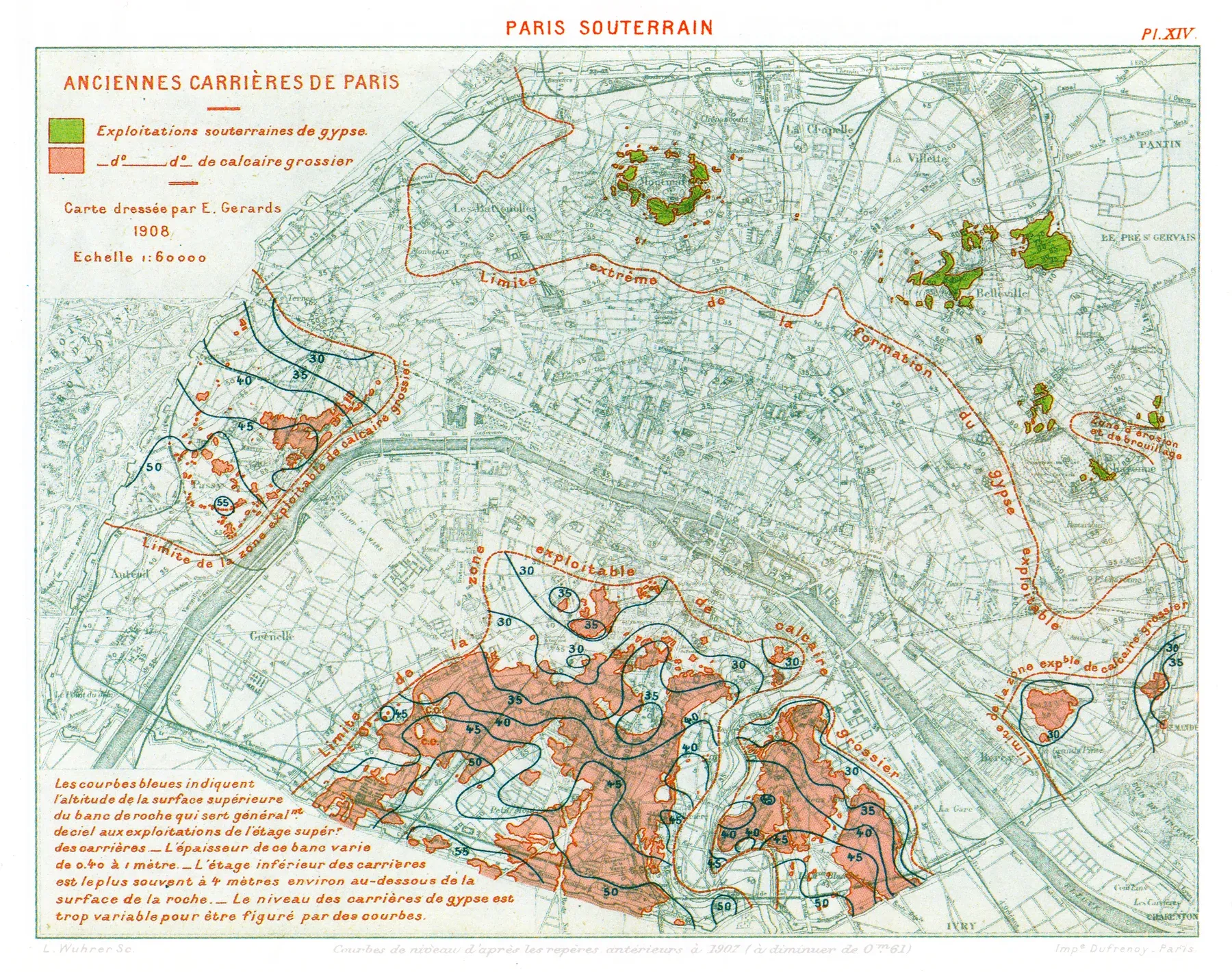
The old quarries of Paris, mapped by Émile Gerards (1908). In pink, the limestone quarries of the Left Bank; in green, the gypsum of the northern hills. If the Catacombs are on the Left Bank, it is because the building stone was.
The wake-up call was brutal: on 17 December 1774, the rue d’Enfer (today’s avenue Denfert-Rochereau) collapsed over dozens of metres. Three years later, King Louis XVI created the Inspection générale des carrières, tasked with mapping and consolidating the void beneath the capital; it still exists today, within the city’s services.
Then, in 1786, a use was found for the consolidated quarries: transferring the bones from the saturated cemeteries of the city centre, starting with the Holy Innocents’ cemetery. That same year, another great clear-out was starting above ground: the demolition of the houses built on the bridges of Paris.
1. The Catacombs, the ossuary of six million Parisians
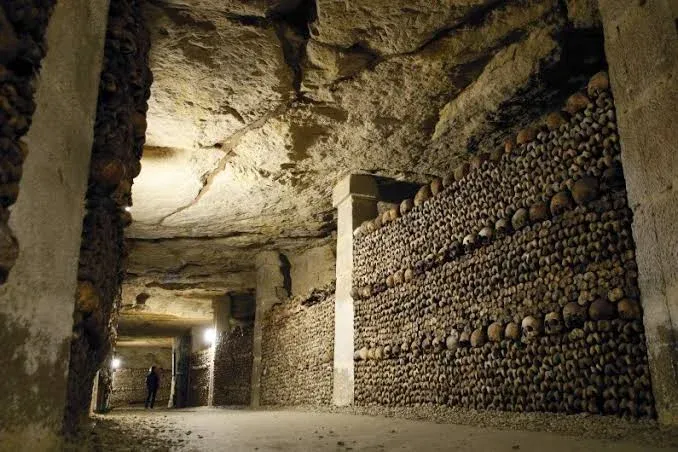
The “hagues”, walls of bones arranged “with as much art as method” under the direction of Héricart de Thury from 1809 onwards.
The archives describe an unbelievable scene: for months, funeral convoys draped in black crossed Paris by night, accompanied by chanting priests, to pour the remains of the city-centre cemeteries into the old quarries. A former quarryman had already carved a model of the Port-Mahon fortress down there by lamplight; inspector Héricart de Thury then turned the bone deposit into a monument, with its walls of tibias and skulls and the warning engraved at the entrance: “Stop! This is the empire of Death.”
Today, the unmissable site of underground Paris comes with good timing: after major works, the Catacombs reopened on 8 April 2026 with a completely redesigned route. Twenty metres underground, the 1.5-kilometre circuit winds between the bones of some six million Parisians, at a constant 14 °C. Booking a time slot online is mandatory: there is no ticket desk on site.
2. The archaeological crypt of the Île de la Cité: Lutetia beneath the square
In 1965, while digging what was meant to be an underground car park beneath the square in front of Notre-Dame, the excavators hit the heart of the ancient city. Preserved under a concrete slab, the remains tell 2,000 years of history in superimposed layers: a quay from the ancient river port, a hypocaust (Roman underfloor heating), and the 4th-century rampart, hastily built with stones torn from the monuments of the Left Bank when the first invasions threatened.
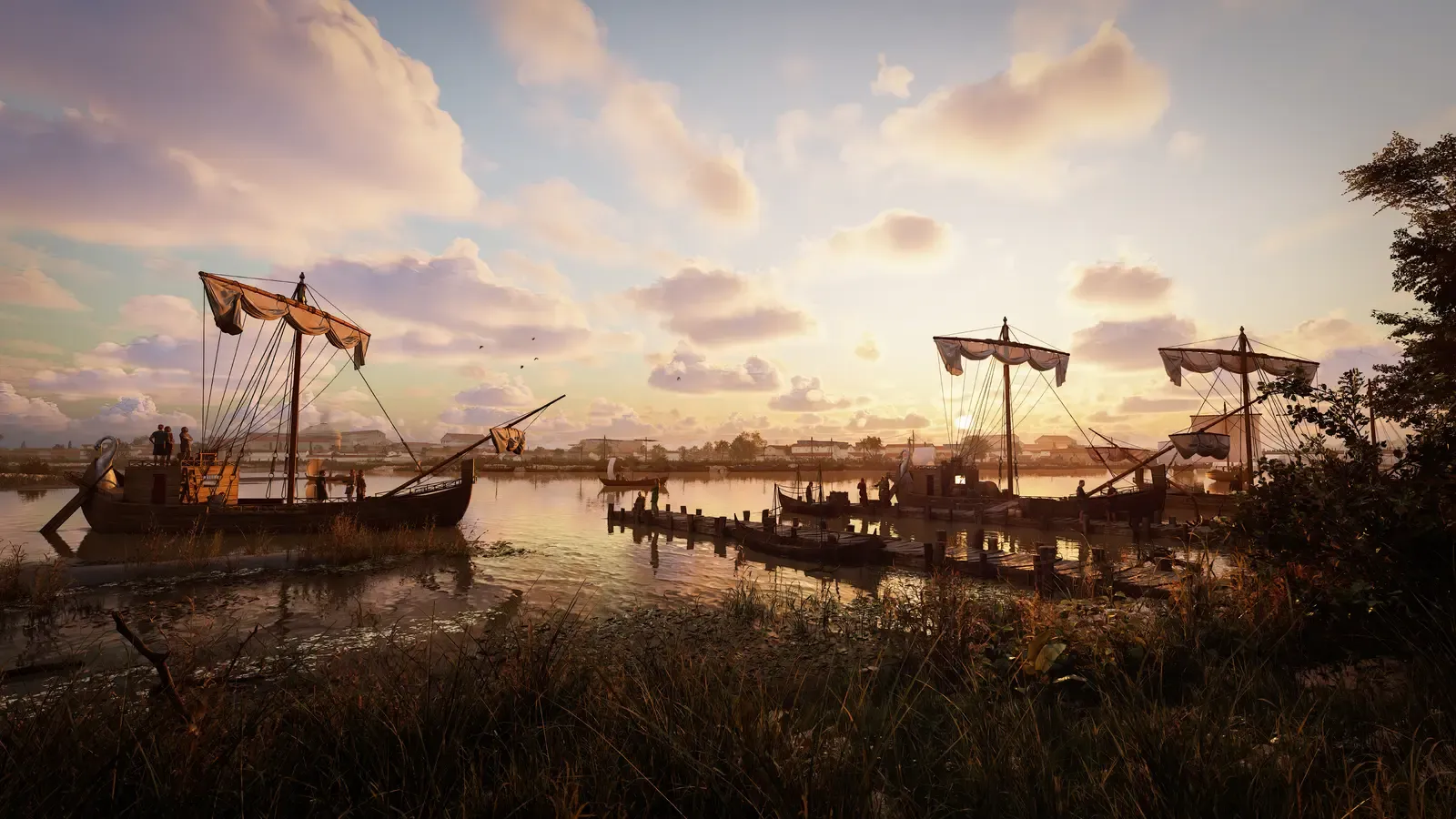
The port of Lutetia, a Timescope reconstruction based on archaeological sources. The crypt preserves its stones, a few metres below today’s street level.
It is the most vertiginous visit on this list, in the literal sense: you can measure how much the ground of Paris has risen in twenty centuries, layer after layer.
3. The medieval Louvre: walking in the moats of the fortress
Before it was a palace, let alone a museum, the Louvre was a fortress, built by King Philippe Auguste around 1200 to lock down the Seine. Its remains, uncovered during the excavations of the 1980s, can now be explored beneath the Cour Carrée, included in the museum ticket: you walk along the bottom of the old moats, past curtain walls that stayed buried for centuries, skirt the base of the keep and enter the lower hall known as the Salle Saint-Louis. To place this castle in the city of its time, our article on medieval Paris sets the scene.
4. The Sewer Museum: the working underside of the city
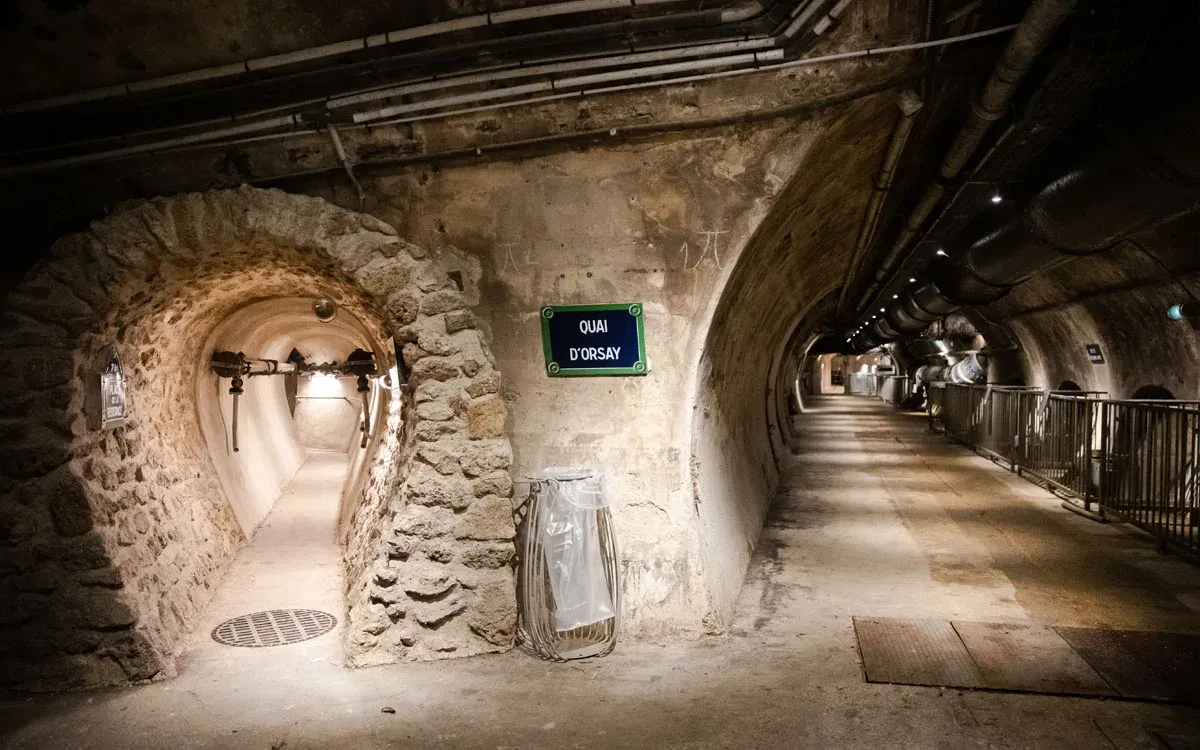
Underground, every gallery carries the blue sign of the street it follows above: the sewers are an exact double of the Paris overhead.
It was Victor Hugo who made the sewers of Paris legendary, sending Jean Valjean fleeing through them in “Les Misérables”; it was the engineer Eugène Belgrand who, at the same period, turned them into a city beneath the city, down to this detail: every gallery carries the street sign of the road it serves. Under the quai d’Orsay, near the Pont de l’Alma, the museum takes you down into 500 metres of galleries of a very much living network, in the footsteps of the sewer workers. Open Tuesday to Sunday. And yes, there is a smell; that is part of the deal.
5. The Bastille vault: 2 kilometres under Paris, by boat
The Canal Saint-Martin does not end at Bastille, it dives underground. The cruises linking the Arsenal marina to the Bassin de la Villette pass through this 2-kilometre vault under the boulevard Richard-Lenoir, pierced by light wells: a gentle, almost unreal crossing of the city from below. Two companies run it all year round, Canauxrama and Paris Canal.
6. The crypt of the Panthéon: great figures, beneath the monument
Under the nave of the Panthéon, the crypt holds the tombs of Voltaire, Rousseau, Victor Hugo, Marie Curie, Alexandre Dumas and Josephine Baker. It is included in the monument visit, and the atmosphere is striking: sober, silent galleries, the exact opposite of the pomp of the dome.
7. The Capucins quarry: the confidential visit
Eighteen metres beneath the Cochin hospital survives a genuine limestone quarry, maintained by an association of enthusiasts, the SEADACC. No ticket office here: visits are requested in writing from the association, in small groups, by lamplight. It is the authentic and legal version of what urban explorers go looking for in the forbidden network.
8. The ghost metro stations: for the lucky few
The Paris metro has a dozen stations closed to the public or never opened. Some have been frozen in time since 2 September 1939, closed on the day of the general mobilisation and never reopened, like Croix-Rouge. The most famous, Porte des Lilas-Cinéma, serves as a film set (scenes from “Amélie” were shot there) and opens during events such as the European Heritage Days in September; the RATP and Seine-Saint-Denis Tourisme also run behind-the-scenes visits during the year. Tickets go within hours: it is the outing to watch for.
What you cannot visit (or hardly ever)
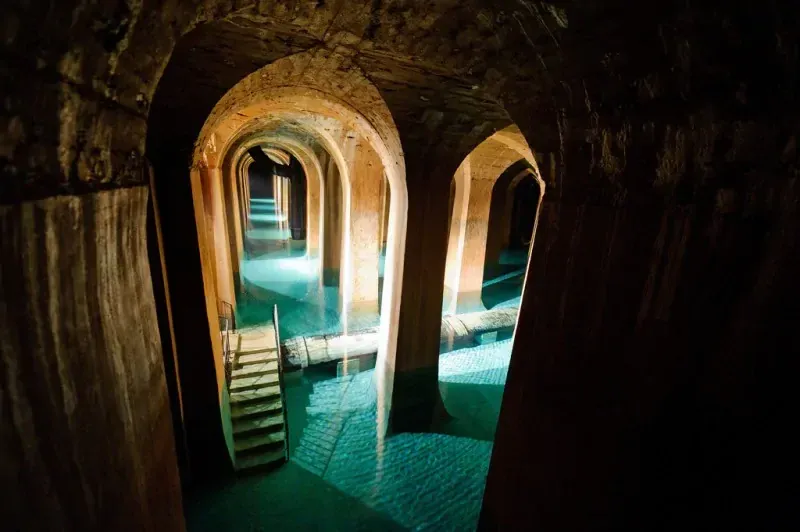
The Montsouris reservoir and its lagoon-blue water: 202,000 m³ of drinking water under vaults carried by 1,800 pillars.
The most beautiful underground space in Paris may be the one almost nobody sees: the Montsouris reservoir, a cathedral of water built between 1869 and 1874 by Eugène Belgrand to receive the waters of the Vanne aqueduct, carried from the Sens region more than 150 kilometres away. It stores about a fifth of the capital’s drinking water, at 12 °C, and only opens to the public on rare occasions, such as certain European Heritage Days.
Two legends to finish. The “lake” under the Opéra Garnier is real: it is a water reservoir beneath the building, which fed the myth of the Phantom of the Opera and is now used as a training pool by the divers of the Paris fire brigade. As for the 300 kilometres of quarries that urban explorers dream about, access has been forbidden by decree since 1955: you risk a fine, and above all getting lost.
Back down to the foundations
If underground Paris is so fascinating, it is because going down, here, always means going back in time: every layer is a page of the archive, from the quay of Lutetia to the moats of Philippe Auguste, and at the very bottom, the stone the city itself is made of. The underground leads back to the foundations, to the moment a city is born on its river.
And if you are claustrophobic but fascinated by the foundations of Paris, there is another way down, in the open air: on the banks of the Seine, The Origins of Paris brings Lutetia and twenty centuries of history back up to you, in virtual reality, right where the city began. To keep exploring off the beaten track, our guide to unusual things to do in Paris takes over.
In short
Yes, Paris can be visited from below: the Catacombs (reopened in 2026, booking required), the archaeological crypt of the Île de la Cité, the medieval Louvre, the Sewer Museum, the crypt of the Panthéon and the Bastille vault by boat are open to everyone; the Capucins quarry and the ghost stations have to be earned, on request or during special events; the Montsouris reservoir only opens in the best heritage years. The rest of the underground belongs to the sewer workers, the firefighters and the ghosts.
Sources
- Official website of the Paris Catacombs and “The ossuary”, Paris Musées.
- Archaeological crypt of the Île de la Cité, Paris Musées.
- Émile Gerards, “Paris souterrain”, Garnier, 1908 (the quarry map reproduced above is taken from it).
- “Les carrières de Paris, visite avec des experts”, City of Paris (in French).
- Paris Sewer Museum, City of Paris.
- “La face cachée du canal Saint-Martin”, City of Paris (in French).
- The crypt of the Panthéon, Centre des monuments nationaux (in French).
- “À la découverte du trésor caché du réservoir Montsouris”, City of Paris, and the Eau de Paris heritage brochure (in French).
- “La carrière des Capucins, sous l’hôpital Cochin”, Paris-Promeneurs (in French).
- RATP heritage visits, Seine-Saint-Denis Tourisme (in French).