
Halloween in Paris: the True Stories That Beat Any Haunted House
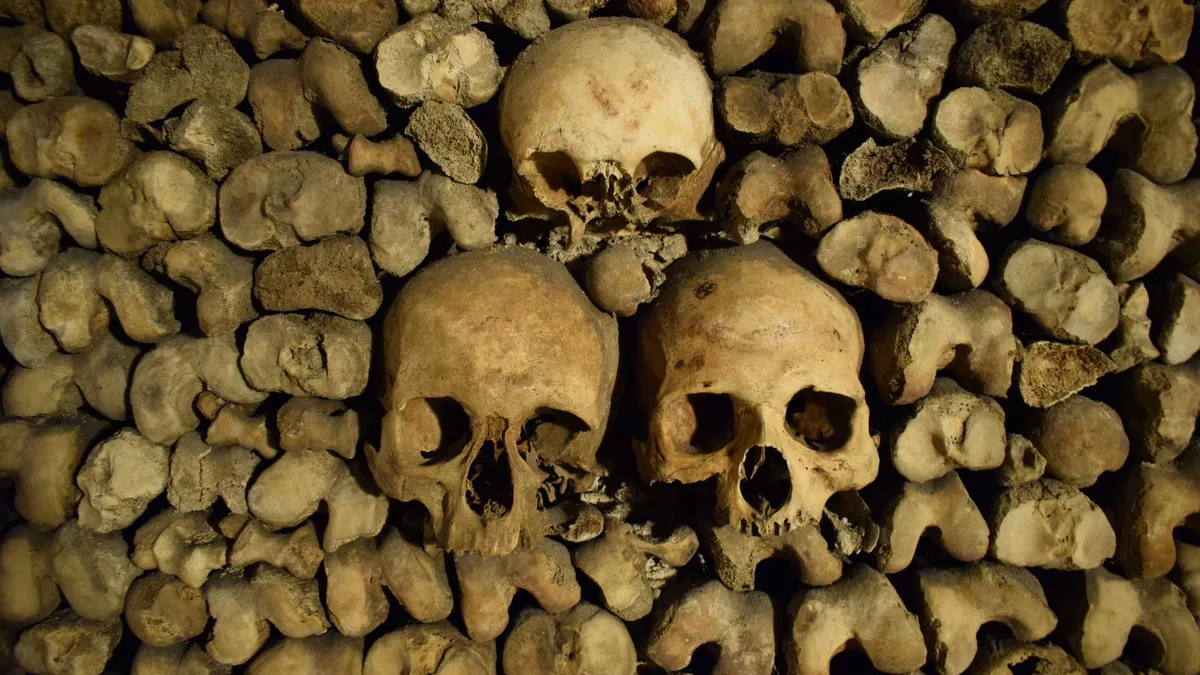
Every year in late October, Paris sprouts plastic pumpkins and synthetic cobwebs. It is charming, and it is a little beside the point: no city in Europe needs props less. Paris owns an ossuary holding six million dead, the site of the largest gallows in France and a square where executions were carried out for six centuries. Everything that follows is true, dated and sourced, and that is exactly why it is frightening.
For a Halloween that does not cheat in Paris: go down into the Catacombs (online booking essential in late October, allow an hour underground), find the plaque of the Montfaucon gallows near place du Colonel-Fabien, cross the square outside the Hôtel de Ville knowing what it used to be, and read up on the Black Death far from the carnival masks. Halloween falls on a Saturday this year: book early.
Six million Parisians beneath your feet
It all starts with a very concrete catastrophe. In 1780, a wall of the Innocents cemetery, saturated by centuries of burials in the heart of Paris, gave way under the pressure of the mass graves: cellars on the rue de la Lingerie filled with corpses. The cemetery was closed in December 1780, then permanently shut down. From 1786, the bones were dug up and moved at night, in convoys of carts accompanied by priests, to former quarries on the Left Bank fitted out to receive them: the Catacombs were born. The exhumation, drawn around 1787, hangs in the musée Carnavalet.
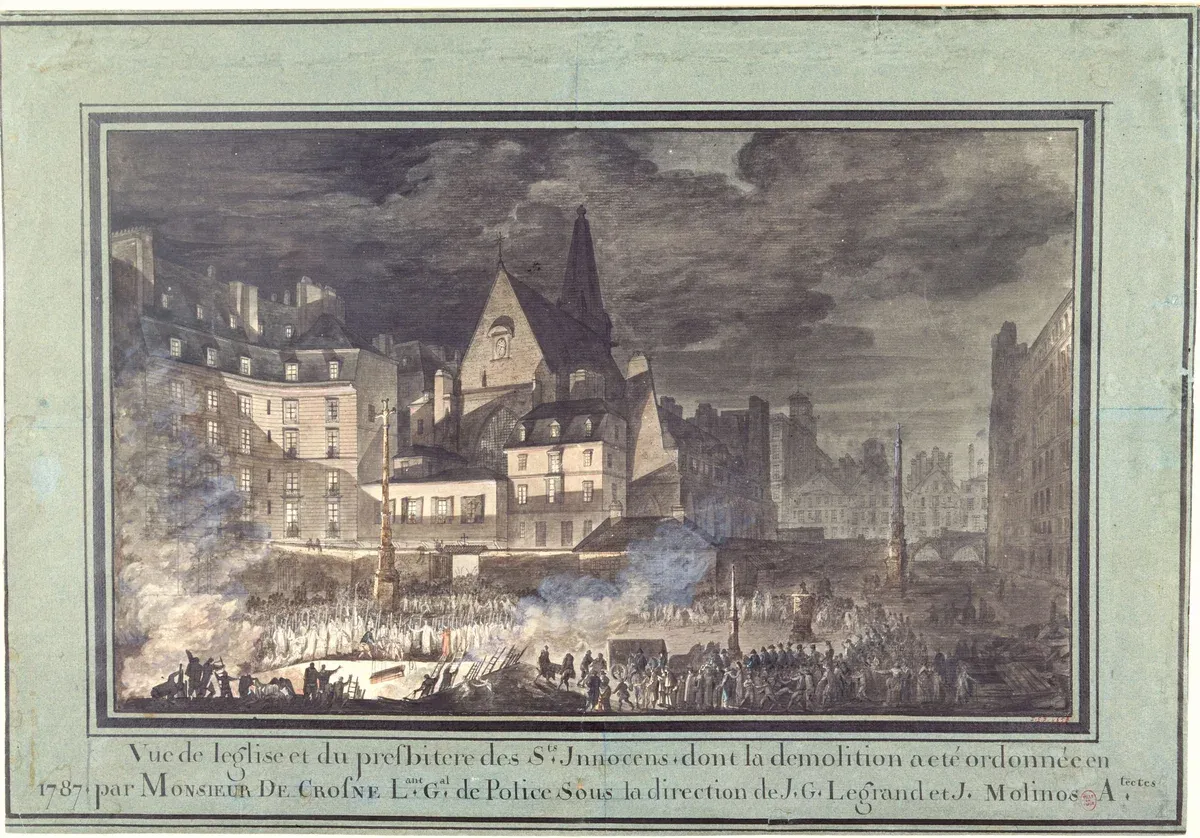
The Innocents around 1787, in a period drawing: the bone transfers were carried out at night, by torchlight.
Today the ossuary of the Catacombs holds the remains of some six million Parisians, twenty metres below the street. It is the definitive Halloween outing, and everyone knows it: late-October slots sell out fast, and online booking is essential. For the full picture of the world below, our article on underground Paris gives the grand tour.
Montfaucon: the gallows that hanged its own architect
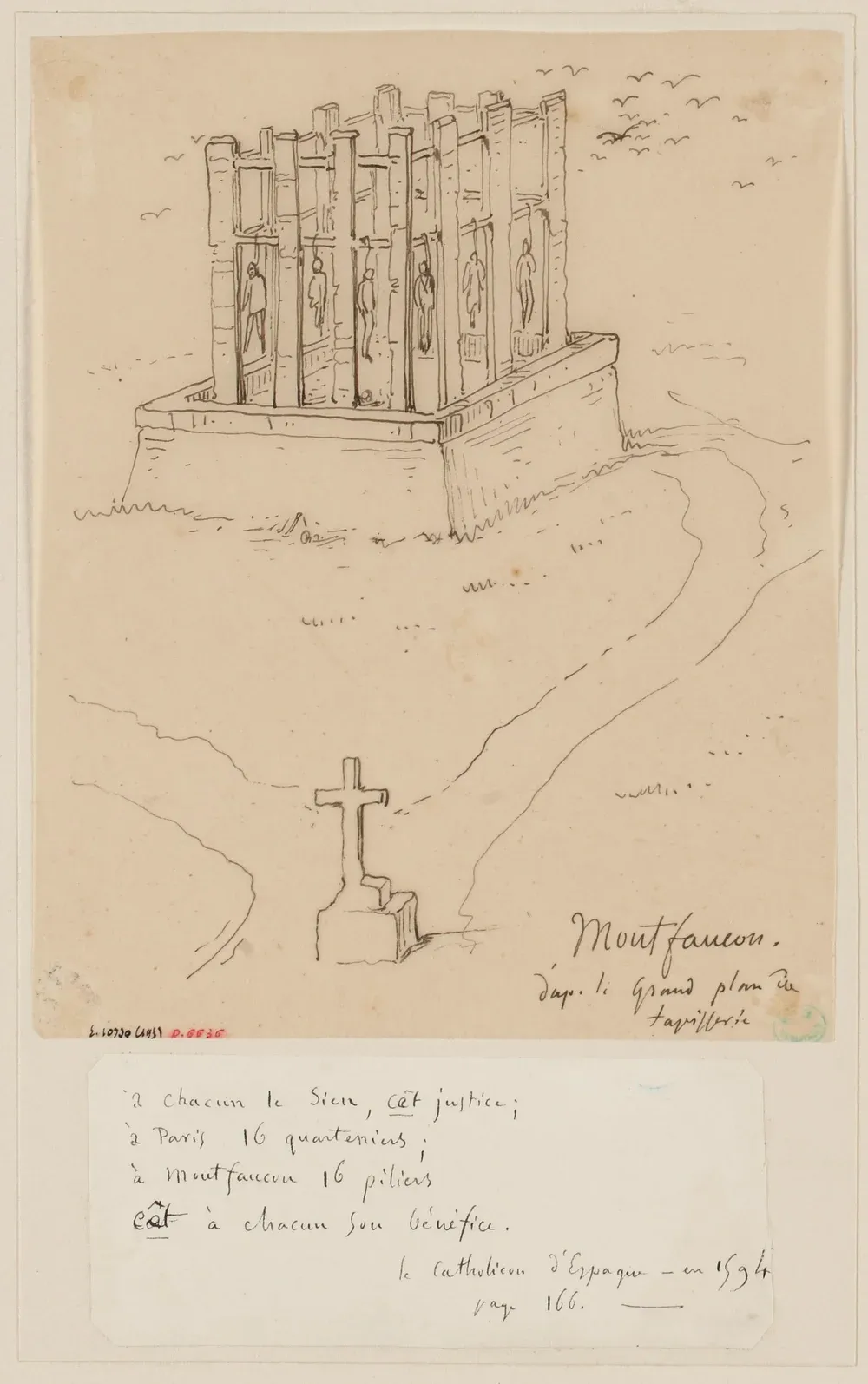
The gallows after a 16th-century plan: sixteen stone pillars, and the bodies left to the winds.
North-east of Paris, on a rise overlooking the road to Meaux, stood the grimmest monument in the kingdom: the Montfaucon gallows, rebuilt in stone in the early 14th century under Philip the Fair. Sixteen pillars linked by crossbeams, where dozens of the condemned could hang at once, their bodies left exposed until they crumbled, as a warning to everyone entering Paris. History has a taste for detail: Enguerrand de Marigny, the man who had the stone structure built, was himself hanged there in 1315 after falling from royal favour. The gallows was only demolished at the Revolution. Today, at the corner of rue de la Grange-aux-Belles and rue des Écluses-Saint-Martin, near place du Colonel-Fabien, a single plaque recalls it: the apartment blocks have covered everything.
The place de Grève, so peaceful in appearance
The finest fright in Paris may be the most discreet: the square outside the Hôtel de Ville, where tourists photograph the façade and the fountains, was for six centuries the place de Grève, the site of the city’s public executions. Gallows, stake, wheel and scaffold followed one another there into the 19th century; we told that story, and what it left in the French language, in our article on the phrase “faire grève”. It is a strange experience to stand on that square on an October evening knowing all this; those who join The Origins of Paris time-travel walk watch it come back to life in its medieval version through the binoculars, taverns and market stalls included, and leave looking at the ground differently.
The Black Death, without the mask
In 1348, the Black Death entered Paris and did damage the chroniclers struggled to count. That is the true terror of the Middle Ages, and it wore no costume: the famous beak-masked plague doctor, star of every Halloween shop, is a 17th-century invention, three hundred years after the Great Plague. It is the very example we use in our deep dive on AI and history to show how badly images of horror travel through time. Shiver, yes; get the century wrong, no.
The evening of 31 October, practically
Halloween 2026 falls on a Saturday, at the very end of the French school holidays. The programme that does not cheat: the Catacombs if you booked in time, the place de Grève and the île de la Cité after dark to walk through the true stories, and for children, the family-calibrated pumpkins of the Jardin d’Acclimatation covered in our October half-term guide. One calendar tip: book the Catacombs now, not the night before.
Halloween questions, answered
Are the Catacombs really scary? They impress more than they frighten: 131 steps down, a constant 14 degrees, an hour’s visit twenty metres underground among the bones of six million Parisians. The official site advises against the visit for claustrophobic visitors and those with heart conditions, and under-14s must be accompanied; for everyone else, it is one of the most striking places in Europe.
Where to celebrate Halloween in Paris with children? The Jardin d’Acclimatation dresses up for the season every autumn, and the true stories in this article tell very well on a walk, at child height, with nothing graphic to see: a plaque, a square, a street name.
Does Paris have haunted places? Paris has better: places whose documented history outdoes any legend. An ossuary born of a cemetery that overflowed into cellars, a gallows that hanged its own builder, an execution square turned city-hall forecourt. The archives are enough.
In short
For Halloween in Paris, leave the ghosts to the costume shops: the city offers six million genuine skeletons in the Catacombs, the site of the Montfaucon gallows, the memory of the place de Grève and the true story of the Black Death. Book the Catacombs early, keep the children on the pumpkin side, and remember the local rule: in Paris, the shiver is historically accurate.