School trip to the Eiffel Tower: how to plan it, and what to do at the foot of the Tower
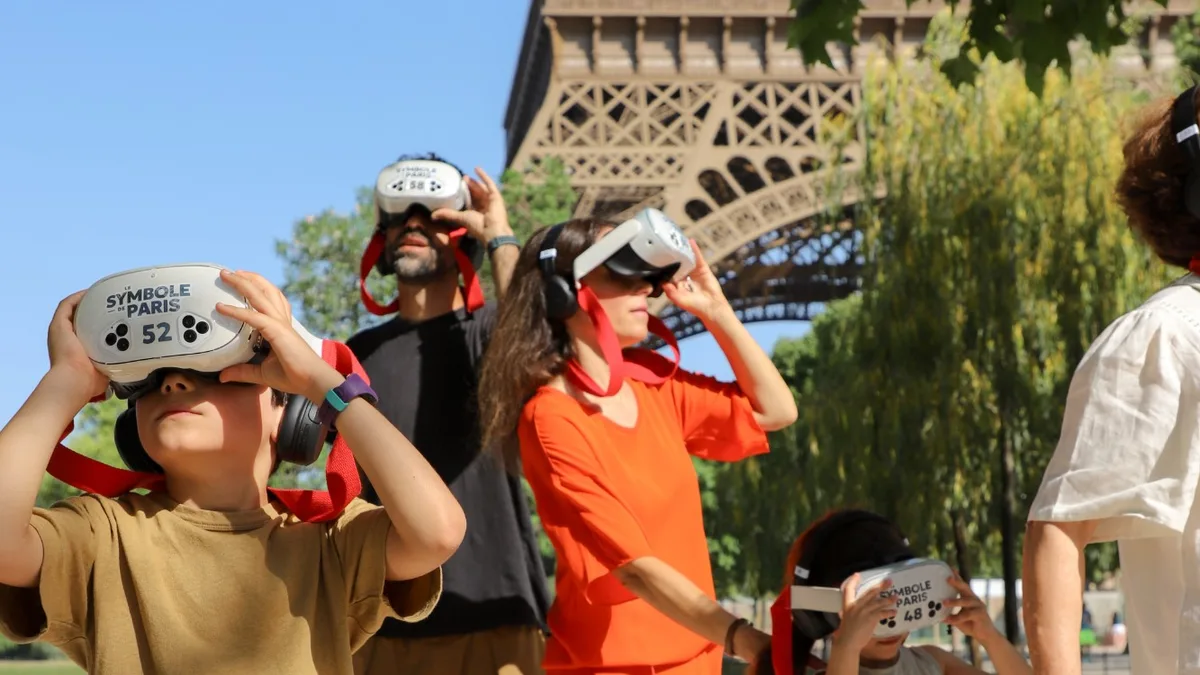
The Eiffel Tower is one of the most requested school trips in Paris, and not one of the easiest to organise. The booking rules for groups changed in autumn 2026, a queue is hard to manage with thirty pupils, and the view from the floors does not, on its own, tell the story of the monument. Here is what to sort out before the day, and how to give the trip a teaching thread.
An Eiffel Tower school trip needs three things prepared in advance. Since 29 September 2026, school groups of more than 35 people, adults included, can no longer buy tickets at the ticket office: they must book online, after opening an account with the Tower. Groups travelling with a tourism professional face a stricter rule, with online booking required from ten people. And the Tower, with the Champ-de-Mars around it, illustrates several classic history topics: the Industrial Revolution, the French Republic and its symbols, the Second World War.
How do you book the Eiffel Tower with a class?
The company that runs the monument, the Société d’exploitation de la tour Eiffel (SETE), changed how it welcomes groups from 29 September 2026. Ticket-office sales are no longer allowed for school groups of more than 35 people, adults included, whether you go up by lift or by the stairs. Several groups from the same school on the same time slot count as a single group, and proof of the group’s origin is requested at purchase. Below 35 people, booking online is still recommended.
To reach the ticket platform, the school first has to request an account. The Tower warns that processing takes time before the account is confirmed, so it is best to apply before you have even fixed the date of the trip. Group prices distinguish children aged 4 to 11 and young people aged 12 to 24; they are listed in the teachers’ section of the official website, together with a price simulator.
Many foreign school groups travel with a tour operator. In that case the rule for tourism professionals applies: any group of more than nine people, guide included, must buy tickets online through the professional platform, and a guide may accompany only one group of up to eight visitors per 30-minute slot. Ask your operator how it has adapted.
On the day, a few rules avoid unpleasant surprises:
- Print the tickets legibly, one ticket per A4 page, with the full, unreduced barcode.
- Allow 15 to 20 minutes for security checks before reaching the foot of the Tower. The time on the ticket is the time the group must present itself at the pillar.
- Start with the highest level: the visit works from the top down, with the first floor and its glass floor last.
- Plan lunch elsewhere: the Tower has no picnic area, and glass bottles, metal cans and cutlery are not allowed inside.
- Check accessibility: the summit and the stairs are not accessible to people with reduced mobility.
How many adults should come?
The rules depend on your own country. For French state primary schools, a circular of 13 June 2023 sets the minimum for a day trip: two adults, at least one of them a teacher, up to 30 pupils, then one more adult for every 15 pupils. Whatever your local rules, a trip in central Paris often justifies one adult more than the minimum.
Which history topics does the Eiffel Tower help to teach?
The Tower is a concrete case study for the Industrial Revolution, because its construction is a lesson in itself. Its 18,038 iron parts were made in Gustave Eiffel’s workshops at Levallois-Perret, accurate to a tenth of a millimetre, then assembled on site with 2.5 million rivets fitted hot. The work took two years, two months and five days.
It also speaks about the French Republic. The Tower was built for the 1889 World’s Fair, which celebrated the centenary of the French Revolution, and Eiffel raised a French flag at the top on 31 March 1889, after climbing its 1,710 steps on foot. The Champ-de-Mars itself hosted the Fête de la Fédération on 14 July 1790, one of the events behind France’s national day. Later, during the Occupation, the symbol of Paris also became a symbol of resistance. For the full story, see why the Eiffel Tower was built.
In France, these topics appear in the history curriculum of the last years of primary school and of lower secondary school: the industrial age, the Republic and the two world wars in CM2 (pupils aged 10 to 11), the European Industrial Revolution and the Third Republic in 4e (13 to 14), defeated and occupied France in 3e (14 to 15).

Gustave Eiffel’s workshops at Levallois-Perret, where the Tower’s parts were designed and made. Timescope reconstruction for The Symbol of Paris.
What can a class do at the foot of the Tower?
Going up gives you the view, but the history of the site is mostly read at ground level. The Champ-de-Mars was a Gallic plain, a parade ground for the École militaire, the setting of the Fête de la Fédération, then of several World’s Fairs before it became the garden we know. We tell that story in the Champ-de-Mars before the Eiffel Tower.
That is what The Symbol of Paris tells: our one-hour guided walk on the Champ-de-Mars. Pupils walk with a guide and, at each stop, raise virtual-reality binoculars to see the landscape in front of them in another era: the land of the Parisii in the 1st century BC, the Fête de la Fédération, Eiffel’s workshops, the construction site, the 1889 World’s Fair and its Galerie des machines, the Roaring Twenties, then the Occupation. No ascent ticket is needed: everything happens at the foot of the Tower.

A Gallic camp on the plain where the Tower stands today, the opening scene of The Symbol of Paris. Timescope reconstruction.
For a school group, in practice:
- Age: from 8 years old.
- Group size: 20 pupils at most per guide, and several guides set off at the same time. The whole class does the visit within the same hour.
- Time slots: 9 am to 8 pm, 7 days a week, Monday and Tuesday included, on booking.
- Languages: English, French or Spanish.
- Meeting point: 12 rue Dupont-des-Loges (Paris 7th), a few minutes’ walk from the Tower. Métro Alma-Marceau (line 9) or RER C Pont de l’Alma.
- Price: €19 per child aged 8 to 15, and a quote for school groups.
All the details, the downloadable booklets and the contact for a quote are on our school trips page.
How should you plan the day?
There is no required order, but this one works well with younger pupils:
- Morning: the ground-level visit. One hour on the Champ-de-Mars to set the story: who wanted this tower, how it was built, why it was nearly taken down.
- Midday: a packed lunch, outside the Tower’s grounds, since it has no picnic area.
- Afternoon: the ascent. Book the slot allowing for 15 to 20 minutes of security checks. Pupils then look at the structure knowing how it was put together.
With a class, allow a good quarter of an hour on foot between the meeting point of the visit and the Tower entrance.
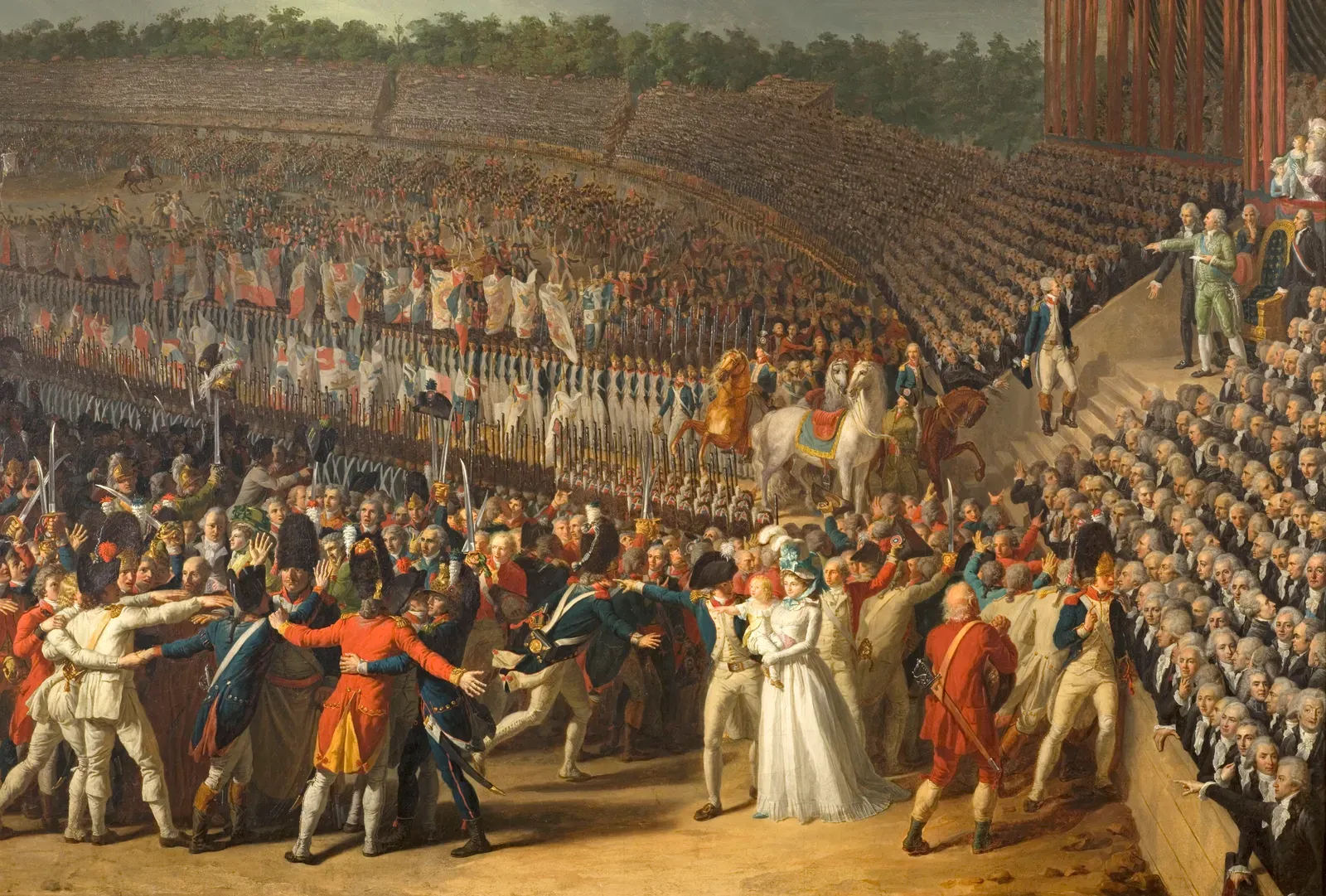
“The Fête de la Fédération, 14 July 1790, on the Champ-de-Mars”, by Charles Thévenin. Musée Carnavalet, CC0. The scene takes place exactly where the trip does.
How can you prepare the trip and follow it up in class?
Several free resources exist, before and after the visit:
- The teaching booklet of The Symbol of Paris, to download from our school trips page: a timeline of the Champ-de-Mars from the Gallic plain to today, with questions for pupils.
- The “Back to the sources” timeline of the experience, online on the history of The Symbol of Paris: every scene is covered, with the sources used to reconstruct it.
- The Tower’s own teaching sheets for primary school, on the teachers’ section of the official website, in French.
Questions we are asked
Do you need an Eiffel Tower ticket for The Symbol of Paris? No. The visit takes place entirely at ground level, on the Champ-de-Mars. It combines well with an ascent but does not require one.
Is the visit available in English? Yes. It runs in English, French and Spanish, which also suits language trips and school exchanges.
Can we come on a Monday or a Tuesday? Yes. Individual visitors are welcome from Wednesday to Sunday, but school groups can come from 9 am to 8 pm, 7 days a week, on booking.
How many pupils can do the visit at once? Each guide leads 20 pupils at most, and several guides set off together. A whole class, or several, does the visit within the same hour.
What happens if it rains? The visit takes place outdoors and runs in most weather. In exceptional conditions sessions can be rescheduled: let us know and we will find a solution.
How do we get a quote? Write to us with the pupils’ age, the group size and two or three possible dates. Contact details are on our school trips page.
In short
- Eiffel Tower booking: online and compulsory since 29 September 2026 for school groups above 35 people, adults included, after opening an account; from ten people for groups with a tourism professional.
- History topics: the Industrial Revolution, the French Republic and its symbols, the Second World War.
- At the foot of the Tower: The Symbol of Paris, one hour on the Champ-de-Mars with virtual-reality binoculars, from age 8, 20 pupils per guide, in English, no ascent ticket needed.
Sources
- La tour Eiffel pour les enseignants, official Eiffel Tower website (SETE): school group booking, prices, visit route, teaching sheets.
- “From 29 September 2026: groups prohibited at the ticket office”, official Eiffel Tower website.
- Circular of 13 June 2023 on school trips, French Ministry of Education, Bulletin officiel no. 26 of 29 June 2023.
- History curriculum, cycles 3 and 4, French Ministry of Education, Bulletin officiel no. 31 of 30 July 2020.
- The history behind The Symbol of Paris, the historical dossier of our experience, validated by our scientific committee.