
The Champ-de-Mars Before the Eiffel Tower: A Century and a Half of Festivals, Balloons and Gunfire
Seen from the Trocadéro, the Champ-de-Mars looks as if it had only ever had one purpose: to give the Eiffel Tower some breathing room. It is the other way round. When Gustave Eiffel sank his four piers in 1887, he was building on the most history-laden ground in Paris, a rectangle of beaten earth where, for more than a century, the capital had come to watch balloons take off, swear oaths, race horses, cheer emperors and, twice already, marvel at a World’s Fair. The Tower did not create the Champ-de-Mars. It inherited a stage.
The Champ-de-Mars was laid out in 1765 as the parade ground of the École militaire, on the former market gardens of the plaine de Grenelle: a rectangle of 916 by 394 metres, ringed by a ditch, where ten thousand soldiers could drill in battle order. Before the Eiffel Tower, it hosted the first hydrogen balloon (27 August 1783), the Fête de la Fédération (14 July 1790), the massacre of 17 July 1791, the Festival of the Supreme Being (1794), the very first industrial exhibition (1798), Paris’s horse races (1834-1857) and the World’s Fairs of 1867 and 1878. The Tower, in 1889, was simply the next chapter.
A parade ground among the cabbages (1751-1780)
In the mid-eighteenth century the place was called the plaine de Grenelle: market gardens, marshes towards the Seine, and a slightly sad reputation. It was here, in 1730, that the actress Adrienne Lecouvreur was buried in haste after the Church refused her a Christian funeral. A path in today’s garden bears her name.
Everything changed with the École militaire. Louis XV had it built from 1751 by Ange-Jacques Gabriel, the architect of the place de la Concorde and the Petit Trianon, to train young noblemen without fortune for a career in arms. An officers’ school needs a drill ground: in 1765 the plain in front of Gabriel’s façade became the Champ-de-Mars, named after the Campus Martius of ancient Rome, where citizen-soldiers trained under the protection of the god of war. The rectangle then measured 916 by 394 metres, ditches excluded. It was ringed by a dry ditch ten metres wide and two metres deep, pierced by five gates, and up to ten thousand men could be drilled on it in battle order. The avenues de La Bourdonnais and de Suffren, laid out in 1770, still mark its edges.
The day Paris watched a balloon take off (27 August 1783)
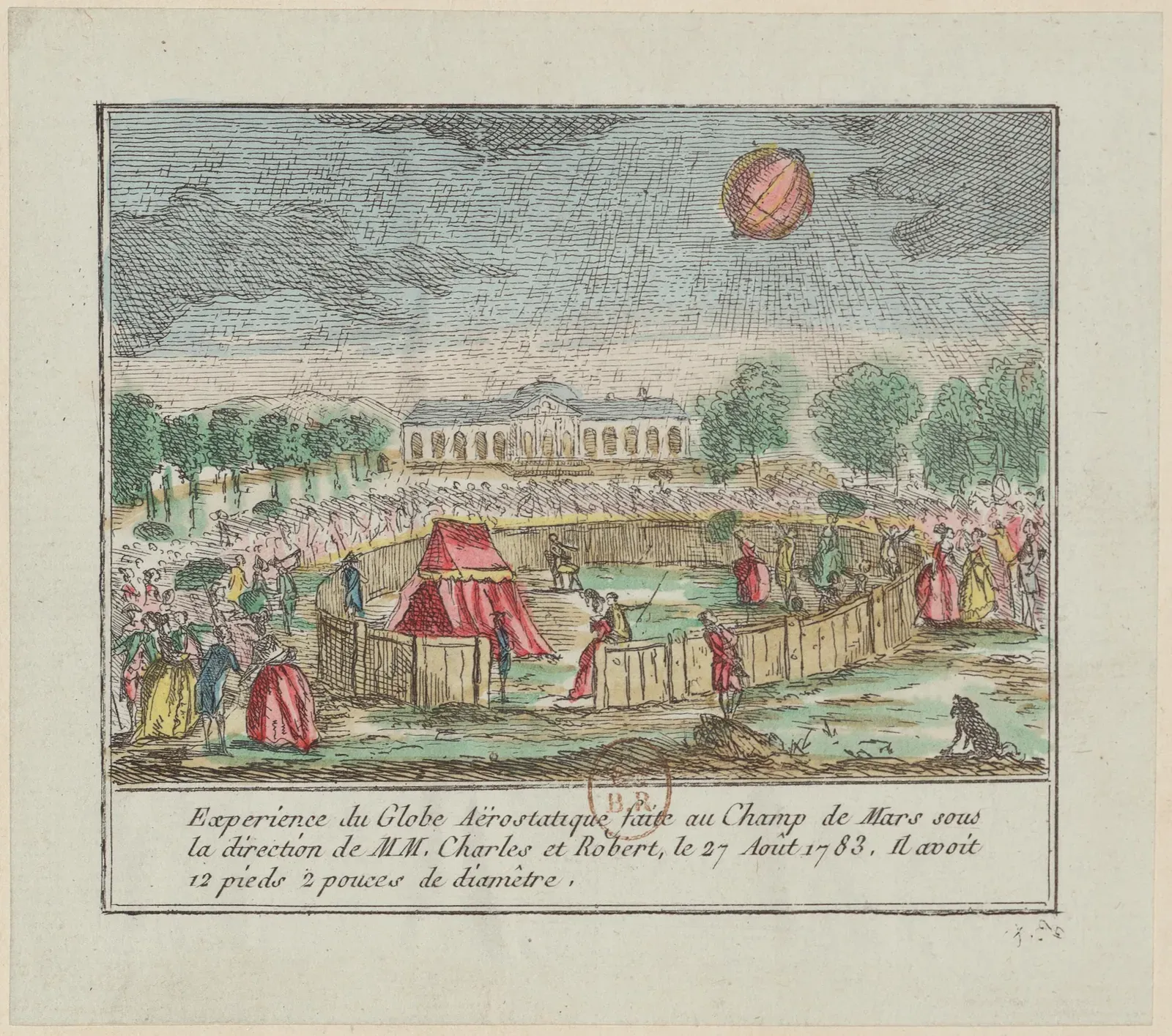
“Experiment of the aerostatic globe made on the Champ de Mars under the direction of MM. Charles and Robert, 27 August 1783.” Period print, Bibliothèque nationale de France, public domain.
The Champ-de-Mars was not yet twenty years old when it entered the history of science. On 27 August 1783 the physicist Jacques Charles and the Robert brothers released the first hydrogen-filled balloon from it, a sphere of rubberised silk about four metres across, “twelve feet two inches” according to the print. The gas had been produced by pouring a quarter of a tonne of sulphuric acid onto half a tonne of iron filings near the place des Victoires, and the balloon had been carried to the Champ-de-Mars by night to escape the crowds. Benjamin Franklin was among the spectators. In the rain, a cannon shot gave the signal: the globe rose, vanished into the clouds and flew north for three quarters of an hour before coming down at Gonesse, twenty kilometres away, where terrified villagers tore it to pieces with pitchforks.
The Champ-de-Mars became the testing ground of the “aeronauts”. On 2 March 1784 Jean-Pierre Blanchard launched from it a balloon fitted with oars and a propeller, a “flying boat” that crossed the Seine before landing at Billancourt. Two centuries later, Parisians still come here to look at the sky, but for the fireworks.
The altar of the Fatherland: the Fête de la Fédération (14 July 1790)
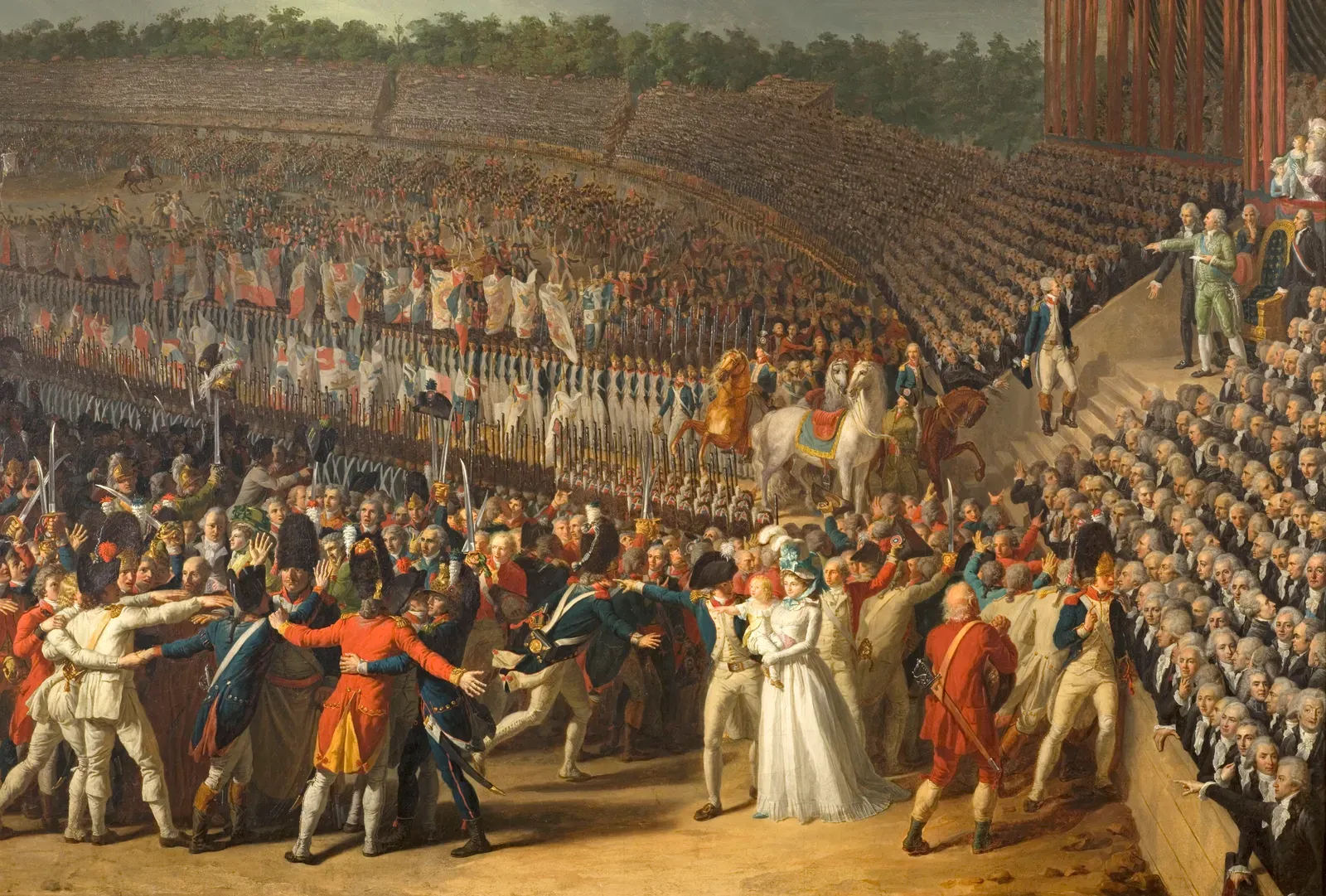
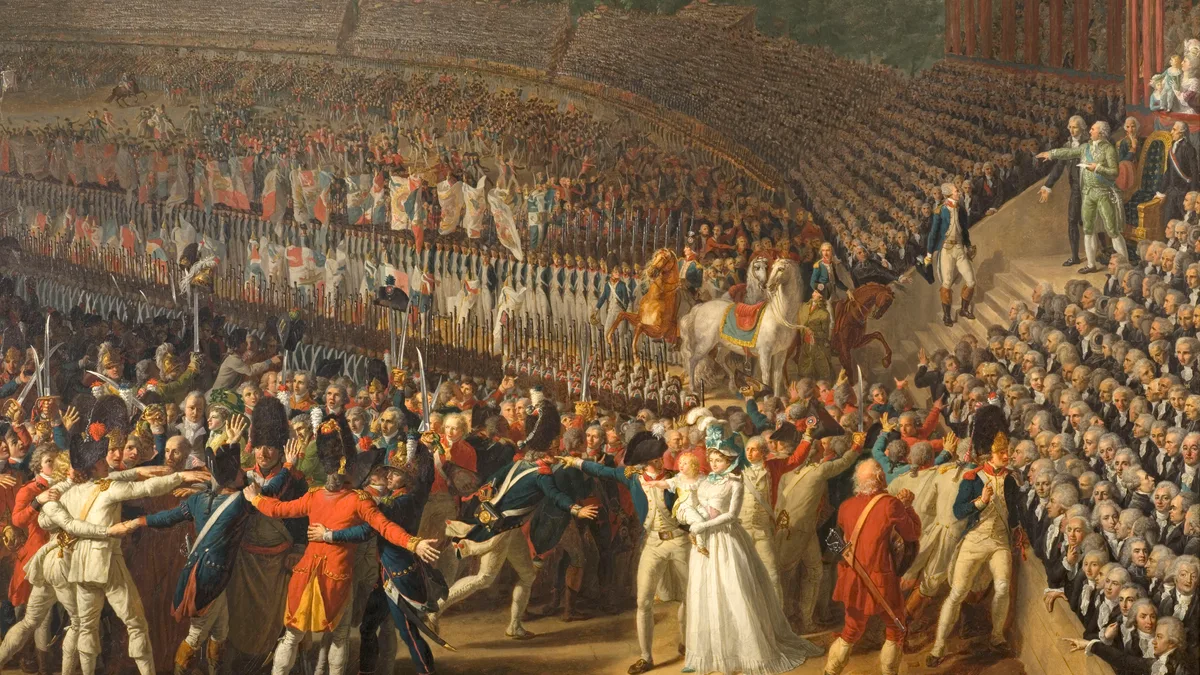
“The Fête de la Fédération, 14 July 1790, on the Champ-de-Mars”, by Charles Thévenin. Musée Carnavalet, CC0. The earthen stands were dug in two weeks by Parisians themselves.
One year after the storming of the Bastille, the Assembly wanted to seal the unity of the kingdom with a national festival. The Champ-de-Mars was chosen as the only space large enough, and it was decided to turn it into a circus for a hundred thousand spectators, with an altar of the Fatherland at its centre. Work began on 1 July 1790, two weeks before the day. The twelve hundred or so labourers were not enough, and then came one of the most astonishing moments of the Revolution: Parisians of every condition arrived in their thousands, spade and wheelbarrow in hand, to dig the embankments. Louis XVI himself came from Saint-Cloud to swing a pickaxe; La Fayette worked in his shirtsleeves. These were the “wheelbarrow days”.
On 14 July, under pouring rain, a hundred thousand fédérés from the eighty-three départements paraded before three hundred thousand spectators. Talleyrand, bishop of Autun, celebrated mass on the altar of the Fatherland, surrounded by three hundred priests. La Fayette, on a white horse, was the first to swear to remain “faithful to the nation, the law and the king”. The king in turn swore to uphold the Constitution. For a few hours, the Champ-de-Mars was the place where France believed it had been reconciled.
The massacre of 17 July 1791
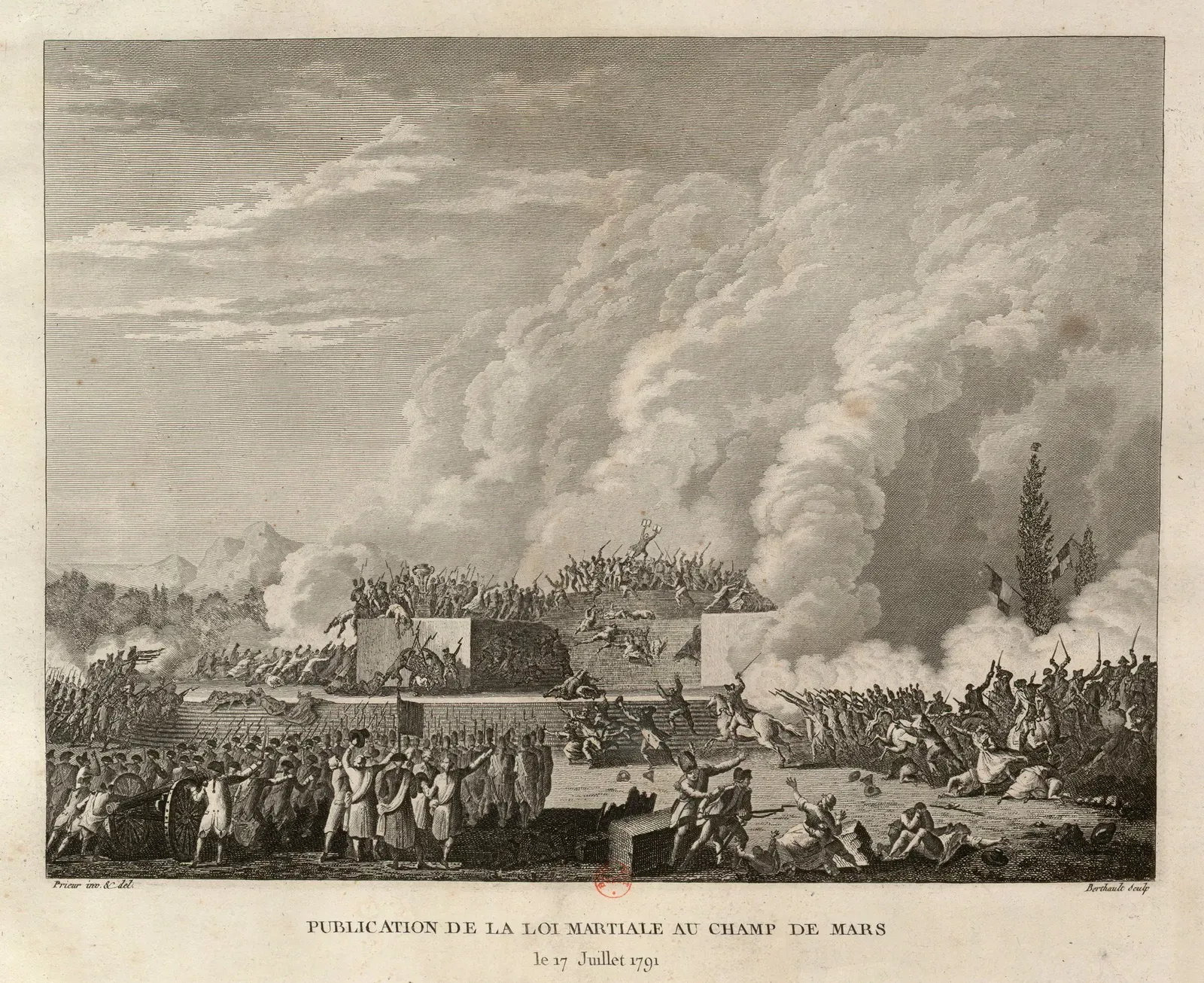
“Proclamation of martial law on the Champ de Mars, 17 July 1791”, engraving by Pierre-Gabriel Berthault after Jean-Louis Prieur. Bibliothèque nationale de France, public domain.
The illusion lasted a year. In June 1791 the king fled and was arrested at Varennes. On 17 July the Cordeliers called on citizens to sign, on the altar of the Fatherland, a petition demanding his deposition. In the morning, two men found hiding under the altar were lynched by the crowd. In the evening, around half past seven, Mayor Bailly arrived with the National Guard under La Fayette’s command and the red flag of martial law. The legal warnings were not given, a shot was fired, nobody ever knew from where, and the Guard opened fire on the petitioners. The toll is still disputed: a dozen dead according to the press loyal to La Fayette, four hundred according to Marat, about fifty according to most historians.
The same ground served both sides. On 12 November 1793 Bailly, held responsible for the shooting, was guillotined on the spot: the scaffold, first set up on the esplanade, was moved into the very ditch that surrounded the field, so that his blood would not mix with that of the victims of 1791. A plaque at 2 avenue de La Bourdonnais marks the place. And on 8 June 1794 Robespierre presided on the Champ-de-Mars over the Festival of the Supreme Being, staged by the painter David around an artificial mountain topped by a tree of Liberty. He fell seven weeks later.
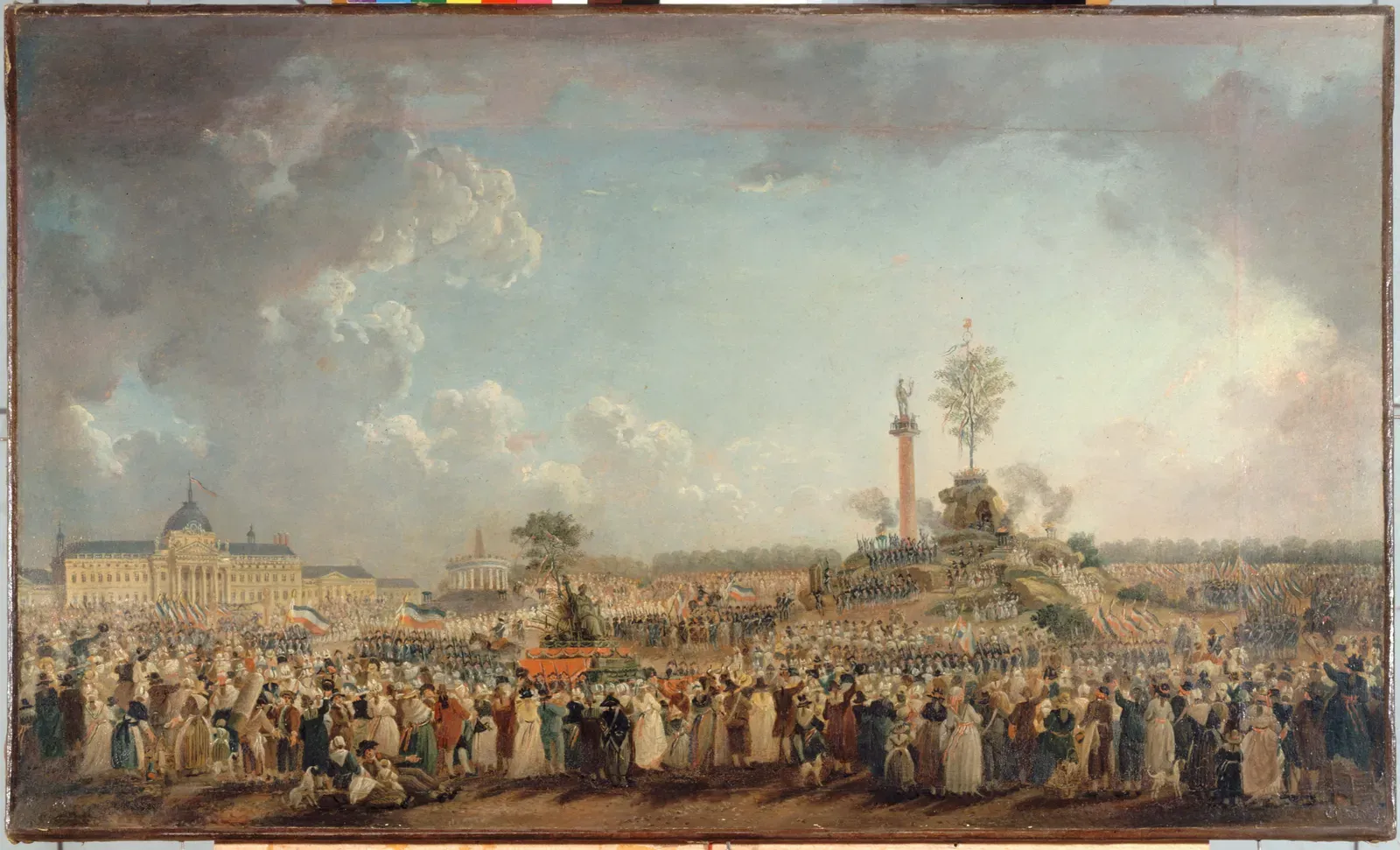
“The Festival of the Supreme Being on the Champ-de-Mars”, by Pierre-Antoine Demachy, 1794. Musée Carnavalet, public domain.
Horses, eagles and the first industrial exhibition (1796-1857)
The Directoire, the Empire and the monarchies that followed kept the same habit: when Paris had to gather, it gathered on the Champ-de-Mars. On 22 September 1796 the first Olympiad of the Republic mixed foot races, horse races and chariot races. From 19 to 21 September 1798 the minister François de Neufchâteau installed a hundred and ten exhibitors under wooden porticoes: this was the first “Public Exhibition of the Products of French Industry”, the direct ancestor of the World’s Fairs, and it was born here. On 3 December 1804, the day after his coronation, Napoleon handed their eagles to the regiments. On 1 June 1815, during the Hundred Days, he reviewed sixty thousand National Guardsmen there: the Champ-de-Mai.
Meanwhile the ground had grown. The pont d’Iéna, completed in 1806, opened it onto the Chaillot hill, and the filling-in of the “little Seine” in 1812 extended it to the exact spot of the future Tower.
Then came the horses. The Société d’encouragement pour l’amélioration des races de chevaux en France, founded in November 1833, held its first meetings on the Champ-de-Mars from 1834, on an earthen track that everyone judged poor. For more than twenty years, Paris’s races were run at the foot of the École militaire, until the Longchamp racecourse opened in the spring of 1857. The Champ-de-Mars had its tragedies too: on 15 June 1837, a crowd crush during the celebrations of the duc d’Orléans’s wedding killed twenty-four people.
1867 and 1878: the first World’s Fairs
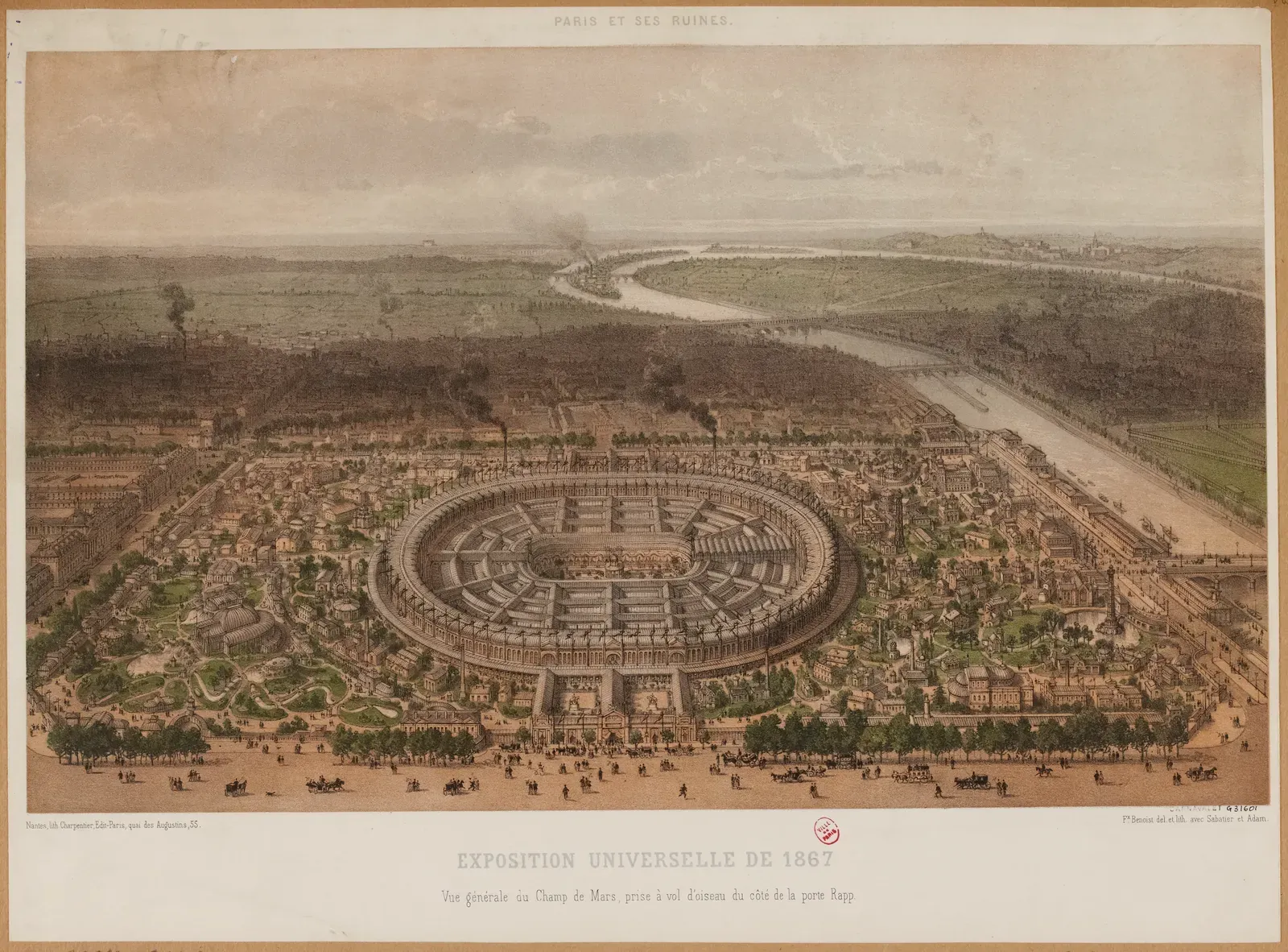
The 1867 World’s Fair seen from the air, lithograph by Félix Benoist. The oval palace covers almost the whole Champ-de-Mars. Musée Carnavalet, CC0.
In 1867 Napoleon III wanted to outdo London. The Champ-de-Mars was levelled with earth from the Trocadéro hill, and an oval palace of 490 by 380 metres was built on it, made of seven concentric galleries, one per field, cut by radial sectors, one per country: a visitor following a gallery toured the world in a single speciality, while one following a radius saw everything from one country. Around it, in a park designed by Alphand, stood about a hundred national pavilions. From 1 April to 31 October, more than fifty thousand exhibitors showed their products, and among the engineers on the site was a thirty-five-year-old named Gustave Eiffel, who calculated the framework of the Galerie des machines. The palace was dismantled when the fair closed.
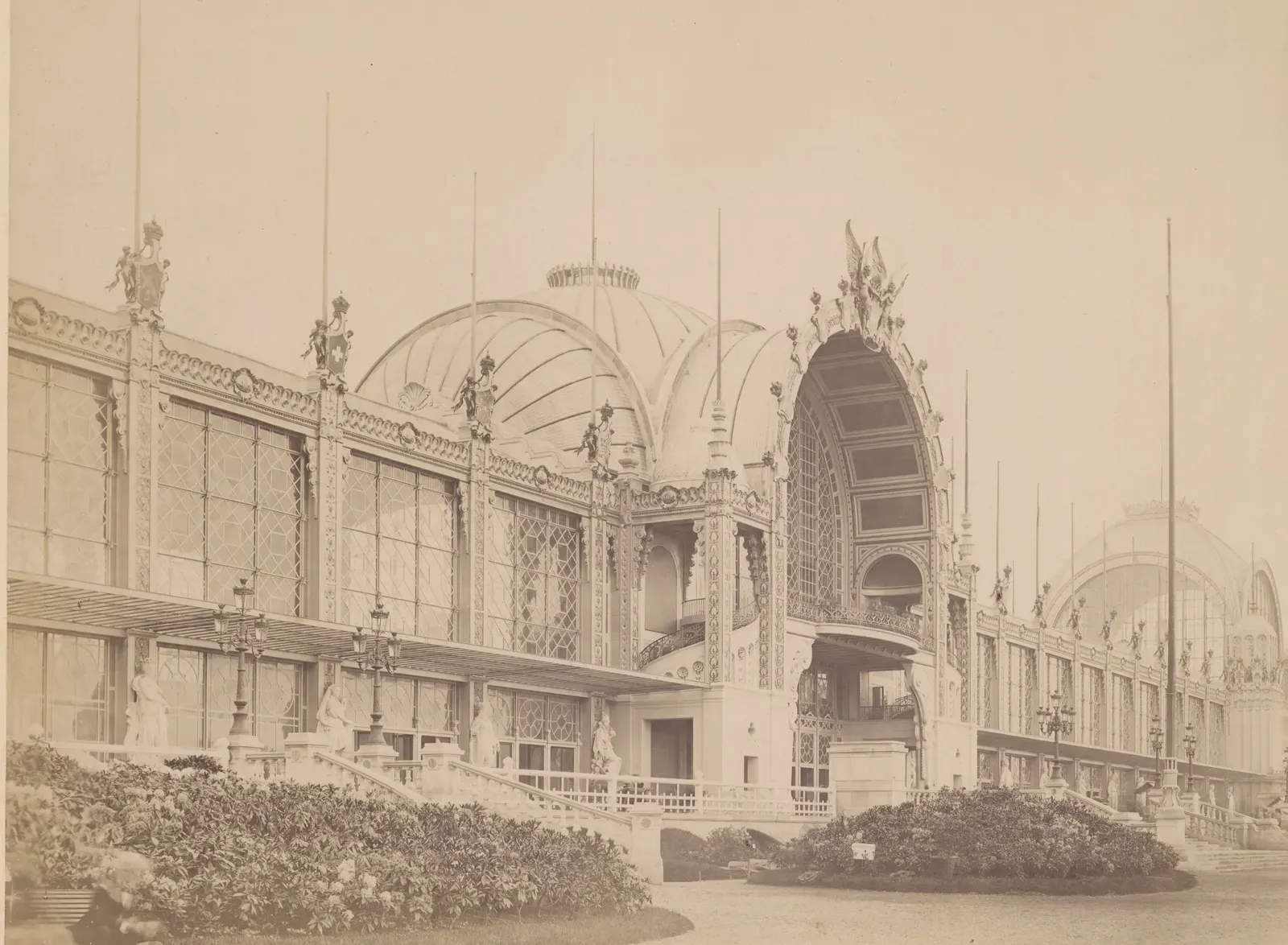
The Palais du Champ-de-Mars of the 1878 fair, photographed by Delmaet and Durandelle. Bibliothèque nationale de France, public domain.
Eleven years later, the Republic wanted to show that France had recovered from the war of 1870. The 1878 fair, from 1 May to 10 November, occupied both banks: on the Champ-de-Mars, a new iron-framed palace by Léopold Hardy; opposite, on the hill, the Palais du Trocadéro by Davioud and Bourdais, with its two 76-metre towers, which would stand until 1937. Visitors discovered Bell’s telephone and Edison’s phonograph, and, on 30 June, the head of the Statue of Liberty, displayed in the Trocadéro garden before leaving for New York. It is this statue, under assembly in Paris, that one of the scenes of The Symbol of Paris brings back to life.
What today’s Champ-de-Mars has kept
When the Tower rose in 1887-1889, the Champ-de-Mars already had a century and a quarter of gatherings behind it, and the 1889 fair simply took over the site of those of 1867 and 1878. Why the Eiffel Tower was built, and what 1889 left on the Champ-de-Mars, is the next chapter, which we tell elsewhere. Two more fairs, in 1900 and 1937, followed before the ground was reduced: in 1907 its edges were sold off to build the apartment blocks of the avenues de La Bourdonnais and de Suffren, and today’s garden, 780 metres by 220, is what remains of Gabriel’s parade ground.
That is precisely the story told by The Symbol of Paris. The walk begins long before the Tower: on today’s Champ-de-Mars, the virtual-reality binoculars first bring up the marshy plain and the camp of the Parisii, then the parade ground and the republican festivals, before Gustave Eiffel’s workshops in Levallois, the building of the Tower, the Statue of Liberty under assembly, the 1889 fair and its Galerie des machines, through to the Roaring Twenties and the Occupation. One hour with a guide, fifteen scenes, from age 8, in French, English and Spanish. You never look at the lawn the same way once you know who swore an oath on it.
Five dates to remember
- 1765: the parade ground. The Champ-de-Mars is created for Gabriel’s École militaire, on the former market gardens of Grenelle.
- 27 August 1783: the first hydrogen balloon. Launched by Charles and the Robert brothers, it flies for three quarters of an hour to Gonesse.
- 14 July 1790: the Fête de la Fédération. Three hundred thousand spectators, a hundred thousand fédérés and an altar of the Fatherland dug by Parisians in two weeks.
- 17 July 1791: the massacre. The National Guard fires on republican petitioners; about fifty dead according to most historians.
- 1867 and 1878: two World’s Fairs precede the 1889 fair and the Tower.
Questions we are asked
Why is it called the Champ-de-Mars? Because it was created in 1765 as the drill ground of the École militaire, and named after the Campus Martius of Rome, where citizen-soldiers trained under the protection of Mars, the god of war.
What was on the Champ-de-Mars before the Eiffel Tower? A military parade ground, then the setting of the great national festivals (the Fête de la Fédération in 1790, the Festival of the Supreme Being in 1794, the distribution of the eagles in 1804), a racecourse from 1834 to 1857 and the site of the World’s Fairs of 1867 and 1878, whose palaces were dismantled.
Has the Champ-de-Mars always been this size? No. It measured 916 by 394 metres in 1765, grew towards the Seine in 1812, then shrank in 1907 when its edges were built over. Today’s garden is 780 metres by 220.
In short
The Champ-de-Mars was a hundred and twenty-four years old when the Eiffel Tower sprang up on it. Created in 1765 for the drills of the École militaire, it saw the first hydrogen balloon leave in 1783, the Fête de la Fédération in 1790, the massacre of 1791, the festivals of the Revolution and the Empire, horse races from 1834 to 1857 and two World’s Fairs, in 1867 and 1878, before the one of 1889. The Tower did not invent the place: it found the stage already set.
Sources and practical links
- Champ-de-Mars (Paris), Wikipédia, drawing on Hurtaut, Dictionnaire historique de la ville de Paris (1779), and Julien de Gaulle, Nouvelle histoire de Paris (1839).
- Le Champ de Mars, 1751-1889, digitised on the Internet Archive.
- Fête de la Fédération and Fusillade du Champ-de-Mars, Wikipédia, drawing on Albert Mathiez, Le Club des Cordeliers pendant la crise de Varennes et le massacre du Champ de Mars (1910).
- Jacques Charles, Wikipedia, for the flight of 27 August 1783.
- Exposition des produits de l’industrie française, Wikipédia, drawing on the Archives nationales.
- Exposition Universelle (1867) and Exposition Universelle (1878), Wikipedia, with the Commission impériale’s Rapport sur l’Exposition universelle de 1867 (1869).
- L’hippodrome de Longchamp, French Ministry of Culture, and the Guide officiel du galop, for the Champ-de-Mars races (1834-1857).
- Why was the Eiffel Tower built?, the next chapter of this story on our blog.
- The Symbol of Paris, opening times and booking.
- Images: Charles Thévenin, “La fête de la Fédération”, musée Carnavalet, CC0; “Expérience du globe aérostatique”, 1783 print, BnF, public domain; Berthault after Prieur, “Publication de la loi martiale”, BnF, public domain; Pierre-Antoine Demachy, “La fête de l’Être suprême”, musée Carnavalet, public domain; Félix Benoist, “Exposition universelle de 1867, vue générale”, musée Carnavalet, CC0; Delmaet and Durandelle, “Palais du Champ-de-Mars, 1878”, BnF, public domain; all via Wikimedia Commons.