
Why Was the Eiffel Tower Built?
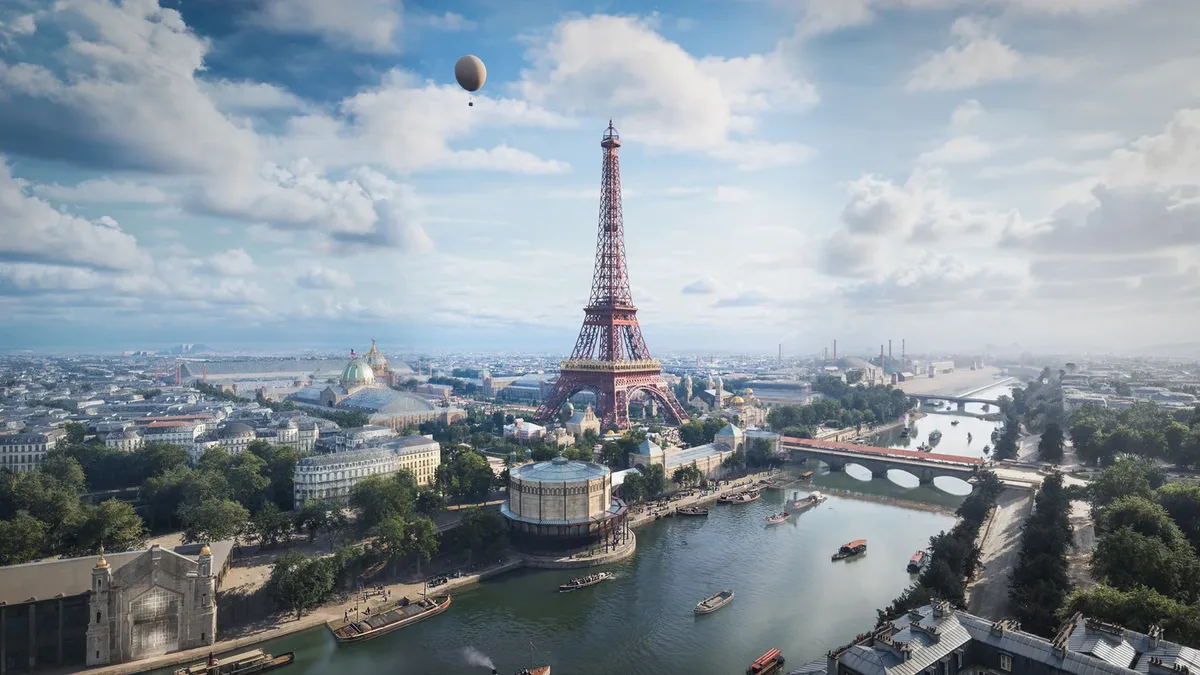
On 31 March 1889, the lifts were not yet running. So Gustave Eiffel climbed the 1,710 steps of his tower on foot, raised a French flag more than 300 metres above Paris, and had a 21-gun salute fired. The tallest monument in the world was finished. One question remained, and all of Paris had been asking it for two years: what on earth was it for?
The Eiffel Tower was built for the 1889 Exposition Universelle, the World’s Fair held in Paris to celebrate the centenary of the French Revolution. France wanted a show of industrial power: an iron tower 300 metres high, the tallest structure ever raised. Planned to stand for twenty years, it was never meant to be permanent; wireless telegraphy saved it from demolition. Here is the full story.
A thousand-foot tower to impress the world
In the 1880s, the French Republic was preparing the 1889 World’s Fair and looking for a gesture worthy of the Revolution’s centenary. The idea of a thousand-foot tower, about 300 metres, a height never reached, was in the air. Two visions clashed: that of the engineer Gustave Eiffel, whose team (the engineers Maurice Koechlin and Émile Nouguier, the architect Stephen Sauvestre) had been sketching an openwork iron tower since 1884, and that of the architect Jules Bourdais, admired author of the Trocadéro palace, who championed a monumental stone “Sun Column” topped with a giant lighthouse. Tradition against modernity, stone against metal: when the official competition was launched in May 1886, it drew 107 entries. Eiffel’s won.
”A dizzyingly ridiculous tower”
Paris did not say thank you straight away. On 14 February 1887, the newspaper Le Temps published the “Protest against the Tower of Monsieur Eiffel”, signed by some fifty giants of arts and letters: Charles Gounod, Guy de Maupassant, Alexandre Dumas the younger, and Charles Garnier, the architect of the Opéra. They denounced “this dizzyingly ridiculous tower”, which they compared to a “gigantic factory chimney”. Legend has it that Maupassant later made a habit of lunching at the tower’s restaurant, the only place in Paris from which you cannot see it. A delicious detail: when the protest appeared, construction had already been under way for three weeks, the first digging having started on 26 January 1887.
A jigsaw of 18,038 pieces
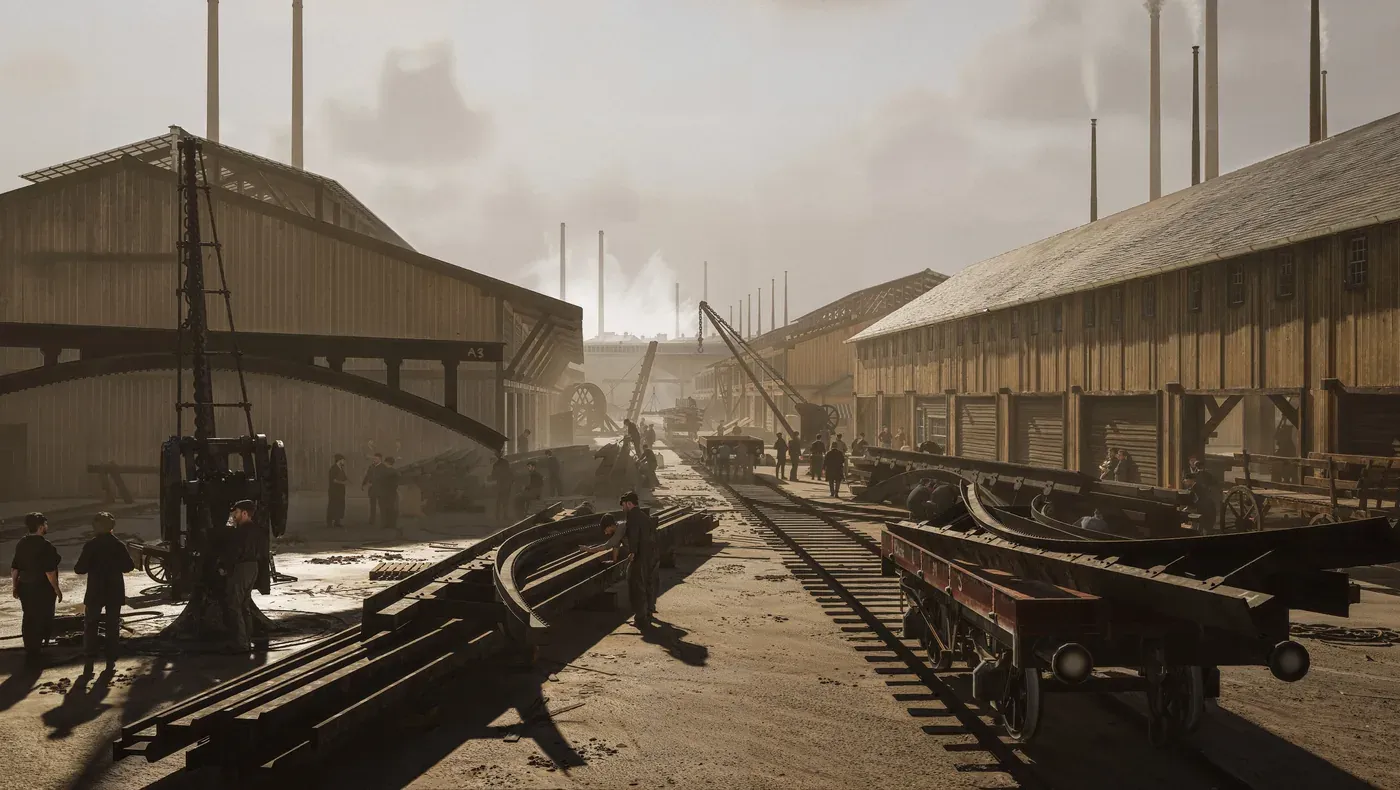
The Eiffel workshops in Levallois-Perret, reconstructed by Timescope for The Symbol of Paris: this is where the tower was first built, piece by piece.
The real feat was not building high, but building fast and true. The tower’s 18,038 metal pieces were machined in the Eiffel workshops in Levallois-Perret to a tenth of a millimetre: no adjustments on site, everything slotted together. On the Seine side, workers sank the foundations from inside compressed-air caissons, working below the water level. Assembly swallowed 2.5 million rivets driven in hot, their grip tightening as they cooled, while creeper cranes climbed with the structure, sliding on the rails of the future lifts. The result: fewer than 300 workers on site, and a 300-metre monument completed in 2 years, 2 months and 5 days.
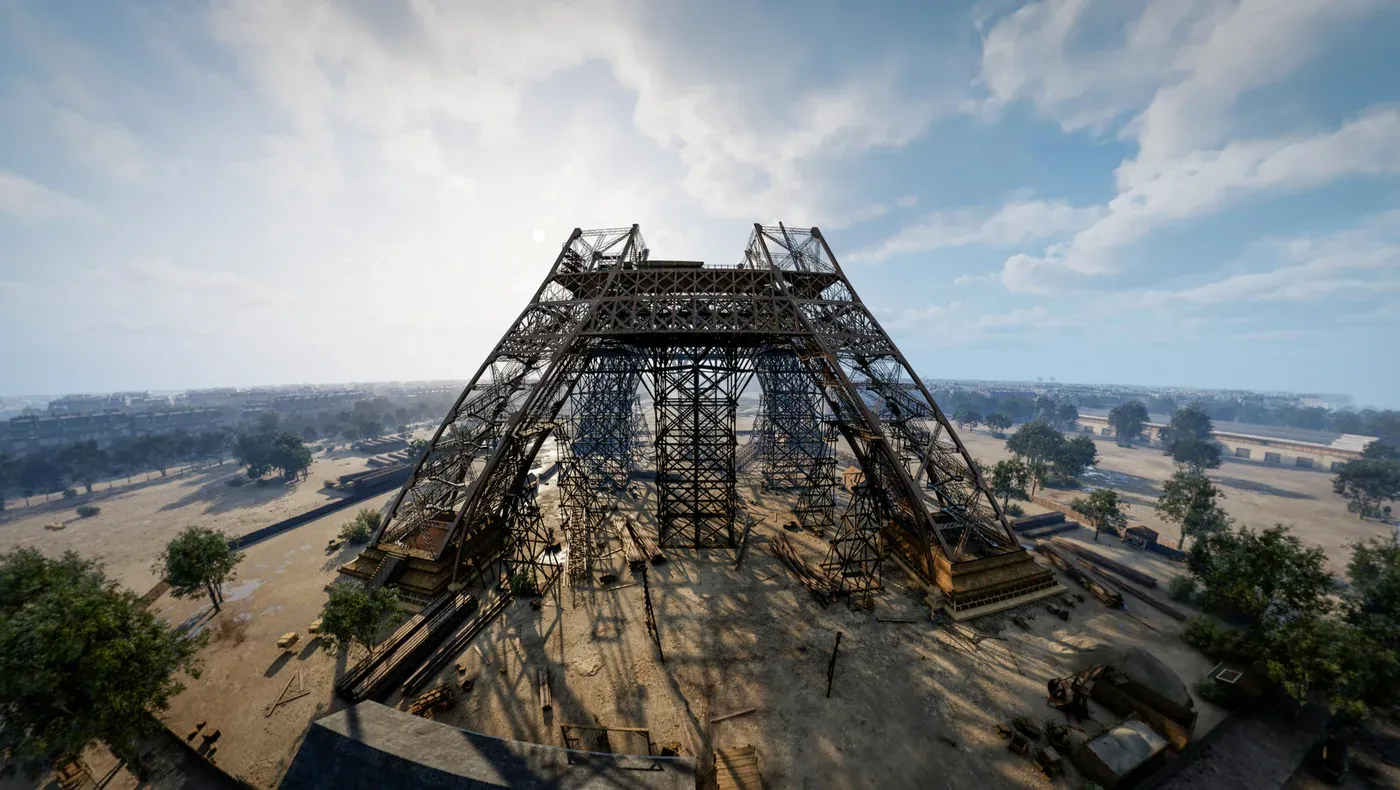
The construction site from the sky, a Timescope reconstruction: the four piers rise above the Champ-de-Mars.
The summer of 1889: the star of the Fair
The Exposition Universelle opened on 6 May 1889 and spread across the whole Champ-de-Mars, with its palaces, its pavilions from around the world and its Galerie des Machines, an iron-and-glass nave that was itself a world record. But the tower eclipsed everything: nearly two million visitors climbed it during the six months of the Fair. The critics fell silent, and the “factory chimney” became the attraction of the planet. It would remain the tallest structure in the world for more than forty years, until New York’s Chrysler Building in 1930.
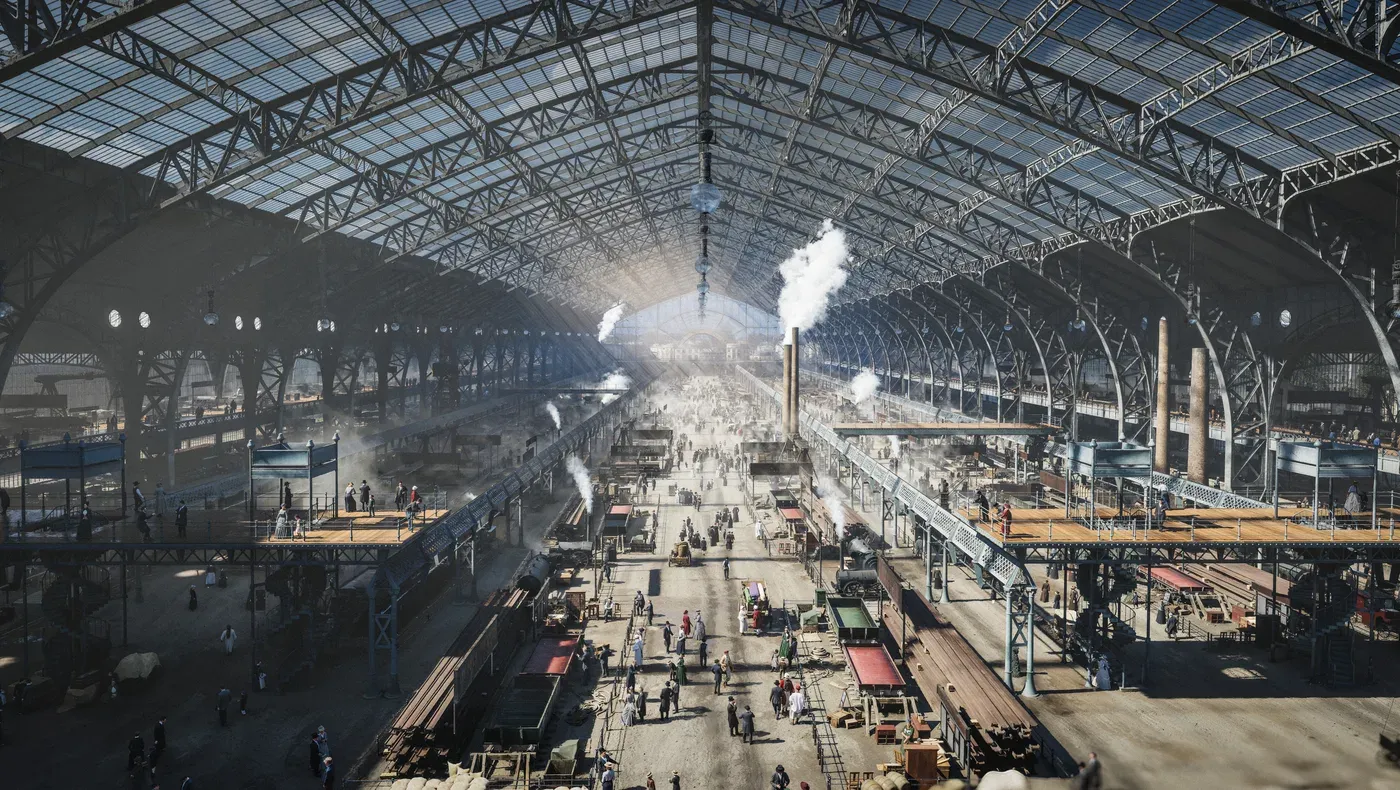
The other giant of 1889: the Galerie des Machines, reconstructed by Timescope. Demolished in 1910, it was not as lucky as the tower.
It was meant to be demolished
It is always forgotten: the Eiffel Tower was temporary. Its concession, granted to Gustave Eiffel for twenty years, expired in 1909, and demolition was the planned outcome. Eiffel spent years proving that his tower was useful: he installed laboratories, encouraged scientific experiments, and bet on an emerging technology, wireless telegraphy. As early as 1898, a first radio link connected the tower to the Panthéon, 4 kilometres away; in 1903, with his backing, captain Gustave Ferrié set up a military station there, and by 1913 the tower’s signals carried 6,000 kilometres, reaching ships far out at sea. Now a strategic antenna for national defence, the tower had its concession renewed for seventy years on 1 January 1910. The “ridiculous” had become indispensable.
What 1889 left on the Champ-de-Mars
Of the 1889 World’s Fair, almost nothing remains above ground: the Galerie des Machines was demolished in 1910, the palaces are gone, and only the iron giant still holds its Champ-de-Mars. That vanished world is exactly what we bring back with The Symbol of Paris: at the foot of the real tower, our virtual-reality binoculars reopen the 1889 Fair, its palaces, its crowds in hats, and follow Gustave Eiffel into his Levallois workshops, based on reconstructions validated by our scientific committee. And to plan your visit to the neighbourhood, our guide to the area around the Eiffel Tower covers the rest.
In short
The Eiffel Tower was built for the 1889 World’s Fair, the showcase of the French Revolution’s centenary and of France’s industrial power. Sketched from 1884 by Eiffel’s team, chosen from 107 entries, loathed by the artists then adored by two million visitors, it was due to disappear in 1909; radio made it permanent. In Paris, the temporary has now lasted more than 135 years.
Sources
- “History of the Eiffel Tower”, official Eiffel Tower website (SETE).
- “Quand la tour Eiffel était un objet de discorde”, official Eiffel Tower website (in French).
- “Protestation des artistes contre la tour de M. Eiffel”, Le Temps, 14 February 1887, full text on Wikisource (in French).
- The History behind The Symbol of Paris, the historical dossier of our experience, sourced and validated by our scientific committee.