
Where Was Gallic Lutetia? The Wall Found Under the Hôtel-Dieu Reopens the Origins of Paris
The news broke on 23 September 2026, and Le Parisien gave it a headline we would not have dared: “This is the origin of Paris.” Beneath the courtyards of the Hôtel-Dieu hospital, on the île de la Cité, archaeologists have uncovered a stone-and-timber wall some twenty metres long, built in the manner of Gallic fortifications and scarred by a violent fire. If the hypothesis they favour is confirmed, it is the rampart of the Lutetia of the Parisii, the town Caesar describes and nobody had ever seen. Here is what was found, why it matters, and what remains to be proven.
What the discovery says, as of 24 September 2026: under the Hôtel-Dieu, a Gallic wall preserved over about 20 metres, in stone and horizontal timbers, carbon-dated between 200 and 10 BCE, backed by a platform of sand and gravel 2 metres thick, burnt, with a Gallic spearhead at its foot. Archaeologists most likely see in it a section of the rampart of the Parisii’s oppidum, set on fire as the Roman legions approached in 52 BCE. It would be the first material proof that Gallic Lutetia stood on the île de la Cité, and not at Nanterre. A further excavation still has to confirm it.
A twenty-year-old debate: île de la Cité or Nanterre?
It all starts with Caesar. In 53 BCE he moves the assembly of the Gauls “to Lutetia, among the Parisii”; the following year his lieutenant Labienus marches on the town, “the oppidum of the Parisii, set on an island in the river Seine”, and the Gauls, rather than hand it over, “order Lutetia burned and its bridges cut.” An island, bridges, a fire: for centuries, readers of the Gallic War saw the île de la Cité in those lines, and the history of Paris began there.
The problem was that the island’s ground, reworked without pause for two thousand years, had almost never yielded a Gallic find. And in the 1990s, then in 2003, rescue excavations at Nanterre, in a bend of the Seine, revealed a large Gallic settlement of the late Iron Age. Large enough for Inrap archaeologists to ask the question: what if Nanterre had been the capital of the Parisii? In that reading, the île de la Cité only mattered once Rome arrived. Ever since, two Lutetias have been competing for the origin of Paris, and one stone was missing to settle it.
What the archaeologists found under the Hôtel-Dieu
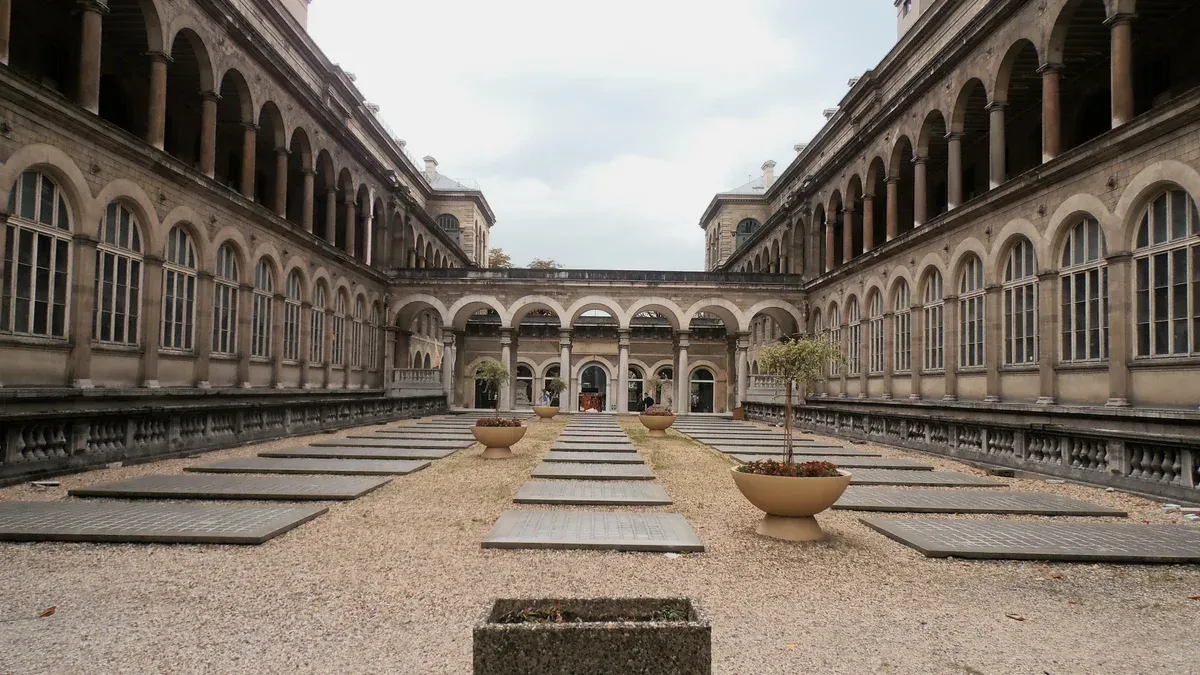
The courtyards of the Hôtel-Dieu, excavated since February 2026 ahead of the hospital’s restructuring. Photo Jeanne Menjoulet, CC BY 2.0.
Since February 2026, ahead of the hospital’s restructuring, a team from the City of Paris archaeology service (DHAAP), led by David Couturier, has been excavating the basements of the Hôtel-Dieu’s courtyards with the support of Inrap, under the supervision of the regional heritage authority (DRAC Île-de-France). In the summer, the wall appeared: large blocks and a system of crossed beams, an architecture that, according to Dorothée Chaoui-Derieux, heritage curator at the regional archaeology service, very quickly suggested a construction of Gallic tradition, typical of late Iron Age oppida.
The rest of the case was built piece by piece. The timber was carbon-dated between 200 and 10 BCE. Behind the wall, an artificial platform of sand and gravel two metres thick marks a fortification rather than a mere building. The facing bears traces of combustion, the blocks and timbers are charred, and nearby the team found carbonised seeds, the remains of a burnt wooden building and a Gallic spearhead. A rampart, a fire, a weapon: hard not to think of 52 BCE. In mid-September, the regional archaeological research commission declared the find of exceptional importance, and the Minister of Culture spoke of one of the most important remains ever uncovered for understanding Gallic Lutetia.
What is proven, and what is still a hypothesis
This is where we insist on precision, because it is our trade. What is established: a wall of Gallic tradition, dated to the late Iron Age, fortified and burnt, on the île de la Cité. What is a hypothesis, favoured but not yet demonstrated: that this wall is the rampart of the oppidum Caesar describes, and that the fire is that of 52 BCE. The carbon-14 range spans two centuries, and it is the combination of clues, not a date, that points to Labienus’s year. The official statement says so in the words of scientific caution, and the DRAC has prescribed a further excavation.
It is exactly the kind of gap we learn to respect in our reconstructions: between knowing that a thing existed and knowing precisely what it was lies the archaeologists’ work, and it is not finished. We wrote about this with the vanished rooms one declines to reconstruct for lack of sources: Gallic Lutetia was the perfect example. It may just have changed category.
What it changes for the origins of Paris
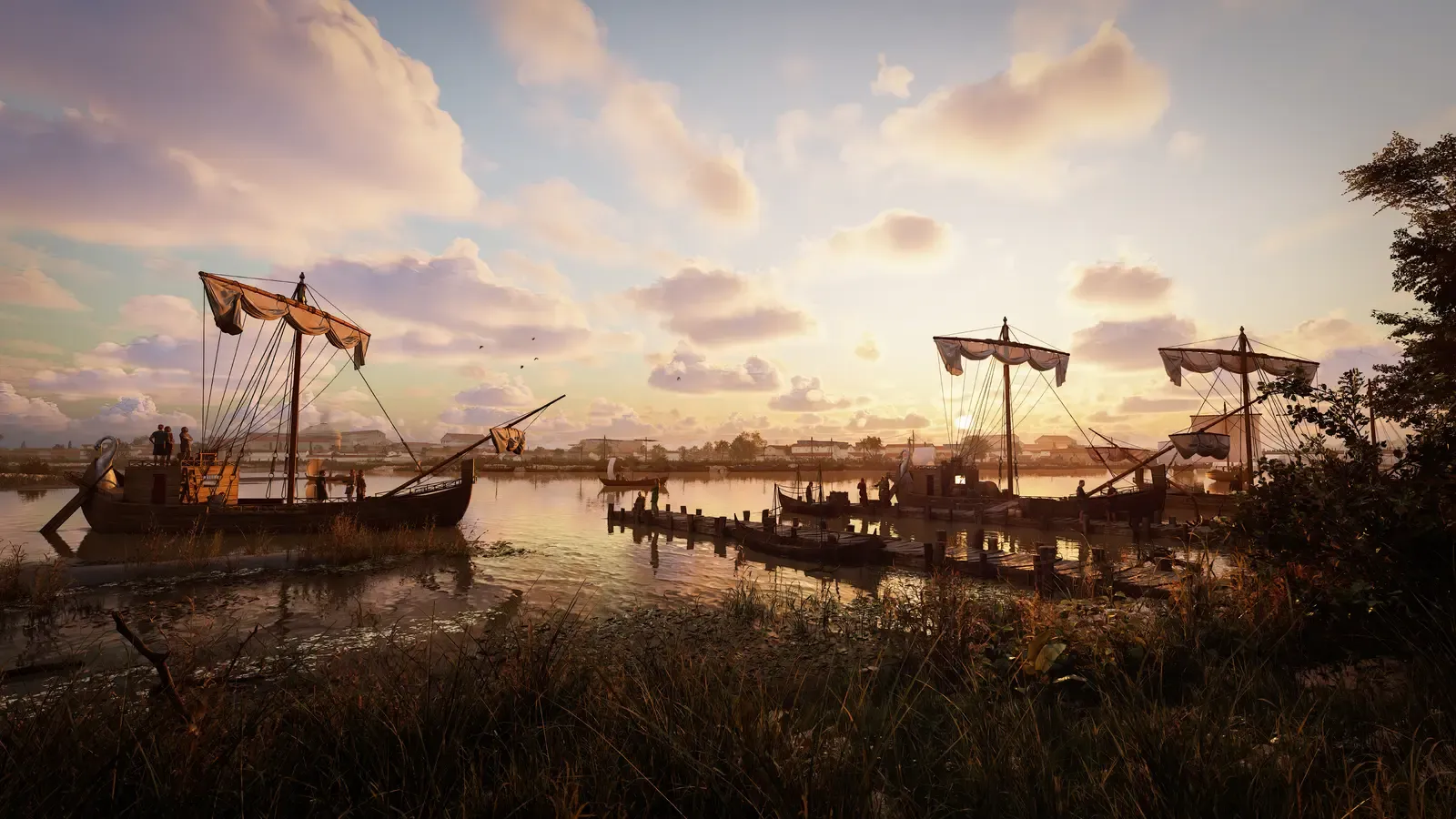
Gallo-Roman Lutetia, as The Origins of Paris brings it back on the banks of the Seine.
If the further excavation confirms the hypothesis, Paris regains a continuity the textbooks asserted without being able to prove: the Gallic oppidum, Roman Lutetia, the medieval Cité and today’s city, in the same place, on the same island. Nanterre would remain a major settlement of the Parisii, but the origin of the capital, in the literal sense, would be right where you walk when you step out of Notre-Dame. And for the first time, this Gallic Lutetia would have an object to show: the statement already announces a cast and a partial reconstruction of the wall, using original stones, for public display, along with digital documentation by photogrammetry.
For us, it is good news. In The Origins of Paris, the journey begins on the riverbanks, upstream of the île de la Cité: from that vantage point, a Gallic rampart on the island would not have been visible anyway. What our visitors watch rise again are the Parisii in their boats, on the river that made their power, and that is precisely what the discovery supports: a people of the Seine, settled on its islands and its banks, at the very spot where Paris was to be born.
Where to see the origins of Paris today
- The archaeological crypt of the île de la Cité, beneath the parvis of Notre-Dame, where the Late Roman rampart, the ancient quays and the foundations of the Roman town surface, two hundred metres from the discovery. Our article on underground Paris takes you through it.
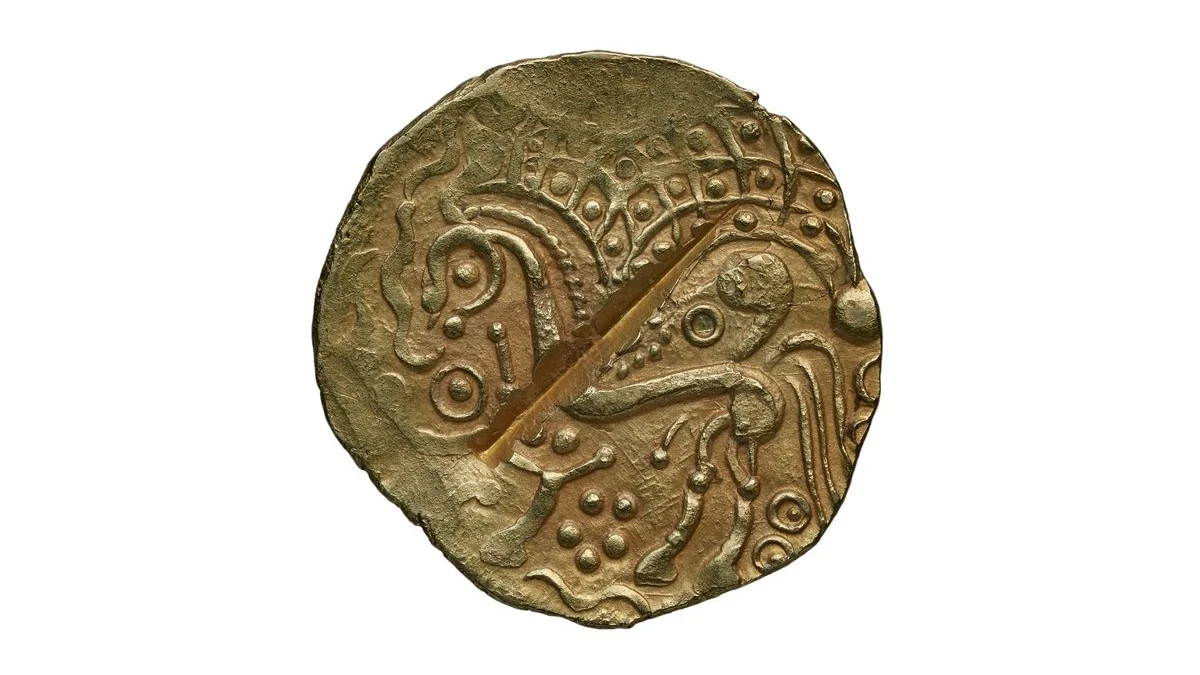
- The gold coins of the Parisii, like the horse stater on the cover of this article, kept at the Bibliothèque nationale de France: the art of the people who would give the city its name.
- The banks of the Seine, facing the island, where The Origins of Paris brings Lutetia back through our virtual-reality binoculars, exactly where it stood.
The questions we get asked
Where was Lutetia? Roman Lutetia is well known: on the Left Bank, around the montagne Sainte-Geneviève, with its baths, forum and arena, and a district on the île de la Cité. The Gallic Lutetia of the Parisii had been untraceable until now; the Hôtel-Dieu discovery strongly suggests it stood on the island, as Caesar wrote.
Who were the Parisii? A Gallic people settled in today’s Île-de-France, wealthy enough to strike superb gold coins, who joined Vercingetorix in 52 BCE. They gave the city its name: Lutetia became Paris in the Late Roman period.
Can you see the wall? Not yet: the excavation continues inside a hospital site, and the remains, weakened by the fire, will be dismantled. A cast and a partial reconstruction with original stones are planned for museum display, and a 3D restitution is under way.
In short
Under the Hôtel-Dieu, a twenty-metre Gallic rampart, dated to the late Iron Age and burnt, has just given the Lutetia of the Parisii what it always lacked: material proof on the île de la Cité. The hypothesis of the rampart of 52 BCE is favoured, not yet demonstrated, and a further excavation must settle it. If it does, the origin of Paris is right where it has always been told, and this time with a stone to prove it.
Sources
- “Découverte archéologique : le rempart de Lutèce gauloise retrouvé sous l’Hôtel-Dieu AP-HP à Paris”, French Ministry of Culture press release, 23 September 2026 (in French).
- “Découverte archéologique majeure à Paris : le rempart de la Lutèce gauloise mis au jour”, DRAC Île-de-France (in French).
- “C’est l’origine de Paris : un mur gaulois découvert sous l’Hôtel-Dieu”, Le Parisien, 23 September 2026 (in French).
- Julius Caesar, Gallic War, book VI, 3 and book VII, 57-58, Latin text.
- “Nanterre pourrait-elle être la capitale gauloise des Parisii ?”, Inrap (in French).
- Archaeological crypt of the île de la Cité, Paris Musées.
- Images: stater of the Parisii, Bibliothèque nationale de France (public domain, via Wikimedia Commons); Hôtel-Dieu courtyard, photo Jeanne Menjoulet (CC BY 2.0); Gallo-Roman Lutetia, Timescope 3D reconstruction.