
How Do You Reconstruct Heritage That Has Completely Vanished?
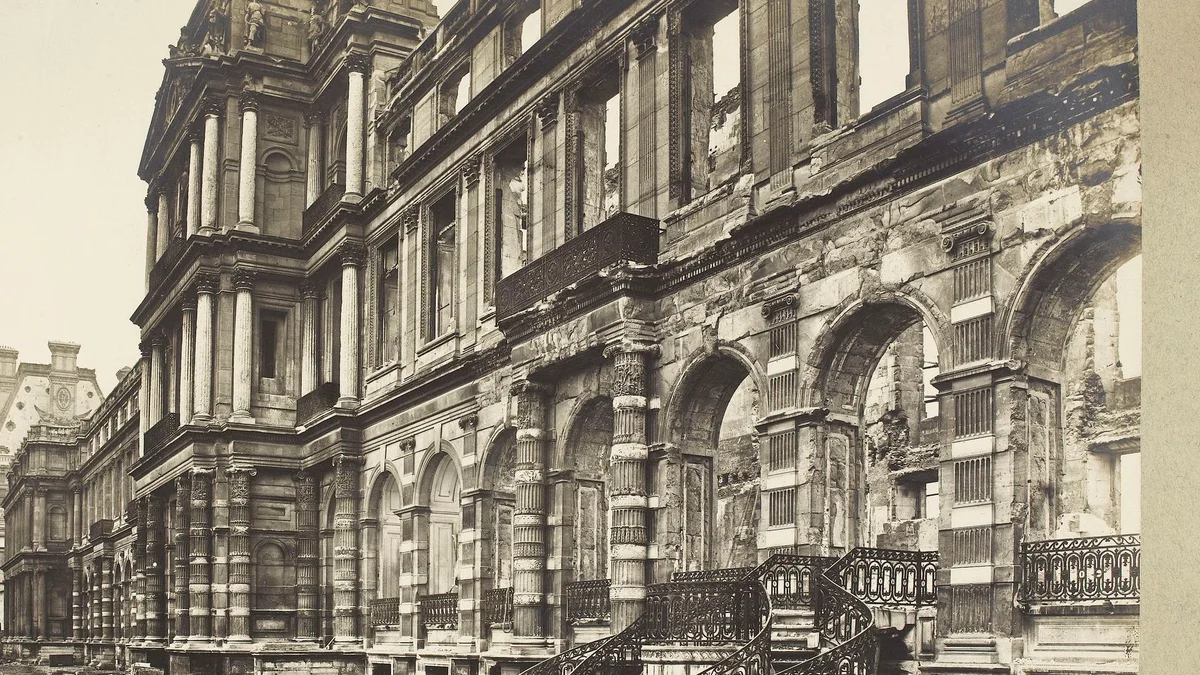
Restoring a faded painting is hard, but the work is there. Re-laying the stones of a cathedral is a building site, but the stones still exist. So how do you reconstruct a building of which absolutely nothing remains? The Tuileries palace burned in 1871 during the Paris Commune, and its ruins were razed in 1883. Not a wall, not a room, not a single piece of furniture left in place. Reconstructing that is the hardest problem in our craft, and it is the one we face every day.
You do not rebuild vanished heritage, you reconstitute it: from sources (inventories, plans, photographs, archives, accounts), replacing lost objects with documented equivalents, spelling out every choice, and owning what you do not know. An honest reconstruction is not the one that shows everything: it is the one that shows what it knows, and knows how to stay silent about what it doesn’t.
Reconstitution, restitution, reconstruction: the word matters
Before the method comes the vocabulary, and it is not neutral. The archaeologist Jean-Claude Golvin, a reference in the field, points to the blur around these terms. To rebuild is to physically raise again what was destroyed: it means stones, a building site, a new structure. To restore is to return an existing work to its assumed original state: it means the work is still there. To reconstitute, finally, is to evoke through substitutes what has disappeared, without claiming the real thing is back. When nothing remains, that is the only accurate word, and it carries a humility: you do not give the thing back, you propose a reasoned image of it.
The textbook case: Napoleon’s lost palaces
In 2021, the Mobilier national devoted an exhibition to Napoleon’s lost palaces at the Galerie des Gobelins: the Tuileries, Saint-Cloud and Meudon, three imperial residences destroyed in 1870 and 1871. With no walls left, the show rested on digital reconstructions of the interiors, room by room. A museology thesis at the École du Louvre, defended in 2025 by Clément Citron, laid out its method from interviews with the project’s participants, and that method looks exactly like ours.
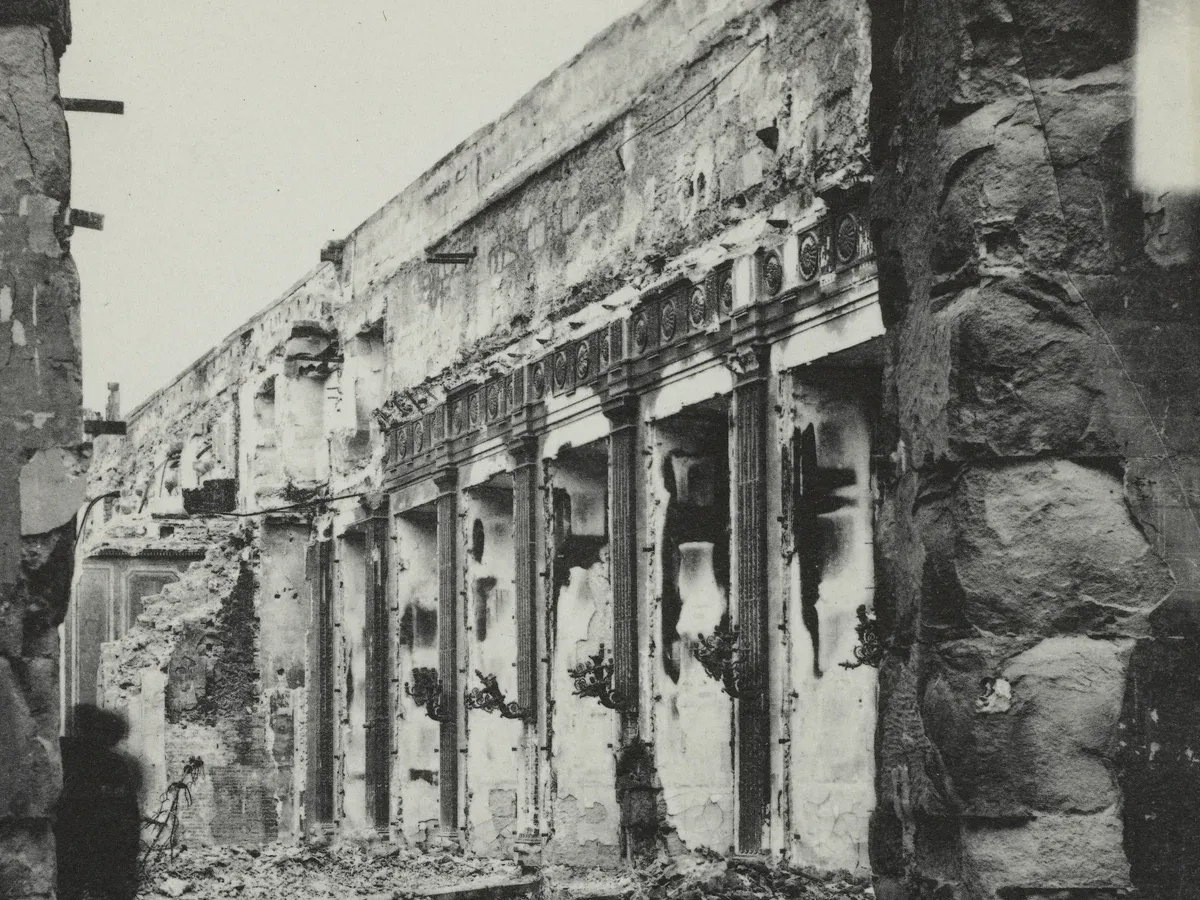
An interior of the Tuileries after the fire: this is where a reconstruction starts, when nothing is left but blackened walls.
The central principle is the documented equivalent. When a piece of furniture has vanished from the collections, the modeller does not invent it: with the Mobilier national’s inspectors, he looks for an existing object whose inventory description best matches the lost original, and takes its forms, dimensions and colours. For the shade of a Saint-Cloud salon, lacking any record, the team even drew on porcelain of the period. Every reconstituted piece is then justified and submitted to the specialists’ critical eye.
The screen trick: show what you know, hide what you don’t
This is my favourite gesture in the whole project. For the Second Consular Salon at the Tuileries, a torchère was meant to stand in the decor, but no satisfactory equivalent was found. Rather than invent a credible but false object, the modeller created an uncertain version and deliberately placed it half-hidden behind a folding screen. The object is evoked, its presence is there, but its details stay in shadow, because they are not known.
It is exactly the same rule as the Notre-Dame sculptures we discussed in our deep dive on polychromy: knowing that a thing existed does not tell you what it looked like. One project email sums it all up: “comparison is not proof.” A serious reconstruction chooses its viewing angles to light up what is sourced and leave in half-darkness what is not.
The opposite trap: the detail that lies
There is a reason to distrust overload as much as emptiness. The same modeller cites, as a counter-example, the video game Assassin’s Creed Unity, whose late-18th-century Paris is visually striking but whose Tuileries interiors are pure fantasy: white panelling and gilding in a pseudo-Louis XV style with no basis. The journalist William Audureau, in Le Monde, explained that the designers were after a coherent look first, even if a statue ended up two metres too tall.
That is the danger: the theorist Pascal Bué speaks of the “government of detail.” The more an image teems with detail, the more credible it looks, including in its invented zones. Realism is not truth; it can even be its best disguise. That is the heart of our deep dive on AI and history: a seductive image is not an accurate one, and the problem long predates generative models.
How you reconstitute, in practice
From these examples a method emerges, the same one we apply scene by scene:
- Primary sources first: inventories, plans, old photographs, building accounts, archives. Nothing is drawn without a document.
- The documented equivalent next: when the object has vanished, you start from an existing object described in comparable terms, never from invention.
- Spell out every choice: distinguish what is attested from what is hypothetical, and say so.
- Own the gaps: push into shadow, hide, or abstain, rather than fill a hole with a guess presented as fact.
- Get it validated: submit each hypothesis to specialists, and accept being corrected.
This discipline is what separates a reconstruction from a pretty picture. In The Origins of Paris, every scene you watch resurface through our virtual-reality binoculars, from Roman Lutetia to the medieval place de Grève, goes through these steps and through validation by our scientific committee. Our behind-the-scenes page details these trade-offs. Reconstructing the past is not resurrecting it: it is offering the most honest image of it possible, knowing exactly where that image stops.
The questions we get asked
What is the difference between restoration and reconstitution? Restoration returns a still-existing work to its original state. Reconstitution evokes, from substitutes and sources, what has completely vanished. The first word assumes surviving matter, the second assumes it lost.
Can the Tuileries be rebuilt? Rebuilding, in the physical sense, would still be a new building: a committee has campaigned for it since the 2000s, and the debate, analysed by the historians Vincent Lemire and Yann Potin, is as much political as heritage-related. Reconstituting the Tuileries, on the other hand, is already being done, digitally and from the archives.
Are digital reconstructions reliable? They are when they rest on verified sources, separate the attested from the hypothetical, and own their limits. They are not when they favour effect over evidence. Reliability is not visible on screen: it is read in the method.
In short
Reconstituting vanished heritage means working when there is nothing left to copy: from sources, with documented equivalents, spelling out your choices and hiding what you don’t know rather than inventing it. The palaces burned in 1871 showed it at the Mobilier national; the construction of Notre-Dame and the place de Grève impose it on us every day. The rule is always the same: an honest reconstruction is not the one that shows the most, it is the one that knows what it does not know.
Sources
- Jean-Claude Golvin, archaeological restitutions and reflections on method (official site), on the terminology of restitution and reconstitution (in French).
- Exhibition “Palais disparus de Napoléon. Tuileries, Saint-Cloud, Meudon”, Mobilier national, Galerie des Gobelins, 2021-2022 (in French).
- Vincent Lemire and Yann Potin, “Reconstruire le Palais des Tuileries. Une émotion patrimoniale et politique ‘rémanente’ ? (1871-2011)”, Livraisons de l’histoire de l’architecture, no. 22, 2011 (in French).
- “Les Tuileries en ruines”, L’Histoire par l’image (in French).
- Clément Citron, “Reconstituer le patrimoine disparu. L’exposition Palais disparus de Napoléon,” master’s thesis (M1), École du Louvre, 2025.
- Images: the Tuileries palace after the 1871 fire, Paris Musées collections (public domain, CC0).