
Inside the Élysée Palace: the Time-Travel Film of the 2026 Heritage Days
If you are reading this in the queue outside the Élysée Palace, welcome: you are in the right place. This weekend, 19 and 20 September 2026, for the European Heritage Days, the French Presidency opens its doors, and Timescope is screening there for the second year “Au cœur du Palais” (Inside the Palace), an immersive film that travels back through three centuries of the Élysée’s interiors. Here is what awaits you in the headset, and what it took to make it.
“Au cœur du Palais” is a 360-degree film, entirely computer-generated from the archives, that passes through six spaces of the Élysée at the moment that shaped each of them: the entrance hall open onto the gardens of 1722, Caroline Murat’s boudoir in 1807, the winter garden and the ballroom around 1890, the smoking room designed by Pierre Paulin in 1972, and today’s Salon doré. You can watch it in the virtual-reality headsets on the garden side, in the four kiosks in the main courtyard, or on your phone via elyseevr360.fr, with no waiting.
What you will see
The film starts from a simple idea: at first glance, the Élysée looks like an 18th-century private mansion, courtyard, garden, pediments, panelling. In reality, it is a palimpsest. Each of its occupants left the taste of their era in it, and those are the layers the film peels back, room by room.
It opens with live footage of the main courtyard and the entrance hall, before the image tips into 3D to reopen, at its centre, the view onto the French gardens of 1722, as the architect of the hôtel d’Évreux intended.
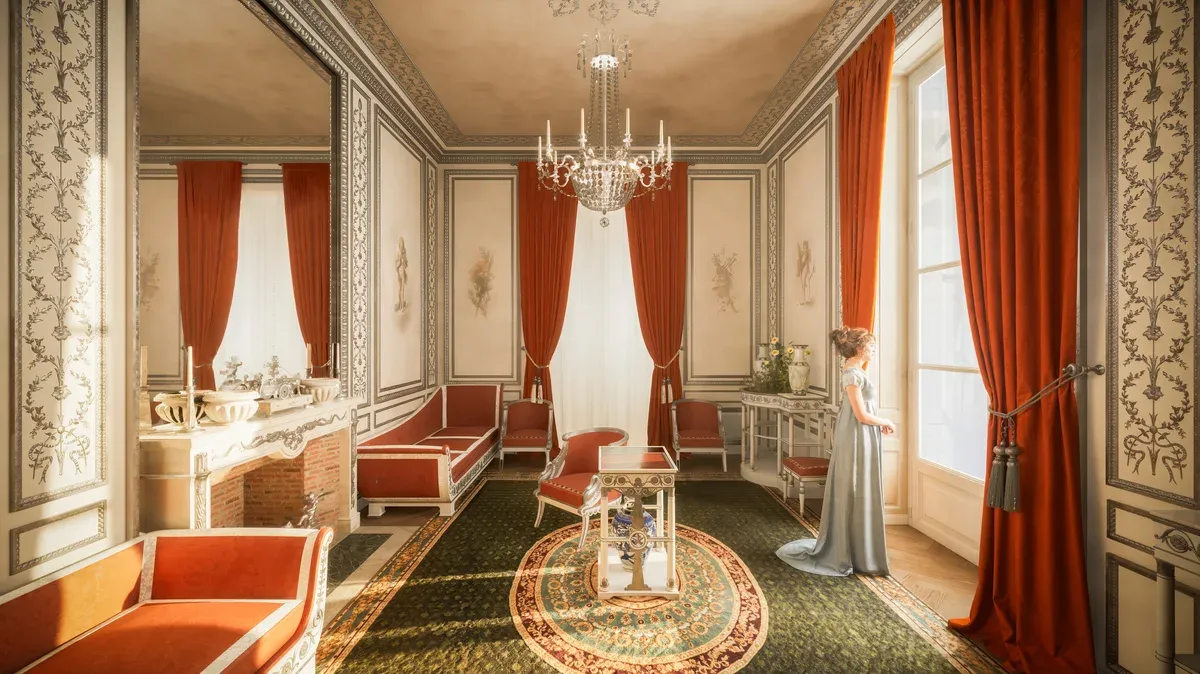
The silver salon around 1808, in the original tones of the boudoir created for Caroline Murat, before the lilac it is known for today.
Then comes the silver salon, created in 1807 for Caroline Murat, the emperor’s sister: swan-neck armrests, lyre-shaped backs, neoclassical friezes, with the original furniture still in place, a rarity at the Élysée. The film shows it in its first decor, and recalls that it was in this room that Napoleon signed his second abdication, on 22 June 1815.
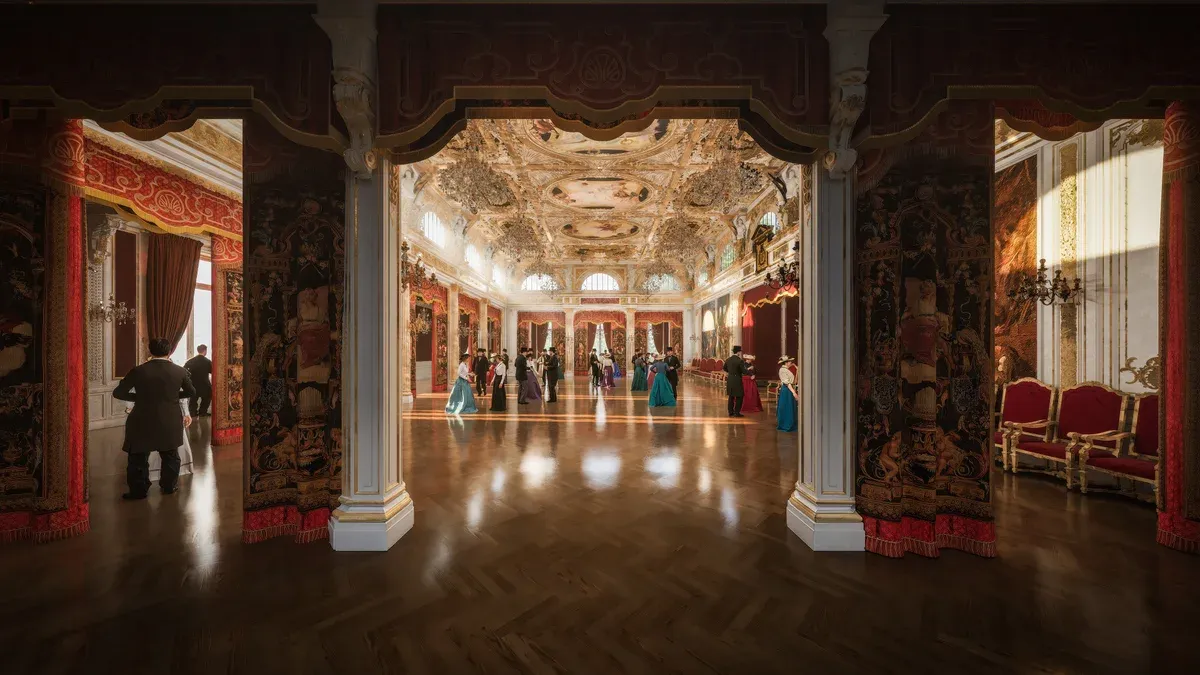
The ballroom around 1890: a 600-square-metre hall for a Republic to receive the monarchies of Europe.
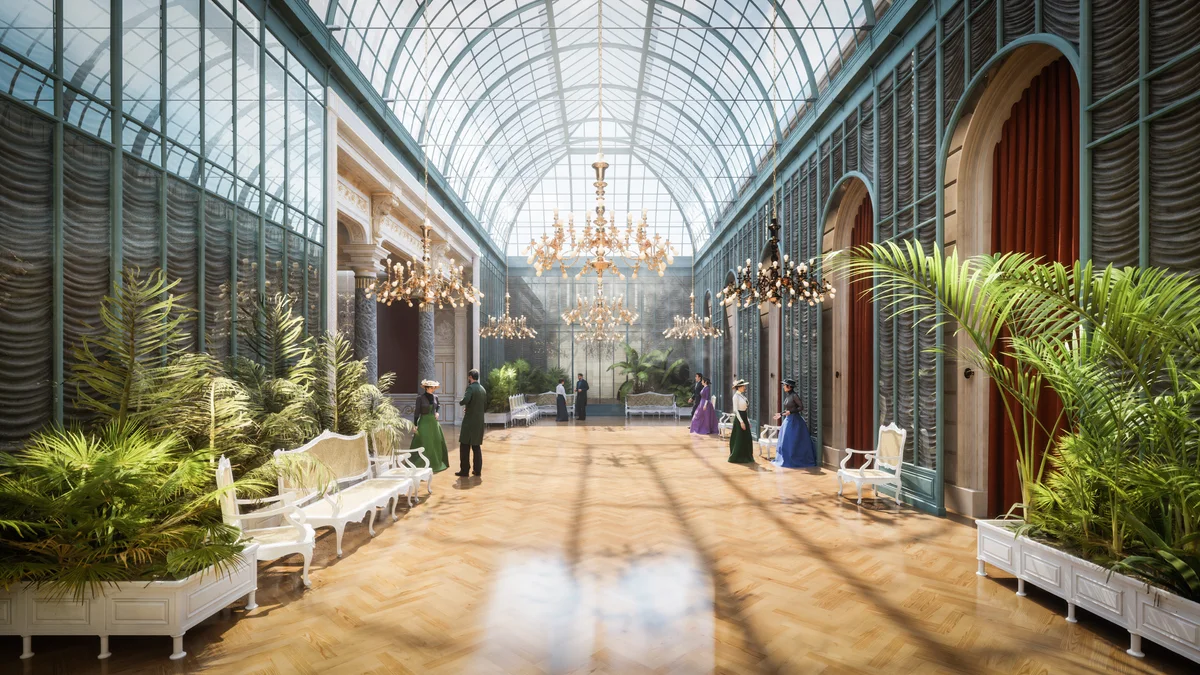
Then the Belle Époque. The winter garden, a conservatory commissioned by Jules Grévy in 1881, becomes again the jungle of exotic plants it was at the end of the 19th century. And the ballroom, inaugurated by Sadi Carnot on 10 May 1889, the year of the Eiffel Tower and the World’s Fair, comes alive with a period reception beneath its stucco celebrating the sciences and the arts.
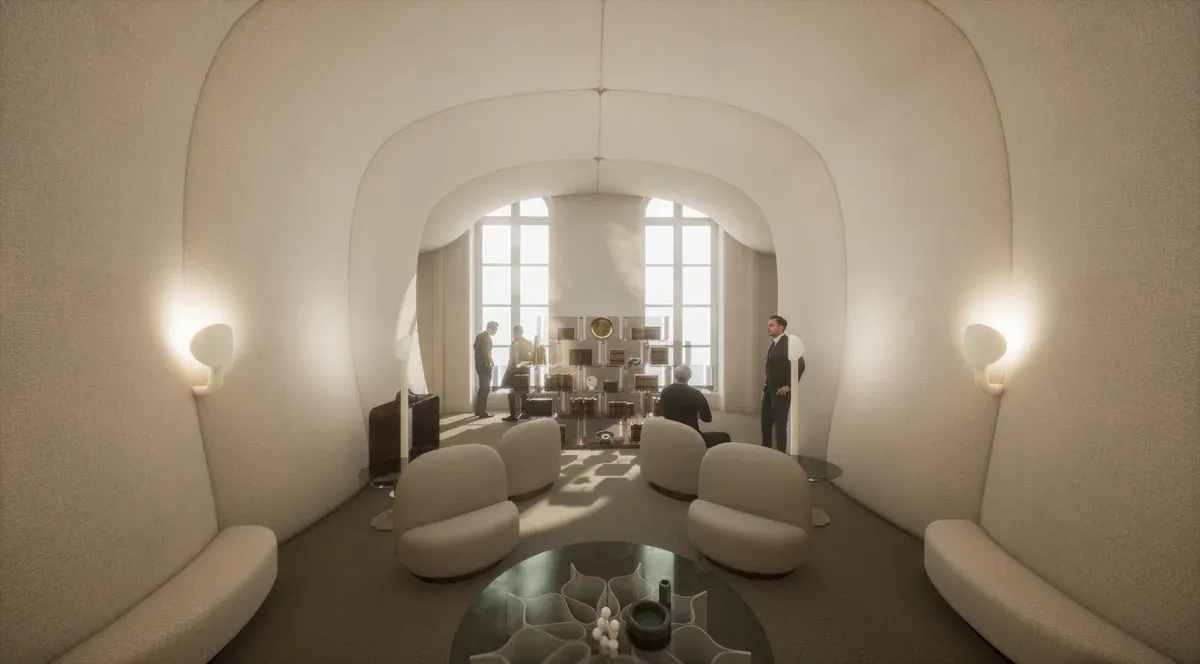
The Paulin smoking room, 1972: a retro-futurist decor dismantled since, which only the reconstruction lets you see again.
Jump to the 1970s: the Pompidous commissioned several rooms from Pierre Paulin, and the library’s alcove became a smoking room of organic curves. Nothing of it remains today, as Paulin designed an entirely reversible structure; the film is the only way to sit in it again. The journey ends in the present, in the Salon doré, the office of the presidents of the Fifth Republic since Charles de Gaulle: the furniture changes, presidencies follow one another, the thread of history never breaks.
Behind the scenes: reconstructing a room of which nothing remains
A convincing computer image takes a few weeks. An accurate one takes months in the archives. For “Au cœur du Palais”, eight months of work, co-produced with the Élysée’s heritage teams, began with one question per room: what do we have?
For the silver salon, a watercolour by Hippolyte Le Bas, around 1810, shows the boudoir in the Murats’ time and fixed the original shade. For the winter garden and the ballroom, the photographs of the Guérinet album, from the late 19th century, served as the main reference. For the Paulin smoking room, gone without a trace, it meant going back to the designer’s own references.
And then there are the rooms we chose not to reconstruct. The Pompadour salon in the marquise’s day, the Salon doré when it was Empress Eugénie’s bedroom: no period reference allows them to be restored rigorously, so the film does not show them. It is the rule we apply everywhere, and detail in our deep dive on lost heritage: you reconstruct what the sources allow, and you own what you don’t know. Once the 3D models were validated, 360-degree filming inside the real palace provided the images that open and close the film, and the transitions that carry the visitor from the real into the reconstruction.
How to enjoy it this weekend
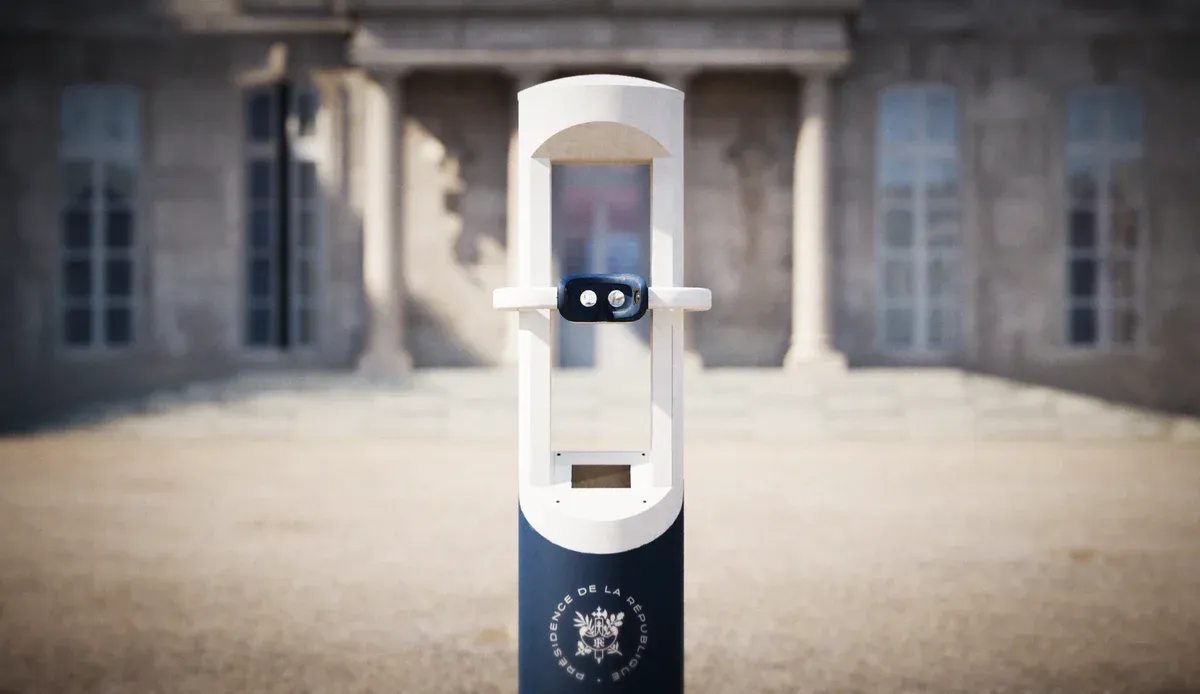
In the main courtyard, four self-service Timescope kiosks screen the three films of the series.
Three ways to watch, depending on your patience:
- Under the tent on the garden side, in a virtual-reality headset, with our team to set you up. It is the most immersive version, and the one people queue for.
- In the main courtyard, at the end of your visit, on the four self-service Timescope kiosks, which also offer the two previous films in the series: “Aux origines de l’Élysée”, the palace as completed in 1722, and “L’Élysée à travers les siècles”, its architectural metamorphoses.
- On your phone, right now, via the web app elyseevr360.fr, turning the screen around you.
After the Élysée: the same journey, on the banks of the Seine
If the idea appealed to you, it does not stop at the palace gates. All year round, The Origins of Paris applies the same method, sources first and validation by a scientific committee, to the city itself: a one-hour guided walk along the quays, where our virtual-reality binoculars bring back Roman Lutetia, medieval Paris or the flood of 1910 exactly where they happened. Open from age 8, in French, English and Spanish, and with no presidential queue.
The questions we get asked in the queue
Can you watch the film without coming to the Élysée? Yes: the web app elyseevr360.fr works on any smartphone, on site or at home, with all three films of the series.
Is everything really reconstructed from archives? Yes. The interiors are entirely computer-generated, modelled from plans, photographs, watercolours and inventories, co-produced with the Élysée’s heritage department. Only the images that open and close the film are live footage.
Is it the same film as in 2025? Yes, “Au cœur du Palais” was created for the 2025 Heritage Days and is screened again this year, alongside the two previous films.
In short
“Au cœur du Palais” travels back through three centuries of the Élysée’s interiors in six spaces, from the entrance hall of 1722 to today’s presidential office, by way of Caroline Murat’s boudoir, the winter garden, the 1889 ballroom and Pierre Paulin’s vanished smoking room. Everything is reconstructed from the archives, nothing is invented, and what is not documented is not shown. Watch it this weekend in the headsets, the kiosks or on your phone. And to carry the journey on, the banks of the Seine are waiting.