
Did the Past Smell Bad? What Paris Smelled Like for Two Thousand Years
It is a question that comes up often on our walks, usually at the moment the medieval place de Grève appears in the binoculars: “And what did it smell like?” The honest answer takes three words: strong, often, and not the way you imagine. Because smell is the one dimension of the past that a reconstruction cannot reproduce, and one of the hardest to document. Here is what the sources allow us to say.
Yes, old Paris smelled bad, and more and more so from the Middle Ages to the eighteenth century: the black mud of the streets, chamber pots emptied from windows, overflowing cesspits, the tanneries of the Bièvre, the charnel houses of the Innocents cemetery, the Montfaucon dump where the city’s excrement was poured out. But the historian Alain Corbin has shown that the threshold of tolerance to smells collapsed between 1750 and 1880: what would make us run was, for a Parisian of 1400, the ordinary air of the city. And one thing remains that nobody knows how to reproduce: the smell itself.
Did Lutetia smell of mud?
You read everywhere that Lutetia comes from the Latin lutum, mud, and that the Romans named the city after its marshes. The hypothesis is appealing; it is not established. The linguists Albert Dauzat and Charles Rostaing see instead a Gaulish root lut-, “marsh”, and Pierre-Yves Lambert, working from the Greek form “Lucotecia”, even proposes a root lucot-, “mouse”. The city of mud is a fine legend, not an etymology.
What we do know is that Gallo-Roman Lutetia was probably one of the least smelly periods in the history of Paris. A sixteen-kilometre aqueduct, built in the second century from the springs of Wissous and Rungis, brought about 1,500 cubic metres of water a day to the baths, fountains and houses of the left bank. Sewers ran beneath today’s boulevard Saint-Michel; their remains were found under the Cluny baths when the boulevard was cut through in the 1850s. A town of a few thousand inhabitants, running water, public baths: the traveller who steps down from our binoculars into the Lutetia of The Origins of Paris would not be troubled.
The Middle Ages: pigs in the streets and a king at the window
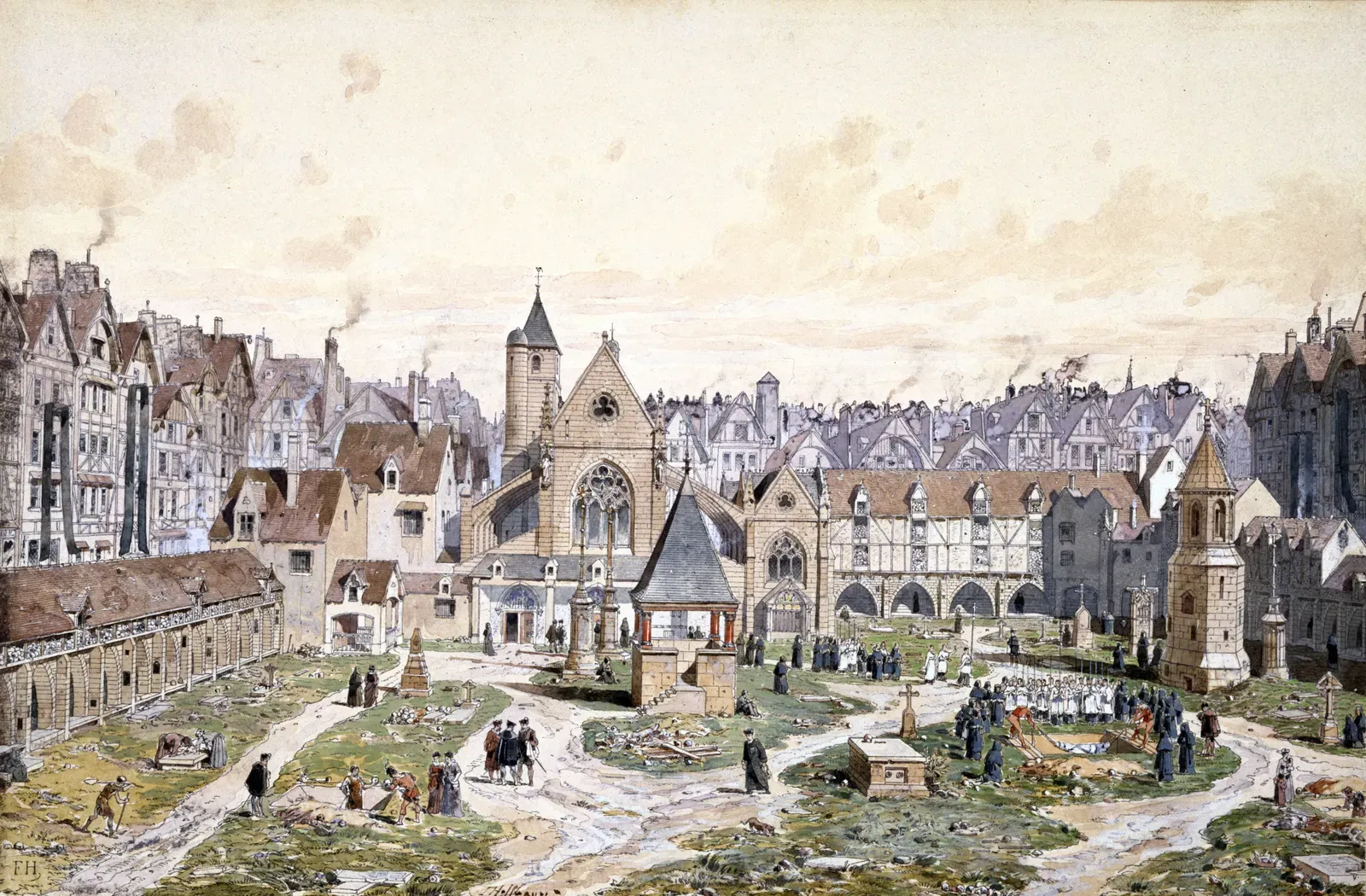
The Innocents cemetery in 1550, a retrospective composition by Fédor Hoffbauer. The arcaded galleries are the charnel houses, where bones taken out of the pits were stacked. Musée Carnavalet, CC0.
On 13 October 1131, Philippe, eldest son of Louis VI and associated king, was riding along the rue du Martroi-Saint-Jean, near today’s Hôtel de Ville. A pig ran between his horse’s legs; the horse reared, the young man was crushed and died that day. His brother Louis VII was crowned associate king at eleven, and pigs were banned from the streets of Paris, which did not make them disappear. The anecdote says it all: the medieval street was a farmyard, where pigs did the work of the refuse service.
Around 1200, Philippe Auguste had the main streets paved with a central gutter. According to the chronicler Rigord, the king, at his window in the palace on the Cité, was nauseated by the smell of mud churned up by carts and ordered the paving. The story is too good to be entirely certain, but the paving itself is attested, and it solved nothing: four centuries later, half the streets were still earth. The first vaulted sewer dates from 1374, on rue Montmartre, under the provost Hugues Aubriot. In 1412 the rue Saint-Antoine sewer was diverted northwards because its smell bothered the royal family at the hôtel Saint-Pol.
And then there were the dead. In the heart of the city, next to Les Halles, the Innocents cemetery received for six centuries the dead of twenty-two parishes, of the Hôtel-Dieu and of the morgue, the plague victims of 1348 included: two million Parisians, by the usual estimate, buried in common pits that could hold up to fifteen hundred bodies. The ground rose two and a half metres above the street. People held market there, strolled there, listened to preachers there, in a smell contemporaries called “fetid and cadaverous” and nobody thought of fighting.
Sixteenth to eighteenth century: “everything into the street”
For three centuries, the Parisian’s daily gesture was to empty the chamber pot out of the window. The Parlement banned it in 1523, 1524 and 1533, then François I, by an edict of November 1539, obliged every owner to build a cesspit under penalty of a fine. The edict remained a dead letter: Paris was still being described as a city of mud three centuries later. The “mud of Paris”, thick and black, had a European reputation, and Louis-Sébastien Mercier returns to it again and again in his Tableau de Paris (1781-1788).
The cesspits, where they existed, were emptied at night by the vidangeurs, and their contents carted to the Montfaucon dump, on today’s Buttes-Chaumont: 230 to 244 cubic metres of faecal matter a day, spread in open-air basins to be dried and sold as fertiliser, next to a knacker’s yard where some twelve thousand horses a year were slaughtered. With a north wind, the smell carried up to eight kilometres and covered the whole of Paris. The capital’s only dump from 1781, Montfaucon did not close until 1849.
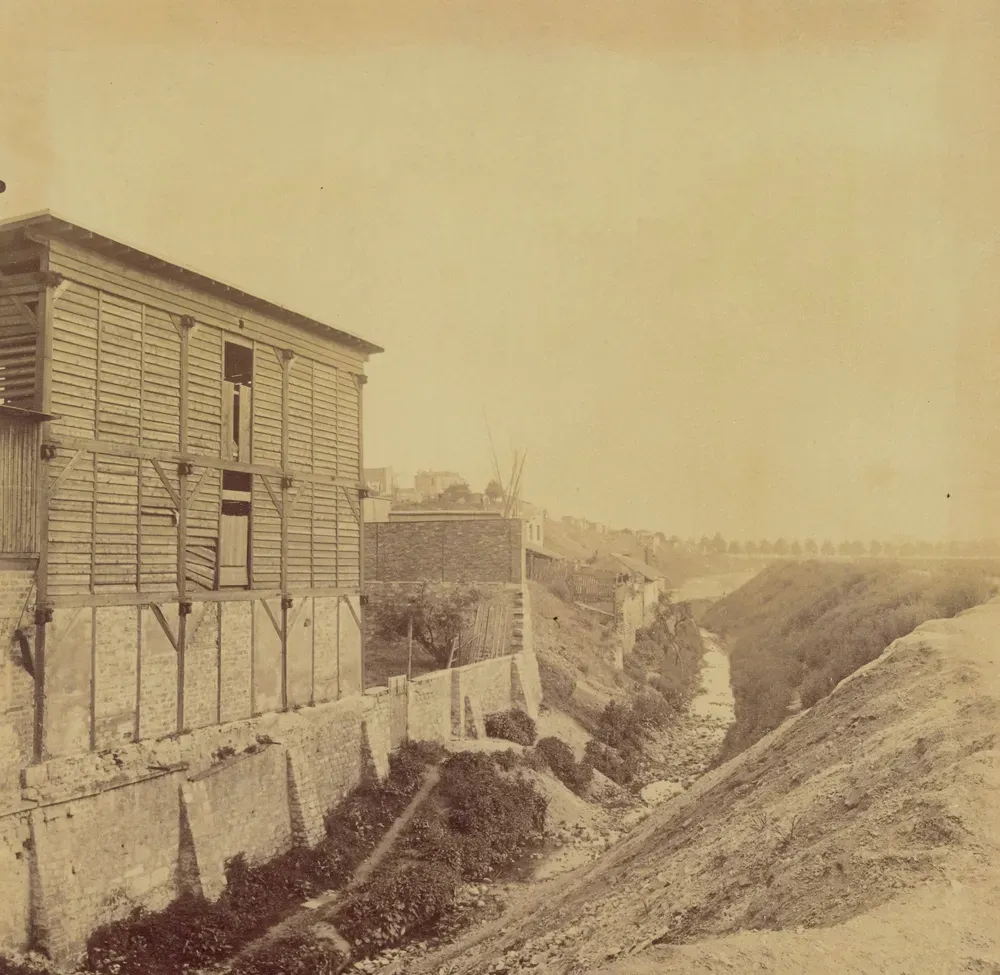
The Bièvre on boulevard d’Italie in May 1898, by Eugène Atget, “before its disappearance”: the tanneries of the faubourg Saint-Marcel. Bibliothèque nationale de France, public domain.
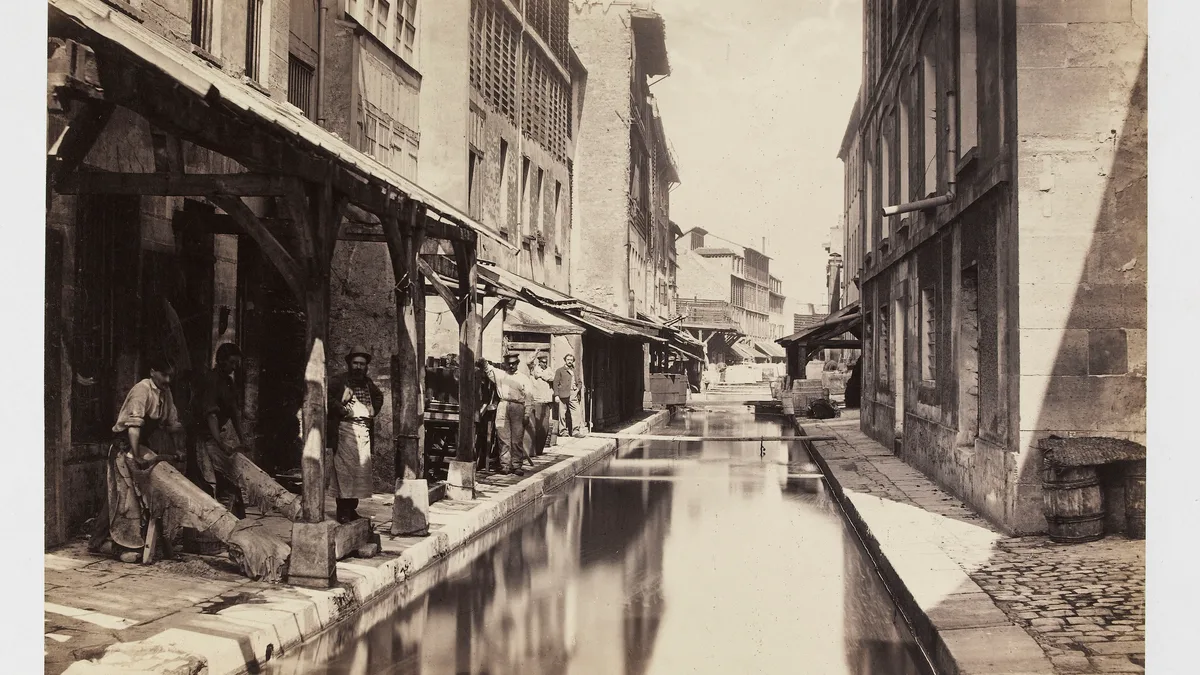
Then the trades. Until 1672, tanners and tawers worked right in the centre, on the place de Grève, the square our binoculars bring back to life: hides soaked in lime, washed in the Seine, dried on racks. A royal edict drove them out that year to the faubourg Saint-Marcel, on the Bièvre, where the Gobelins dyers had been settled since 1443. The little river became the industrial sewer of Paris: a hundred and twenty-five riverside businesses in 1822, plus five hospitals, four barracks and a prison discharging their water into it. Pierre Larousse spoke of “foul streams”. As early as 1790, the physician Jean-Noël Hallé submitted a report on its insalubrity and proposed moving the mills out. It took until 1912 for the Bièvre to be entirely covered within Paris.
The Innocents cemetery, for its part, ended up overflowing in the literal sense. On 7 May 1780, the wall of a cellar on rue de la Lingerie gave way under the pressure of bodies and bones. The Parlement ordered the closure in September, it took effect in December, and from 9 November 1785, for fifteen months, carts escorted by priests carried the bones to the old quarries of the Tombe-Issoire: these are the Catacombs.
The olfactory revolution: when noses changed
This is where the reference work on the subject comes in: Alain Corbin’s The Foul and the Fragrant (Le Miasme et la Jonquille, 1982). Its thesis fits in one sentence: the sense of smell has a history. Between the mid-eighteenth century and the end of the nineteenth, the threshold of tolerance to odours collapsed. What the Parisians of 1700 breathed without a thought became, for those of 1780, intolerable, then dangerous. The reason was not that the city smelled worse, but that doctors and chemists had given the smell a name: miasma, the exhalation of cesspits, cemeteries and hospitals, believed to carry disease. Before Pasteur, what stinks kills. Hallé, first holder of the chair of public hygiene at the Paris faculty of medicine in 1794, catalogued the smells of the city as one draws a map.
This fear had concrete effects. It emptied the Innocents. It pushed out the slaughterhouses, the dumps, the tanneries. After the cholera of 1832, which revived the idea that the poor spread disease and stench, it launched the great works: fourteen kilometres of sewers in two years, then, from 1854, Belgrand’s network under Haussmann. In August and September 1880, a “great stink” enveloped Paris for weeks, with no identified source and no attributable death; the government appointed a commission on which Pasteur sat, which nonetheless concluded that these odours “can pose a threat to public health”. In 1894, an order by the prefect Poubelle imposed the all-to-the-sewer system: the end of cesspits and vidangeurs. In the twentieth century, the ideal became what Corbin calls olfactory silence.
And perfumes? The other half of the story
The past did not only smell bad. It smelled of other things, and differently. The historian Georges Vigarello (Concepts of Cleanliness, Le Propre et le Sale, 1985) has shown that between the sixteenth and the eighteenth century, cleanliness did not go through water, thought dangerous because it opened the pores to miasmas, but through linen: to be clean was to change one’s shirt, and the whiteness of a collar served as a certificate. Body odours were masked rather than washed away, with scented waters, powders and sachets; the court of Louis XIV was a perfumed court. Add the smells of the trades, leather, tan bark, wax, the dung of thousands of horses, wood smoke and later coal smoke, bread from the ovens, and you have the true bouquet of a Paris street: not one single stench, but a layering of strong smells, some of which we would miss.
What our binoculars cannot reproduce
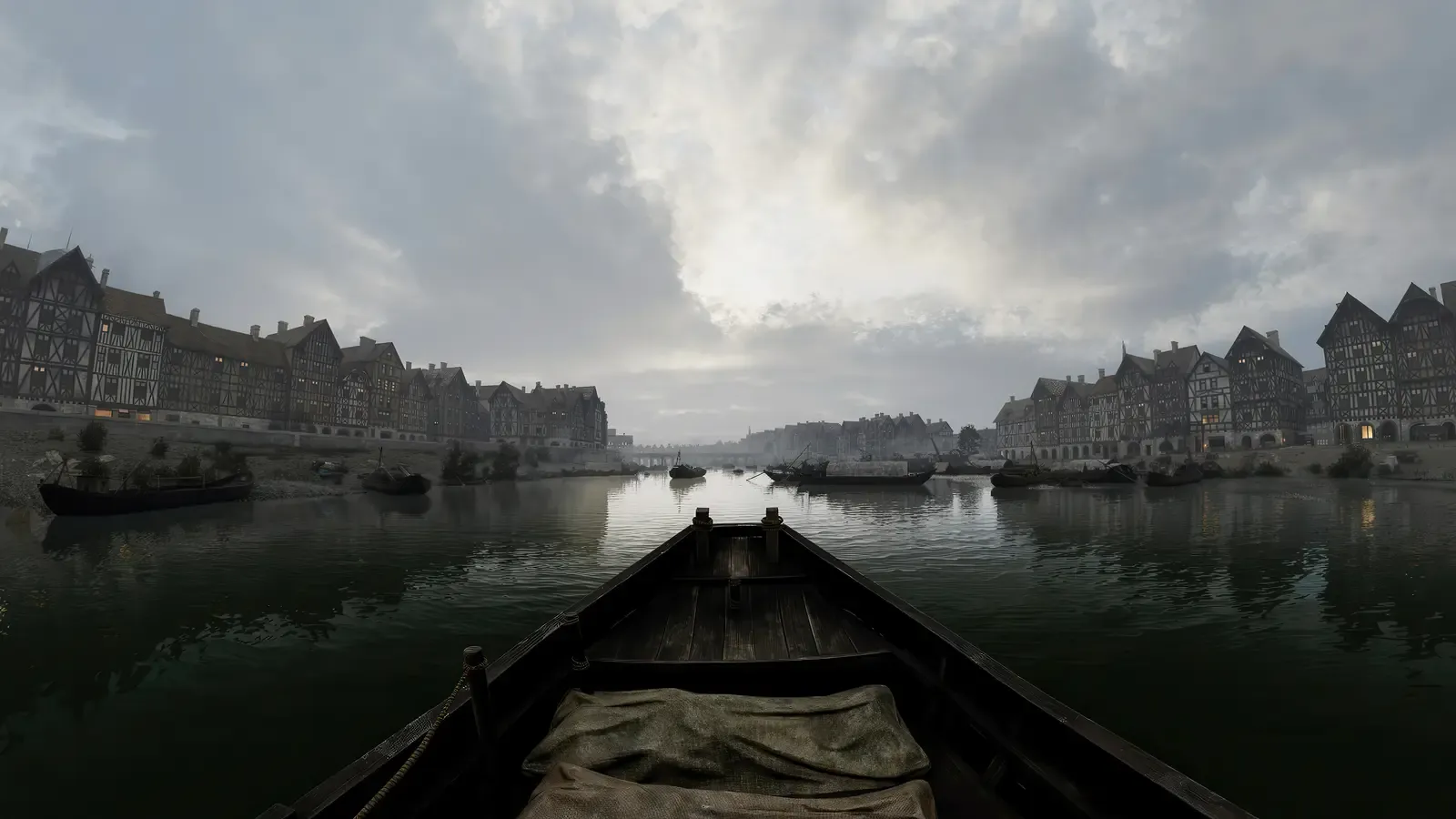
The plague of 1348 on the quays, in The Origins of Paris. Image, sound, narration: everything, except the smell.
Here is the confession. When we reconstruct the place de Grève around 1400 for The Origins of Paris, the sources tell us that there are tanners at the water’s edge, pigs in the street and a central gutter carrying what the windows have thrown out. We can show that. We cannot make you smell it. Scent devices exist, but they release rough synthetic fragrances that saturate the headset and linger from one scene to the next, so that Lutetia would end up smelling of the plague. Above all, no source says exactly what the Grève smelled like in 1400. We chose not to cheat.
So we do what the chroniclers did: we tell it. It is the guide’s role, at each stop, to say what the image does not carry, the smell of tan and leather on the Grève, of the Seine in summer, of smoke. And it is the role of sound: a street you can hear gives the brain what it needs to reconstruct the rest. There is a kind of honesty in leaving that gap: smell is the part of the past that has no archive, and saying what we do not know is part of the method we apply everywhere.
Five ideas to remember
- Yes, Paris smelled strong, and more and more so from the Middle Ages to the eighteenth century: mud, chamber pots, cesspits, tanneries, charnel houses, the Montfaucon dump.
- But not to the same noses. Alain Corbin showed that the threshold of tolerance to smells collapsed between 1750 and 1880; the ordinary air of 1400 would make us flee.
- Lutetia was probably clean, with its aqueduct, baths and sewers; the “city of mud” is a popular etymology, not an established one.
- The real turning point is miasma: once doctors believed that smell killed, the city set about deodorising itself, down to the all-to-the-sewer order of 1894.
- Smell has no archive. No reconstruction reproduces it honestly; with us, it is the guide and the sound that tell it.
Questions we are asked
Did the Middle Ages smell worse than the eighteenth century? Probably less: the city was smaller, less dense, and its inhabitants put up with it. It was in the eighteenth century that Paris reached the peak of its nuisances, with six hundred thousand inhabitants, saturated cesspits and Montfaucon, and that is also when people began to complain.
Did people wash? Differently from us. From the sixteenth to the eighteenth century, water was distrusted and people “washed” by changing their linen; they used perfume to mask odours. The daily bath is an invention of the late nineteenth century.
Why doesn’t The Origins of Paris use scents? Because no source allows a smell to be reconstructed, and because existing scent devices saturate and linger from one scene to the next. We would rather the guide told you what the image cannot show.
In short
The past smelled bad, yes: the mud of the streets, the chamber pots, the cesspits, the tanners of the Grève and then of the Bièvre, the charnel houses of the Innocents and the basins of Montfaucon. But it smelled to noses that were not ours, and it was the fear of miasma, in the eighteenth century, that turned smell into an enemy and launched the deodorisation of Paris. In The Origins of Paris, we show the tanners and the pigs of the Grève, we let you hear the street, and we leave it to the guide to say what it smelled like: it is the part of the past that has no archive.
Sources and practical links
- Alain Corbin, The Foul and the Fragrant: Odor and the French Social Imagination (Le Miasme et la Jonquille, 1982), Harvard University Press, 1986.
- Georges Vigarello, Concepts of Cleanliness: Changing Attitudes in France since the Middle Ages (Le Propre et le Sale, 1985), Cambridge University Press, 1988.
- David S. Barnes, The Great Stink of Paris and the Nineteenth-Century Struggle against Filth and Germs, Johns Hopkins University Press, 2006.
- Michel Pastoureau, Le Roi tué par un cochon, Paris, Seuil, 2015, and Philippe de France (1116-1131), Wikipédia.
- Égouts de Paris, Wikipédia, drawing on Pierre-Denis Boudriot, “Les égouts de Paris aux XVIIe et XVIIIe siècles” (Histoire, économie & société, 1990) and Donald Reid, Paris Sewers and Sewermen (1991).
- Voirie de Montfaucon, Wikipédia, drawing on Parent-Duchâtelet, Hygiène publique (1836) and Sabine Barles, L’Invention des déchets urbains (2005).
- Bièvre and Cimetière des Innocents, Wikipédia.
- Aqueduc de Lutèce, Wikipédia, drawing on Stéphane Ardouin and Bruno Deloumeaux, Revue archéologique d’Île-de-France (2009).
- François I’s edict on cesspits, November 1539, digitised copy at the BnF.
- Louis-Sébastien Mercier, Tableau de Paris, 1781-1788.
- How to reconstruct lost heritage, our piece on the method.
- The Origins of Paris, opening times and booking.
- Images: Charles Marville, “Cours de la Bièvre, près de la rue du Pont-aux-Biches”, c. 1865, musée Carnavalet, CC0; Fédor Hoffbauer, “Le cimetière et l’église des Innocents en 1550”, musée Carnavalet, CC0; Eugène Atget, “La Bièvre, boulevard d’Italie”, 1898, BnF, public domain; via Wikimedia Commons. The plague of 1348 is a Timescope reconstruction.