What to do in Paris in January 2027: a guide to an underrated month
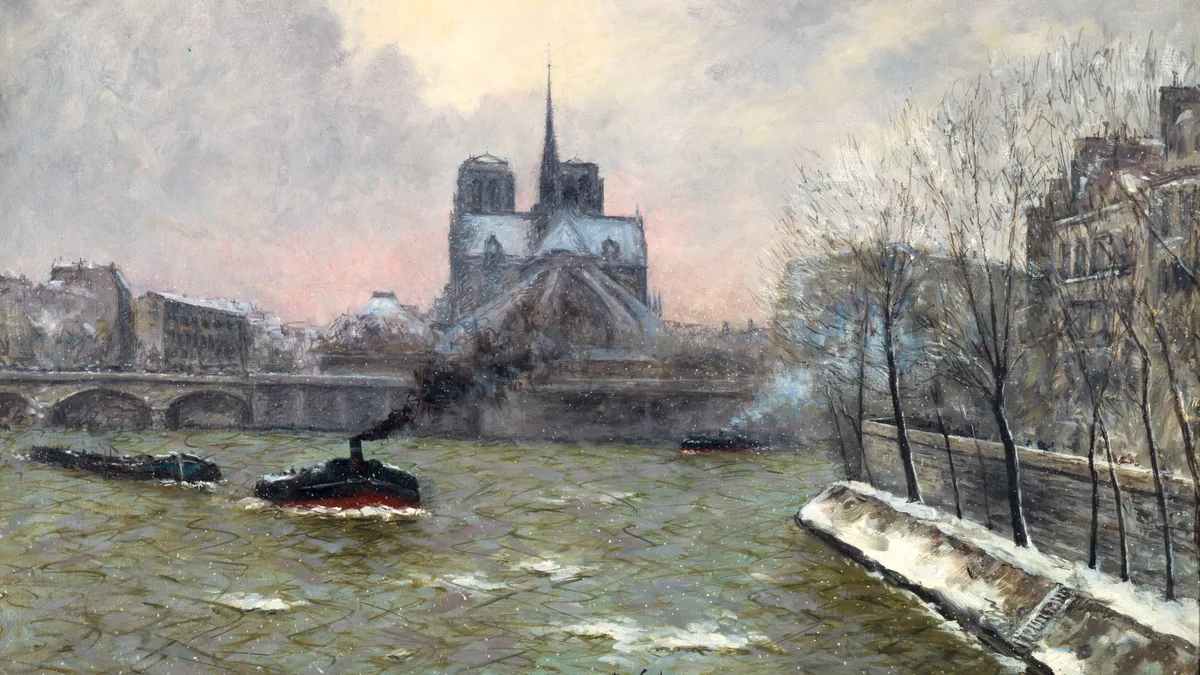
January has a poor reputation: the holidays are over, the lights go off, the sky is low. In Paris, though, the month has real advantages. Days grow an hour longer between the 1st and the 31st, the winter sales start in the first week, every bakery sells the galette des rois, and once French schools go back on 4 January the city settles into a calmer weekday rhythm. It is also the month of the Seine’s two great winters: the ice break-up of January 1880 and the flood of January 1910.
What to do in Paris in January 2027: catch the last days of the Christmas markets (Tuileries until 3 January, Champs-Élysées until the 4th) and of the Grand Palais ice rink until the 6th; share a galette des rois on Sunday 3 January, the day France celebrates Epiphany; shop the winter sales from Wednesday 6 January to Tuesday 2 February; join the Reading Nights from 20 to 24 January; and visit museums on quieter weekdays. On the banks of the Seine, The Origins of Paris shows the frozen river of 1880 and the flood of 1910, two events that happened in January.
What is the weather like in Paris in January, and when does it get dark?
Météo-France normals for Paris-Montsouris give an average of 3 °C in the morning and 8 °C in the afternoon, around ten days of rain in the month and about five days of frost. Sunshine stays scarce, with around sixty hours over the month, barely more than in December.
Daylight comes back quickly. The sun sets at 5:03 pm on 1 January and around 5:45 pm on the 31st; it rises around 8:45 am at the start of the month and around 8:25 am at the end. Days gain an hour in a month. The December rule still works, with a little more margin: outdoors in the afternoon, indoors once night falls.
The month’s dates, one by one
- Until 3 January: the Tuileries Christmas market and its ice rink.
- Sunday 3 January: Epiphany, which the Catholic Church in France celebrates on the Sunday between 2 and 8 January. Families share the galette des rois that day, but bakeries keep selling it for much of the month.
- Until 4 January: the Christmas market and lights on the Champs-Élysées.
- Until 6 January: the Grand Palais des Glaces, the ice rink set up under the glass roof of the nave.
- Wednesday 6 January to Tuesday 2 February: the winter sales. They start on the first Wednesday of the month this year, because the second one falls after the 12th, as French commercial law provides.
- Wednesday 20 to Sunday 24 January: the Reading Nights (Nuits de la lecture), on the theme of childhood, with a programme in the City of Paris libraries.
- Thursday 28 January: the anniversary of the 1910 flood, when the Seine reached its highest level in Paris.
Why is January the month of the Seine?
Two of the most memorable winters in the river’s history happened in January, and both can be relived on the quays with The Origins of Paris. The walk starts under Pont Louis-Philippe, on the voie Georges-Pompidou, facing Île Saint-Louis, and follows the Right Bank for one hour and 1.2 kilometres, with a guide. At each stop, virtual-reality binoculars show the Paris of another era, on the very spot where you stand.
The first episode is the frozen Seine of the winter of 1879-1880. In December 1879 the cold locked the river in ice in front of Notre-Dame. On 3 January 1880 a thaw set off the break-up: blocks of ice swept away the washhouse boats and barges moored between the Pont d’Austerlitz and the Pont-Neuf. In the experience the Seine is still frozen, and Parisians skate on it and throw snowballs.

The Seine on 3 January 1880, seen from the quai Saint-Michel, during the ice break-up. Photograph by Auguste-Hippolyte Collard, public domain.

The frozen Seine in The Origins of Paris: skating and snowball fights on the river. Timescope reconstruction.
The second episode is the great flood of 1910. After a very wet summer and autumn in 1909, heavy rain fell on the Seine basin from 17 to 20 January. The river rose for about ten days and reached 8.62 metres on the Pont d’Austerlitz gauge on 28 January 1910. Whole districts were flooded, and Parisians moved about on plank walkways. The Seine did not return to a normal level until around 10 March.
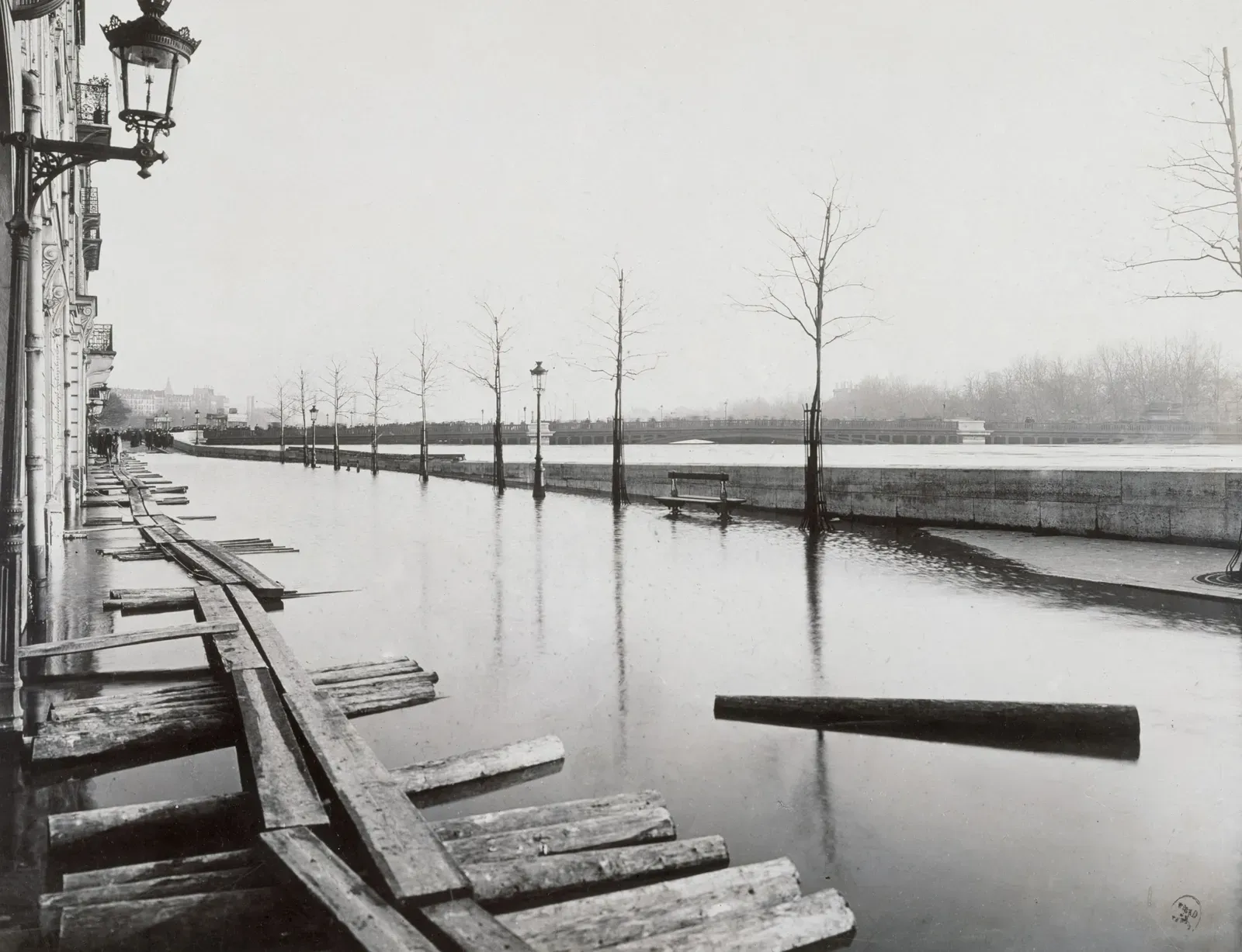
The quai de Béthune, on Île Saint-Louis, and the Pont de Sully on 29 January 1910, the day after the flood peaked. Anonymous photographer, Musée Carnavalet, CC0.
The experience is open Wednesday to Sunday, 10 am to 6:30 pm, from age 8, in English, French and Spanish. Bookings open one to two months ahead, so January slots can be booked in December. The last departures of the day end after sunset, on quays that are lighting up.
To go further, the Musée Carnavalet, the museum of the history of Paris, is a quarter of an hour’s walk away, on rue de Sévigné in the Marais. Its permanent collections are free and need no booking, Tuesday to Sunday from 10 am to 6 pm.
Museums and rainy days
With French schools back in class, the big museums are calmer on weekdays. The Louvre stays open until 9 pm on Wednesdays and Fridays, the Musée d’Orsay until 9:45 pm on Thursdays. A late opening in January starts before nightfall and ends in a lit-up city.
Five rules for January in Paris
- Go out in the afternoon, head in with the dark. The sun sets between 5 pm and 5:45 pm: a walk that starts at 3 pm gets the best light.
- Shop the sales on weekday mornings, when stores are less crowded than on Saturdays.
- Book in December anything that opens its slots one to two months ahead.
- Plan museums on weekdays and keep weekends for walks, when Parisian families are out.
- Dress for 3 to 8 °C and around ten days of rain: waterproof shoes, and a hot coffee at the end of the walk.
January questions
When do the 2027 winter sales start in Paris? On Wednesday 6 January 2027, for four weeks, until Tuesday 2 February. A few departments in eastern France have different dates, but not Paris.
Is Paris very cold in January? On average 3 °C in the morning and 8 °C in the afternoon at Paris-Montsouris, with around five days of frost in the month.
What can you do in Paris on 1 January? Many museums are closed, including the Louvre, Orsay and Carnavalet. Walks along the Seine remain the best option. For The Origins of Paris, which falls on a Friday this year, check the booking calendar.
Is The Origins of Paris open in January? Yes, Wednesday to Sunday, 10 am to 6:30 pm. The visit takes place outdoors and runs in most weather.
In short
January in Paris means days that gain an hour, the last days of the Christmas markets and the Grand Palais ice rink, the galette on Sunday 3rd, the sales from 6 January to 2 February, the Reading Nights from 20 to 24, calmer museums on weekdays, and the banks of the Seine with The Origins of Paris, where you see the frozen river of January 1880 and the flood of 28 January 1910.
Sources and practical links
- Sunrise and sunset times calculated for central Paris with the NOAA solar algorithm; January 1991-2020 normals from the Météo-France climate sheet for Paris-Montsouris.
- Sales: rules to follow, Service-Public.fr; winter sales 2027, France.fr.
- The 2027 Reading Nights in City of Paris libraries, paris.fr; press release from the Centre national du livre.
- Report on the January 1910 flood, DRIEAT Île-de-France.
- Winter of 1879-1880: Météo-Paris, “La débâcle catastrophique des fleuves au mois de janvier 1880”.
- Christmas markets and ice rink: see the sources of our December guide.
- Musée Carnavalet; Louvre and Musée d’Orsay, opening hours and late openings.
- The Origins of Paris, opening times and booking.
- Images: “Le chevet de Notre-Dame, vu du pont de la Tournelle, effet de neige”, Siebe Johannes ten Cate, 1902, and “Crue de la Seine, le quai de Béthune et le pont de Sully”, 29 January 1910, Musée Carnavalet, CC0; “La Seine le 3 janvier 1880, vue du quai Saint-Michel”, Auguste-Hippolyte Collard, public domain; all via Wikimedia Commons. The frozen Seine in virtual reality is a Timescope reconstruction.