
Paris in December 2026: The Month the City Lights Up at 5 pm
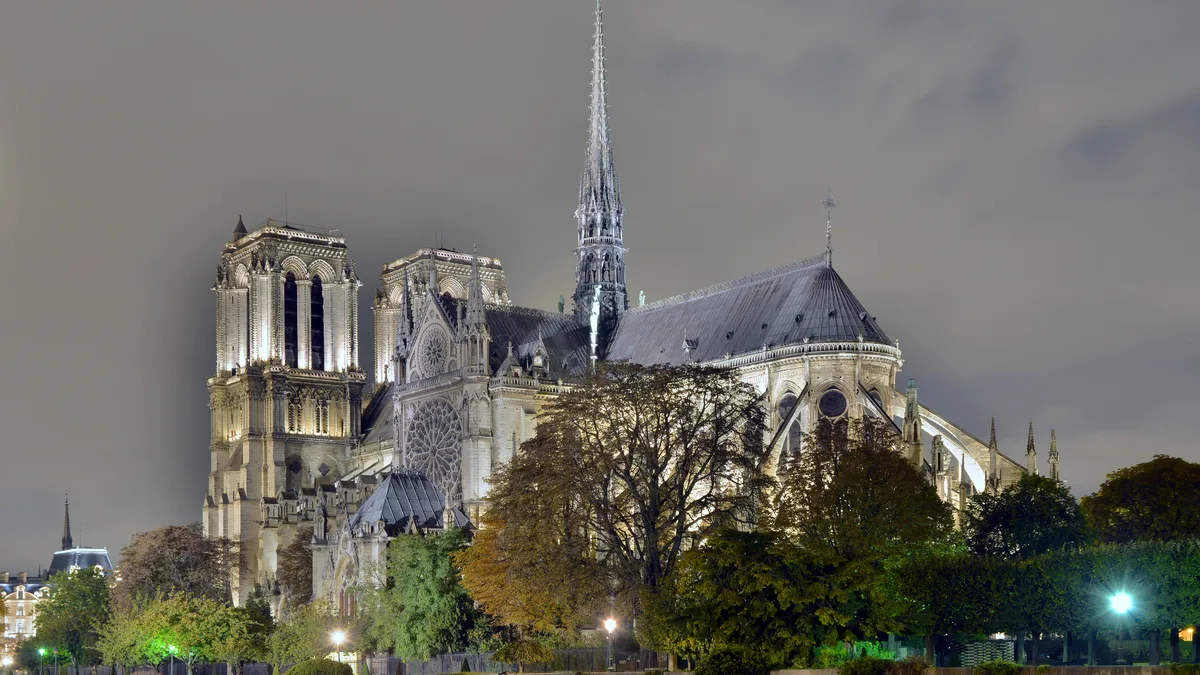
December is usually described as the month of days that are too short. In Paris, the opposite is what matters: the sun sets around 5 pm, the city lights up while the cafés are still full and the museums still open, and everything that makes Paris beautiful at night, the bridges, the quays, Notre-Dame, the shop windows, can be visited at teatime. Here is how to make the most of the brightest month of the year, the one when the light comes from the windows.
Paris in December 2026: night falls between 4:55 pm and 5:03 pm, which puts every illumination in the afternoon; the Christmas markets of the Tuileries (until 3 January), the Champs-Élysées (until 4 January) and Notre-Dame (square René-Viviani, 26 November to 27 December); the Christmas concerts of the Notre-Dame choir school on 15 and 16 December and the Christmas Eve mass on the 24th; the giant Grand Palais ice rink from 13 December to 6 January; the late openings of the Louvre and Orsay; New Year’s Eve on the Champs-Élysées. And, at dusk, the quays of the Seine with The Origins of Paris, whose last afternoon departures end in front of a floodlit Notre-Dame.
What time does it get dark in Paris in December?
The sun sets at 4:58 pm on 1 December, around 4:55 pm between the 8th and the 15th, the shortest days of the year, at 4:56 pm on the winter solstice, Monday 21 December, and at 5:03 pm on the 31st. Add half an hour for full darkness: by 5:30 pm, Paris is lit. As for the weather, the Paris-Montsouris normals give 4 to 8 °C on average and eleven rainy days in the month, which leaves some twenty dry days and an often low sky that makes the lights stand out.
The rule of the month fits in one sentence: outdoors from 2 pm to 5:30 pm, indoors after. A walk that starts at 3 pm ends in a lit city, without your having been cold for too long.
The quays of the Seine at nightfall
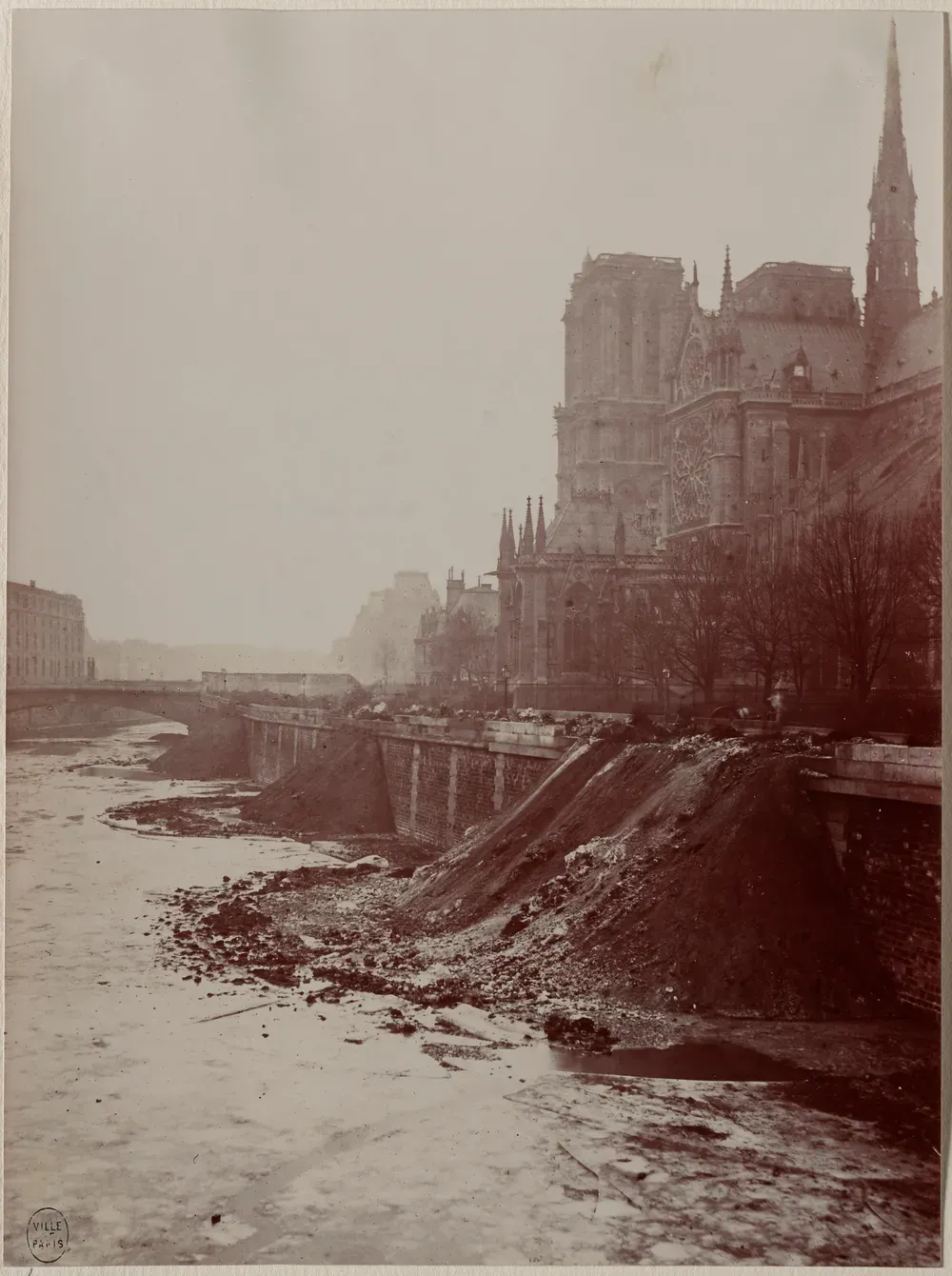
The Seine locked in ice in front of Notre-Dame, winter 1879-1880. Anonymous photograph, musée Carnavalet, CC0.
This is our favourite moment of the year for The Origins of Paris. The walk starts from under the pont Louis-Philippe, on the voie Georges-Pompidou, facing the île Saint-Louis and the tip of the Cité, and follows the right-bank quays for one hour and 1.2 kilometres, with a guide. At each stop, the virtual-reality binoculars bring up the Paris of before on the very spot: Lutetia, the medieval place de Grève, the building of Notre-Dame, the Viking siege, the flood of 1910. In December, the last afternoon departures set off in the low light and end after dark, when the quays empty and Notre-Dame lights up: you come out of the binoculars from thirteenth-century Paris to find the floodlit cathedral, in the same place.
One of the scenes is made for the month: the frozen Seine. It is no invention. On the night of 9 to 10 December 1879, the thermometer at the parc Montsouris dropped to 23.9 degrees below zero, and the river froze solid in front of Notre-Dame; the photographers of the day, Atget among them, recorded it. On 3 January 1880 a sudden thaw set off the break-up: the ice swept away the washing boats and barges moored between the pont d’Austerlitz and the Pont-Neuf. The binoculars put you on the bank of that Seine, and you only have to lower them to find today’s, which no longer freezes.
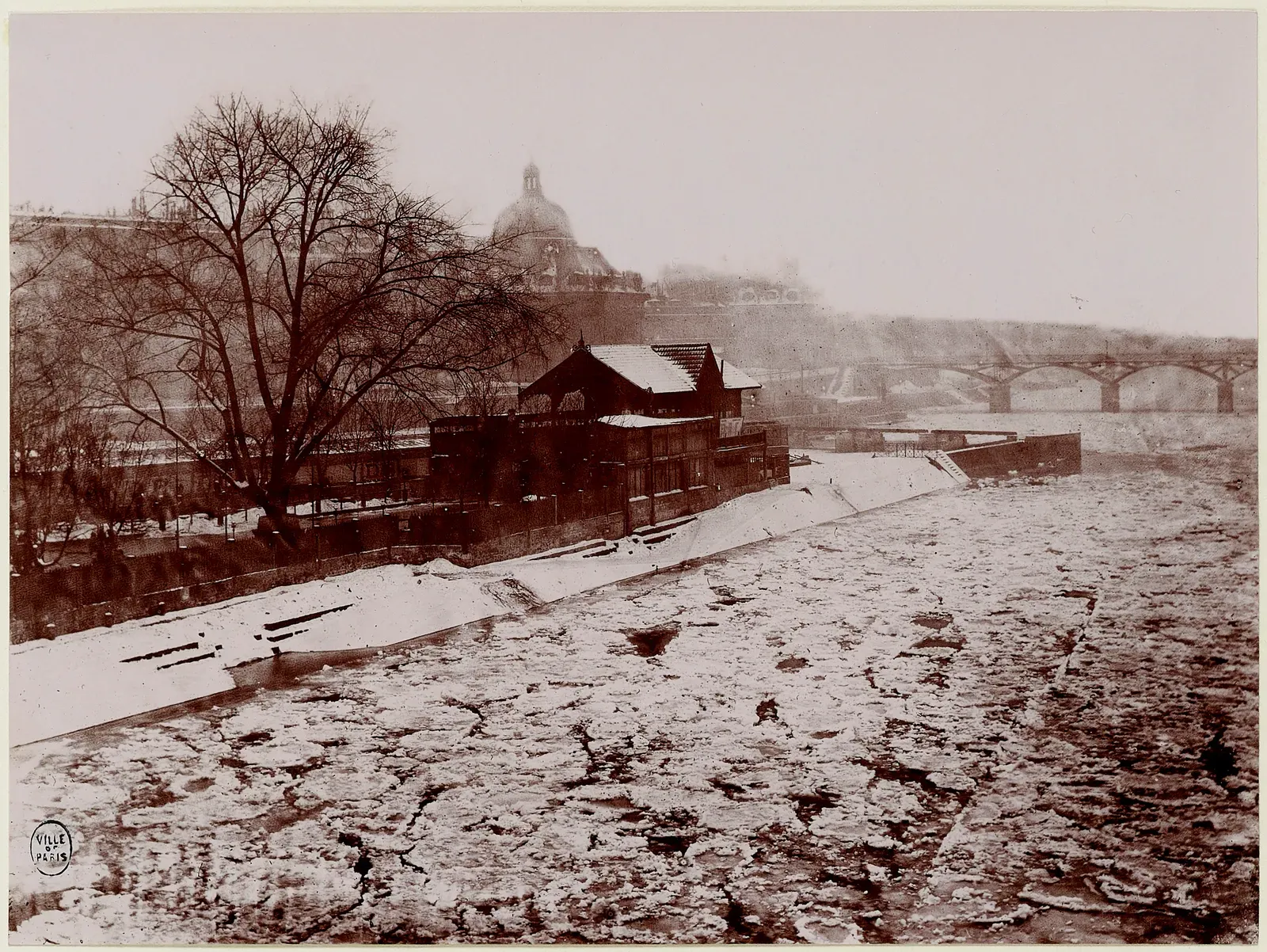
The square du Vert-Galant under the ice, winter 1879-1880. Photograph attributed to Eugène Atget, musée Carnavalet, CC0.

The frozen Seine in The Origins of Paris: the scene is watched from the quay, on the very spot where the river froze.
The experience runs Wednesday to Sunday, 10 am to 6:30 pm, from age 8, in French, English and Spanish. For the holidays, check the booking calendar for 25 December and 1 January, which both fall on a Friday this year. And plan what comes next, ten minutes’ walk away: the Notre-Dame Christmas market, on the other side of the river.
Notre-Dame at Christmas: the market, the concerts, the night of the 24th
The Notre-Dame Christmas market sets up in the square René-Viviani, facing the cathedral, from 26 November to 27 December 2026, free entry, 10 am to 8 pm on weekdays and until 9 pm from Friday to Sunday: craft chalets, mulled wine, and the finest view of the floodlit façade. It is the most modest market in Paris and the best placed.
Inside the cathedral, the Maîtrise Notre-Dame de Paris gives its Christmas concerts on Tuesday 15 and Wednesday 16 December at 8:30 pm, booking required. On the night of 24 December, the Christmas night mass is celebrated around 11:30 pm; the doors open around 10:30 pm and the queue forms well before, as it did last year for the first midnight mass since the reopening. The crib is installed in the cathedral throughout the Christmas season; the 2026 dates should be checked on the cathedral’s website, which also publishes the times of the masses on the 25th.
The lights: Champs-Élysées, shop windows, Tuileries, Grand Palais
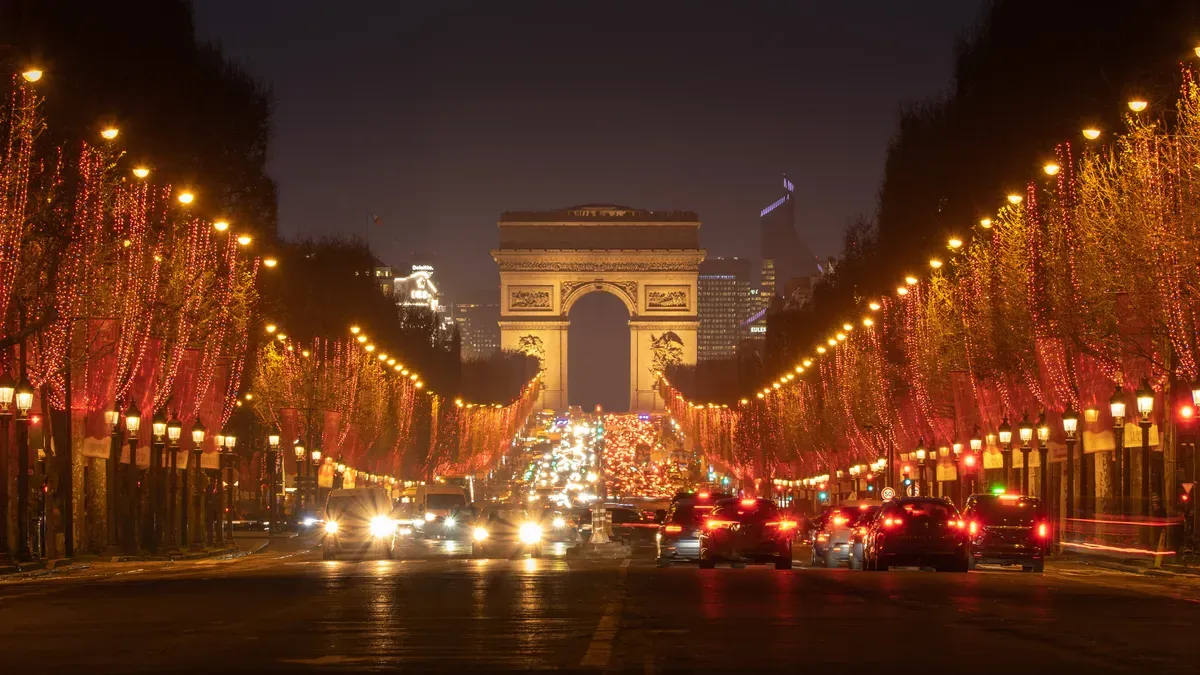
The Champs-Élysées in lights, towards the Arc de Triomphe. The 2026 illuminations have been on since Sunday 22 November. Photo CC0.
The Champs-Élysées illuminations have been on since Sunday 22 November, the same day as the opening of the avenue’s Christmas market, back after ten years’ absence, on the lower Champs-Élysées until 4 January. Across the Concorde, the Tuileries Christmas market and its ice rink are open every day from 11 am to 11:30 pm, until 3 January. The boulevard Haussmann windows have been lit since mid-November, and the tree under the dome of the Galeries Lafayette remains the one Christmas attraction in Paris that costs nothing and asks for no queue.
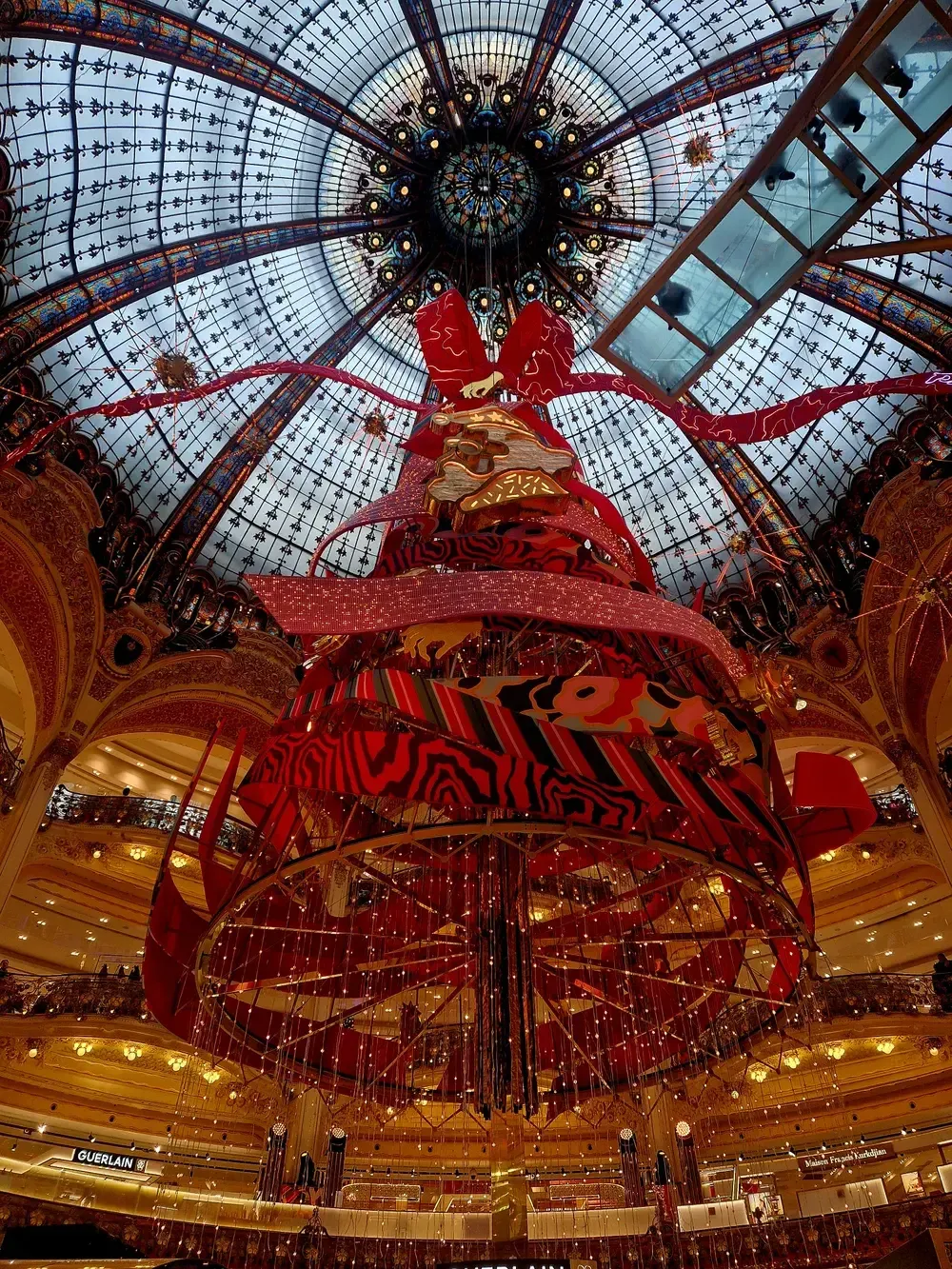
The tree under the dome of the Galeries Lafayette Haussmann. Photo CC0.
New at the end of the month: the Grand Palais des Glaces, the giant ice rink set up under the glass roof of the nave, returns from 13 December to 6 January, in three sessions a day from 10 am to 1 am (closing at 6 pm on the 24th and 31st), from 27 euros skates included, tickets online only. Skating under the 1900 glass roof, with night fallen at 5 pm, is one of the images of the Parisian winter.
Museums in the evening, and the two quietest weeks of the year
From 1 to 18 December, before the school holidays, Paris is at its low point of the year for crowds: this is the time for the Louvre and Orsay without queues. The Louvre is open until 9 pm on Wednesdays and Fridays, the musée d’Orsay until 9:45 pm on Thursdays; both are closed on 25 December and 1 January. When night falls at 5 pm, a late opening starts in daylight and ends in a lit city.
For families, our guide to the Christmas holidays with children takes over from the 19th. And if you are here earlier, our guide to Paris in November covers the start of the season.
New Year’s Eve: the Champs-Élysées at midnight
On 31 December, the City of Paris has for several years staged the turn of the year on the Champs-Élysées, with a countdown projected onto the Arc de Triomphe and fireworks at midnight; last year, the concerts planned on the avenue were cancelled for security reasons and only the countdown and the fireworks went ahead. The 2026 programme is published by the City in December on paris.fr. The avenue is pedestrianised and packed from 8 pm: come early, by the métro stations that stay open, and leave on foot.
Five rules for December in Paris
- Outdoors from 2 pm to 5:30 pm, indoors after. Night falls around 5 pm; a walk that starts at 3 pm ends in a lit city.
- The first two weeks for the museums, before the holidays begin on 19 December: it is the quietest time of the year.
- The quays at dusk: the last departures of The Origins of Paris end in front of a floodlit Notre-Dame.
- Book the Notre-Dame concerts and the Grand Palais ice rink now: 15 and 16 December and the evening sessions go fast.
- Dress for 4 to 8 °C and expect eleven rainy days: waterproof shoes, and always a warm café at the end of the walk.
December questions
What time does it get dark in Paris in December? The sun sets between 4:55 pm and 5:03 pm depending on the day, earliest between 8 and 15 December. Full darkness comes half an hour later.
Is Paris crowded in December? Not before the holidays: from 1 to 18 December, museum attendance is at its lowest of the year. The crowds arrive with the school holidays, from 19 December to 3 January, and concentrate on the Champs-Élysées, the department stores and the markets.
Is The Origins of Paris open over the holidays? The experience runs Wednesday to Sunday, 10 am to 6:30 pm, all winter. For 25 December and 1 January, which fall on a Friday in 2026-2027, check the booking calendar.
In short
December in Paris is the city lit up at 5 pm: the quays of the Seine at dusk with The Origins of Paris, the frozen Seine of 1879 in the binoculars and a floodlit Notre-Dame when you lower them, the Christmas market of the square Viviani until 27 December, the choir concerts on the 15th and 16th, Christmas night in the cathedral, the Champs-Élysées and the Tuileries until early January, the Grand Palais ice rink from the 13th, the late openings of the Louvre and Orsay in the two quietest weeks of the year, and New Year’s Eve under the Arc de Triomphe.
Sources and practical links
- Sunset times calculated for central Paris with the NOAA solar algorithm; December normals 1991-2020 from the Météo-France station sheet for Paris-Montsouris.
- Notre-Dame Christmas market 2026, square René-Viviani, 26 November to 27 December 2026.
- Christmas concert of the Maîtrise Notre-Dame de Paris, 15 and 16 December 2026; Notre-Dame de Paris cathedral, Christmas service times.
- Champs-Élysées Christmas market 2026, 22 November 2026 to 4 January 2027; Christmas in Paris 2026, lights and markets.
- Tuileries Christmas market, 14 November 2026 to 3 January 2027.
- Paris ice rinks, winter 2026-2027, Grand Palais des Glaces from 13 December 2026 to 6 January 2027.
- Musée du Louvre and musée d’Orsay, opening hours and late openings.
- New Year’s Eve on the Champs-Élysées, City of Paris.
- Winter 1879-1880: Météo-Paris, “Quand la Seine gelait à Paris” and “La débâcle catastrophique des fleuves au mois de janvier 1880”.
- The Origins of Paris, opening times and booking.
- Images: Notre-Dame from the pont de l’Archevêché at night, photo Livioandronico2013, CC BY-SA 4.0; “La Seine gelée avec la cathédrale Notre-Dame”, winter 1879-1880, and “La Seine gelée, square du Vert-Galant”, attributed to Eugène Atget, musée Carnavalet, CC0; the Champs-Élysées and the Galeries Lafayette tree, CC0; all via Wikimedia Commons. The frozen Seine in virtual reality is a Timescope reconstruction.