
Where to Watch the Sunset in Paris in November: Eight Viewpoints, Hour by Hour
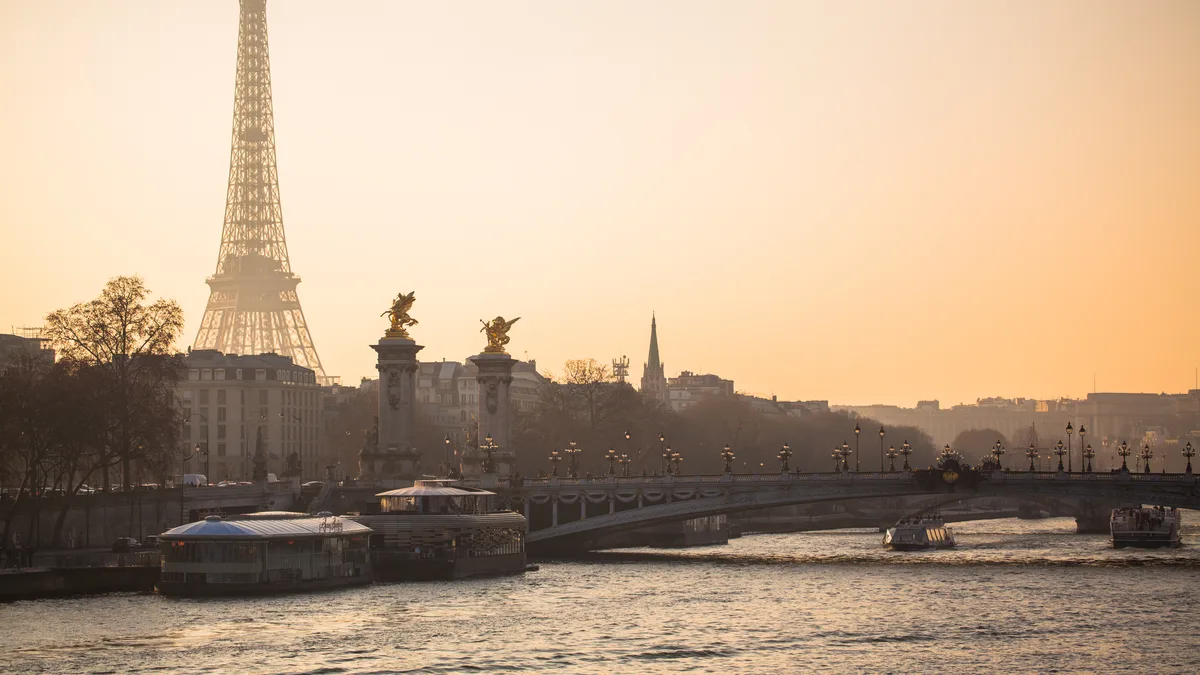
There is one month in the year when the most beautiful moment of the Parisian day falls squarely between the end of work and dinner: November. The switch to winter time, on Sunday 25 October, pushes sunset back in one go, from 6:47 pm the day before to 5:45 pm the day after. Then it keeps sliding, a minute at a time, down to 4:59 pm on 30 November. For once, no need to take a day off or keep the children up late: the golden hour is within everyone’s reach. You just need to know where to stand, and which way to look.
In November 2026 the sun sets in Paris at 5:33 pm on the 1st, 5:13 pm on the 15th and 4:59 pm on the 30th, towards the west-south-west. Full darkness comes a good half-hour later, which leaves time to watch the city light up. The best viewpoints are free: the bridges over the Seine (pont Alexandre III, pont des Arts, pont de la Tournelle), the steps of the Sacré-Cœur, the Trocadéro esplanade, the Galeries Lafayette rooftop, and, if you are paying, the terrace of the Arc de Triomphe. Arrive thirty minutes before the time given and stay thirty minutes after.
What time does the sun set in Paris in November 2026?
Here is the calendar, Paris time, for the centre of the city. One simple rule to remember: the sun loses about a minute a day over the month, and it sets further and further south.
- Sunday 1 November: 5:33 pm
- Sunday 8 November: 5:22 pm
- Sunday 15 November: 5:13 pm
- Sunday 22 November: 5:05 pm
- Monday 30 November: 4:59 pm
One detail changes everything when choosing a viewpoint: in November the sun does not set in the west but in the west-south-west, and it keeps drifting south as the days pass. From certain spots, that places the disc exactly behind a monument, and it only lasts a few days. That is what we have worked out below.
The banks of the Seine: the sun sets behind the Eiffel Tower
Pont Alexandre III, first week of November. From the bridge or the quay below it, on the right bank, the Eiffel Tower stands at the end of the river, more or less in the direction where the sun disappears. From the 1st to the 10th of November, the disc goes down almost in line with the Tower: that is this article’s cover photograph, taken on a January evening when the sun sets in the same place. After mid-November it shifts to the left, and it is still very fine.
Pont des Arts and pont Neuf, all month. Here you are not looking at a monument but at the river itself, which takes on the colour of the sky. From the pont des Arts, turn your back on the île de la Cité: the sun goes down over the left bank, above the quays, and the façade of the Louvre lights up on the other side. Public, free, and two minutes from the métro.
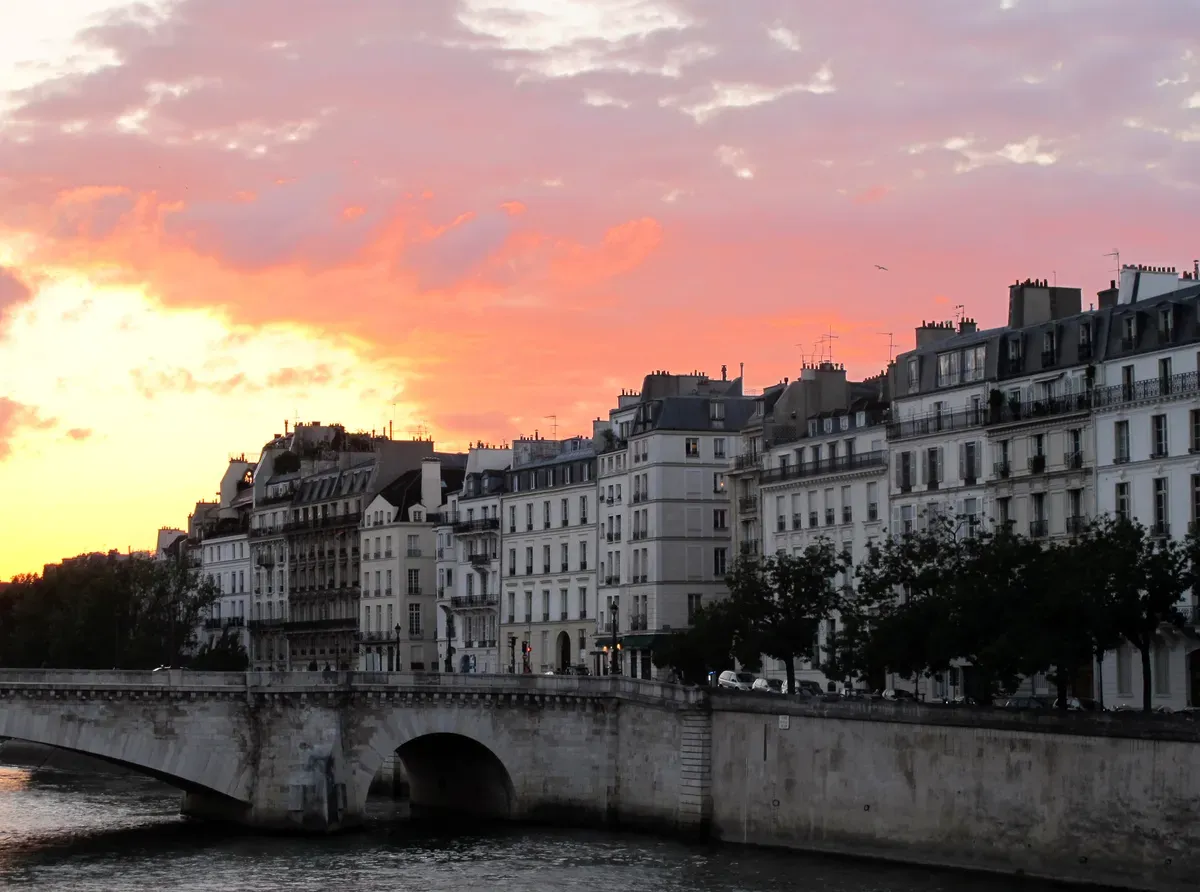
The pont de la Tournelle and the île Saint-Louis: the façades catch the last light before the Seine absorbs it. Photo Acediscovery, CC BY 4.0.
Pont de la Tournelle, for Notre-Dame. From the left bank, the apse of the cathedral and its flying buttresses stand out against the reddening sky; the sun sets to the left, behind the rooftops, and the façades of the île Saint-Louis are the last to blaze. Stay until dark: that is when Notre-Dame is lit.
The high ground: Sacré-Cœur, Arc de Triomphe, Galeries Lafayette
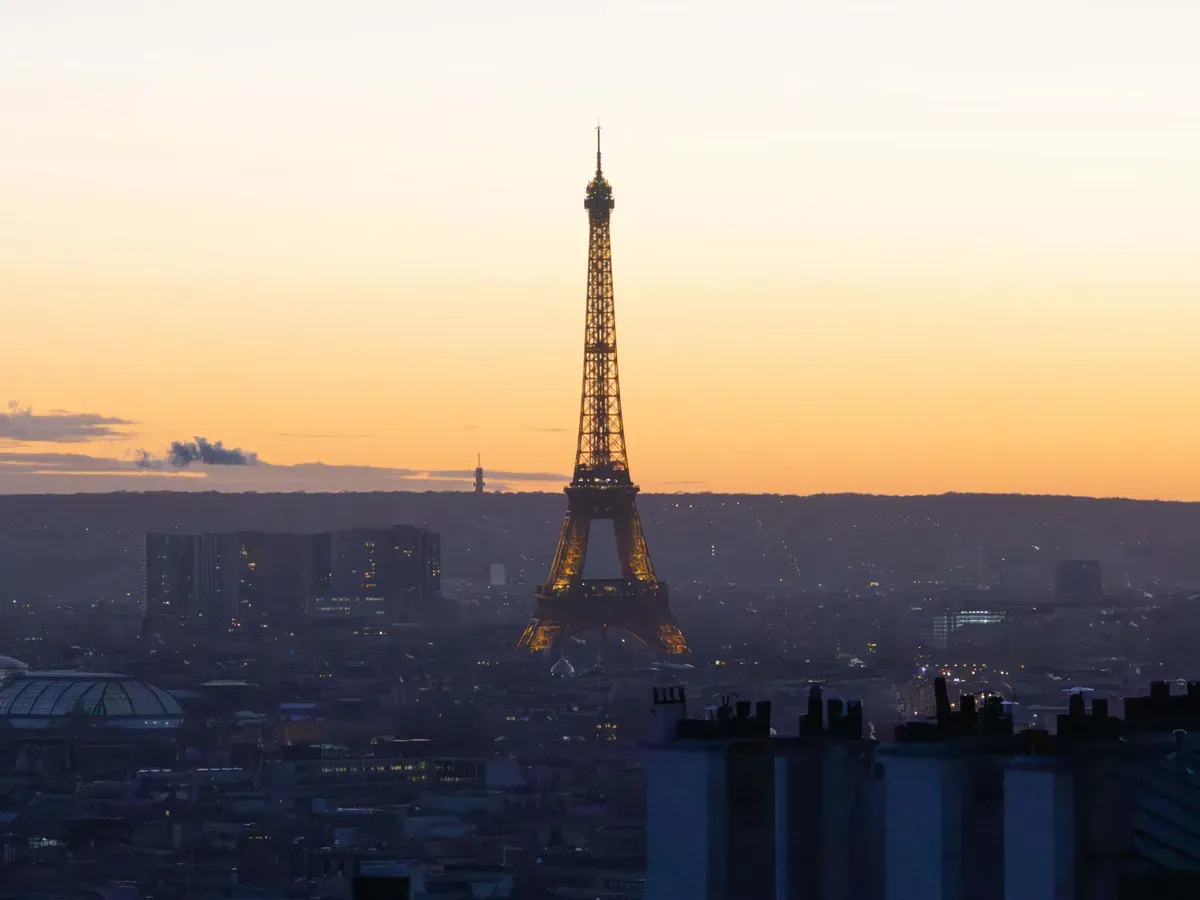
From Montmartre on a January evening: the Eiffel Tower, already lit, against the last orange of the sky. In November the sun sets just to its right. Photo Renée Kools, CC BY 4.0.
The steps of the Sacré-Cœur, late November. The forecourt faces south, and the Eiffel Tower sits to the right of the panorama. The further the month goes, the closer to it the sun sets: in the last days of November it disappears just to its right. The advantage of Montmartre is what comes afterwards: from up there you watch the whole city light up district by district, and the Tower sparkle for five minutes at the top of every hour from nightfall. Free access, at any hour.
The Galeries Lafayette rooftop, around 20 November. On the eighth floor of the department store on boulevard Haussmann, a free terrace opens onto the rooftops, from the Eiffel Tower to Montmartre. From there, the Tower lies almost exactly in the direction of the sunset in the second half of November: around the 20th, the sun goes down behind it. Accessible during store hours, which works out well, since in November the sun sets long before closing time. And the Christmas windows are waiting downstairs.
The terrace of the Arc de Triomphe, for the Champs-Élysées. The only paid viewpoint on this list, and worth it: the monument is open until 10:30 pm from October to March (last entry 45 minutes before), closed on the morning of 11 November. From the roof, the Eiffel Tower is due south, the sun sets to its right, and the avenue des Champs-Élysées runs east, straight towards the Concorde. From the second half of the month, the avenue’s Christmas lights come on at nightfall beneath your feet.
A useful warning: the observation deck of the Montparnasse tower, long the default sunset spot, has been closed since 31 March 2026 for several years of works. Do not count on it.
The Trocadéro: turn your back on the sun
The Trocadéro esplanade is the most famous viewpoint on the Eiffel Tower, and it is not the right place to watch the disc disappear: the sun sets behind you. It is, on the other hand, the best place for what comes next. The Tower catches the last light, golden then pink, on its western face, the sky turns deep blue behind it, then it lights up. Arrive a quarter of an hour before sunset, stay until the first sparkle of the following hour.
And the sunset over Paris 2,000 years ago?
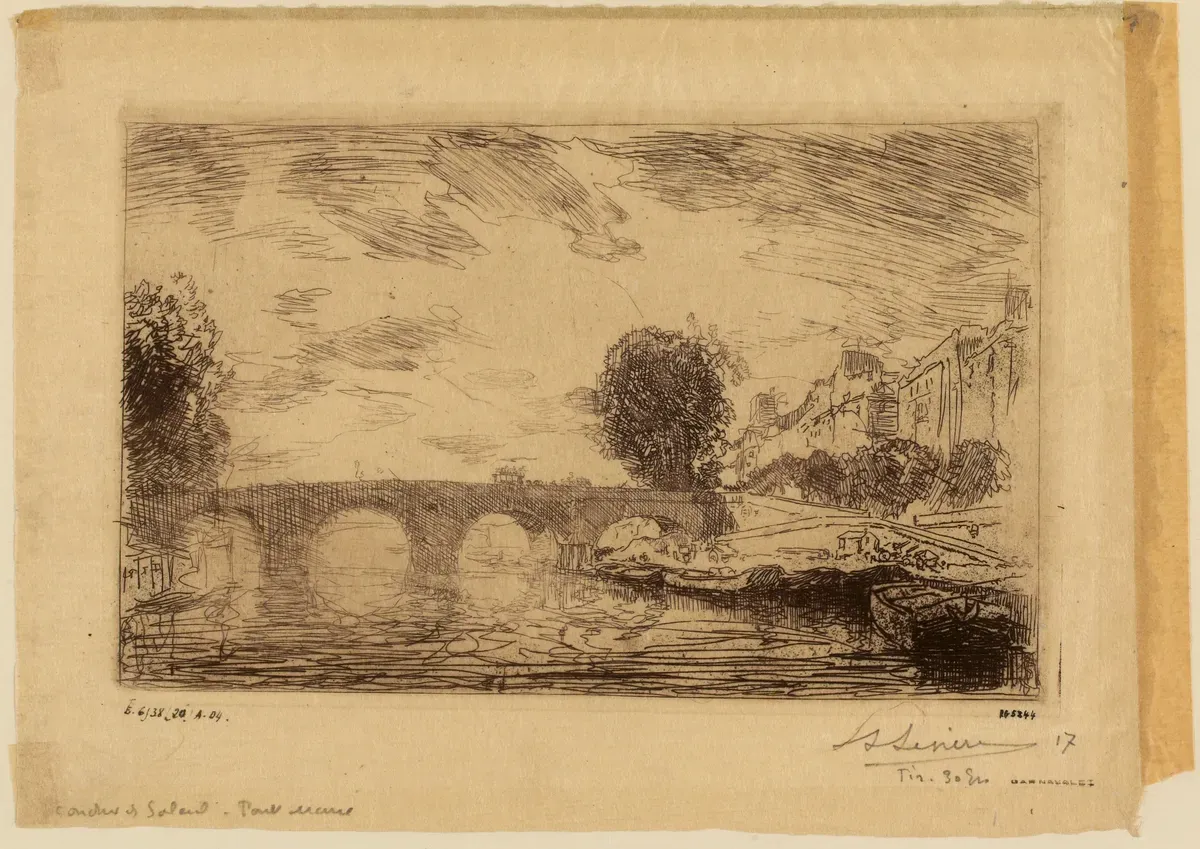
“Sunset at the pont Marie”, etching by Auguste Lepère, 1890 (musée Carnavalet, CC0). The same bridge, a few steps from the starting point of The Origins of Paris, and the same light.
One viewpoint remains, and it is ours. The starting point of The Origins of Paris is under the pont Louis-Philippe, on the right-bank quays, facing the île Saint-Louis and the tip of the Cité. From there, the apse of Notre-Dame lies exactly in the direction where the sun sets in the last days of November: the disc goes down in line with the cathedral, and the Seine in front of you turns to gold.
That is when the walk is at its most beautiful. For one hour and 1.2 kilometres, with a guide, you walk through today’s Paris and, at each stop, raise the virtual-reality binoculars onto the Paris of the past: Lutetia, the medieval place de Grève, the building of Notre-Dame, the flood of 1910. In November the late-afternoon departures set off at sunset and end after dark, when the quays empty and the monuments are lit. The experience runs Wednesday to Sunday, 10 am to 6:30 pm, from age 8. For the rest of the month, our guide to November in Paris has you covered.
Five rules for not missing the sunset in Paris
- Arrive thirty minutes before sunset time: the most beautiful light comes before the disc goes down, not after.
- Stay thirty minutes after: full darkness only comes about 35 minutes after sunset, and that half-hour is when the city lights up.
- Look west-south-west, not west: in November the sun sets well south of west, and more so as the month goes on.
- Prefer quays and bridges to parks: gardens close at nightfall in winter, bridges never do.
- Check the time on the day: it moves back a minute a day, and an overcast sky brings night forward by a quarter of an hour.
Questions we are asked
What time does the sun set in Paris in November? Between 5:33 pm on 1 November and 4:59 pm on the 30th, Paris time. The sun sets about a minute earlier each day. Full darkness comes a good half-hour later.
What is the best free place to watch the sunset in Paris? The bridges over the Seine, which never close: the pont Alexandre III for the Eiffel Tower at the end of the river, the pont de la Tournelle for Notre-Dame, the pont des Arts for the river itself. Up high and still free, the steps of the Sacré-Cœur.
Can you see the sun set behind the Eiffel Tower? Yes, but only on certain dates, since the direction of sunset changes every day. In November: from the pont Alexandre III in the first week, from the Galeries Lafayette rooftop around the 20th, and almost from the Sacré-Cœur at the end of the month, where it disappears just to its right.
In short
November is the month when the Parisian sunset fits into an ordinary schedule: 5:33 pm at the start of the month, 4:59 pm at the end, always towards the west-south-west. The bridges over the Seine and the steps of the Sacré-Cœur are enough, and free; the Arc de Triomphe adds the illuminated Champs-Élysées; the Trocadéro is kept for afterwards. And under the pont Louis-Philippe, in the last days of the month, the sun sets in line with Notre-Dame, at the exact hour when our binoculars reopen the Paris of 2,000 years ago.
Sources and practical links
- Sunset times calculated for central Paris (48.86° N, 2.35° E) with the NOAA solar algorithm, cross-checked against the Sunrise-Sunset API; winter time begins on Sunday 25 October 2026.
- What time does the Eiffel Tower light up and sparkle?, official Eiffel Tower website.
- Arc de Triomphe, Centre des monuments nationaux, opening hours and tickets.
- The Galeries Lafayette Haussmann rooftop terrace.
- Montparnasse tower observation deck, closed for works, Paris Region.
- The Origins of Paris, opening times and booking.
- Images: sunset over the Seine and the pont Alexandre III, photo Bradley Weber, CC BY 2.0; the Eiffel Tower from Montmartre, photo Renée Kools, CC BY 4.0; the pont de la Tournelle, photo Acediscovery, CC BY 4.0; Auguste Lepère, “Coucher de soleil au pont Marie”, 1890, musée Carnavalet, CC0; all via Wikimedia Commons.